


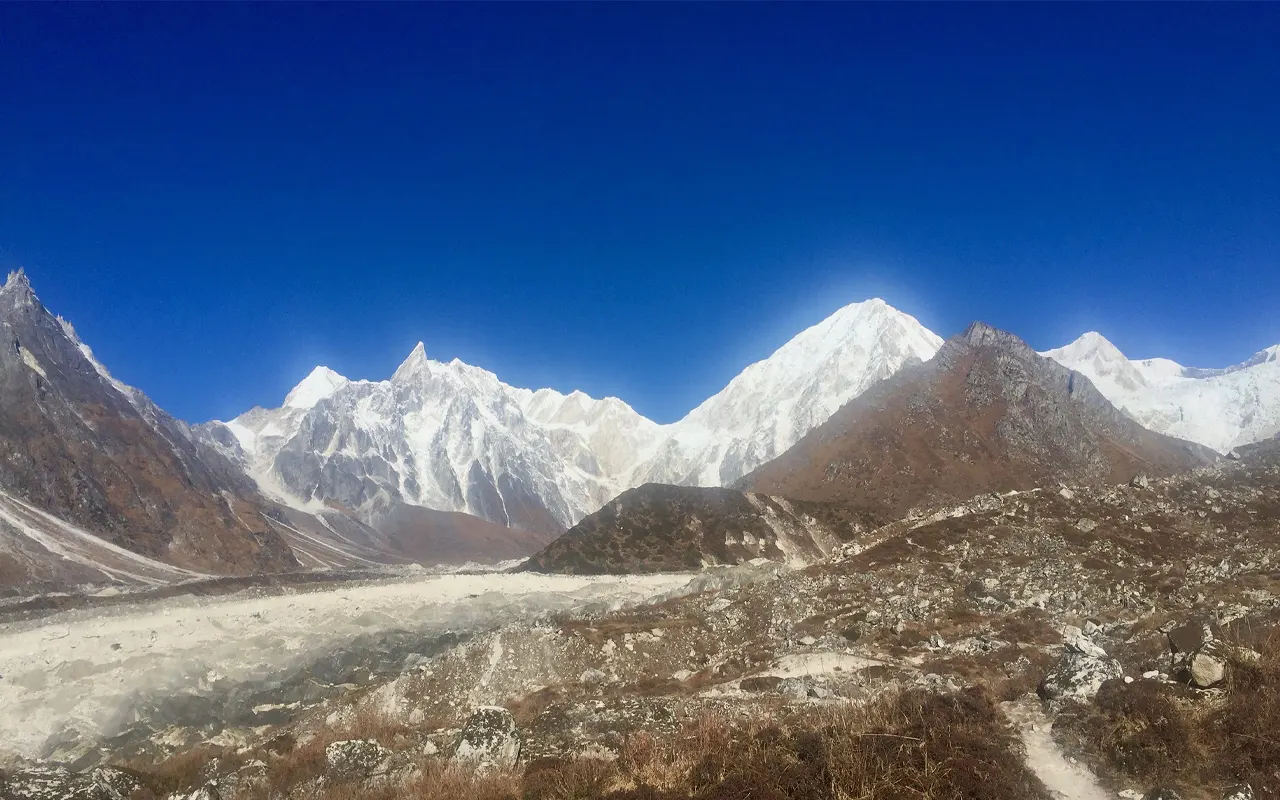


Nar Phu Valley Trek

Duration
9 Hnub

Qhov Siab Tshaj Plaws
5,320 ,17,454m. / XNUMX ft.

nyuaj
Ib qho yooj yim

Cov pab pawg neeg luaj li cas
2-20 Tib neeg Pax

Noj mov
- 8 Noj tshais
- 8 Noj su
- 8 Noj hmo

Kev pab
- Teahouse
- Hotel

Tsheb thauj mus los
Jeep

Kev ua ub no
- Trekking
- Sightseeing

- Koj txoj kev nyab xeeb, peb qhov tseem ceeb thib 1
- Zoo tshaj qhov guarantee
- Pab neeg uas muaj kev paub dhau los thiab mob siab rau
- Kev teem caij yooj yim, tsis muaj nqi zais
- Koj tuaj yeem kho qhov kev mus ncig no



Tham nrog Tus Kws Tshaj Lij Txog Kev Mus Ncig Ua Si Samundra Rimal (+ 977-9843127084)
Introduction of Nar Phu Valley Trek
The Nar Phu Valley trek is a remote and culturally rich journey in the Annapurna region of Nepal. This journey brings you out of crowded tracks and into remote valleys where some ancient Tibetan-inspired towns, stone buildings, and old monasteries continue to influence everyday life. It is the most suitable destination for travelers who desire to enjoy the mountain landscape and experience the profound culture.
The Nar Phu Valley Trek is typically started by a trip from Kathmandu to the start of the trail, after which one walks through the valley of the rivers, forests, and small mountain trails over several days. The higher you get, the drier and more dramatic the landscape is.
Located in the mountains, over 4,000 m / 13,120 ft and encircled by snow-capped mountains and broad empty valleys, are the villages of Nar and Phu. Life in the region is tranquil and traditional.
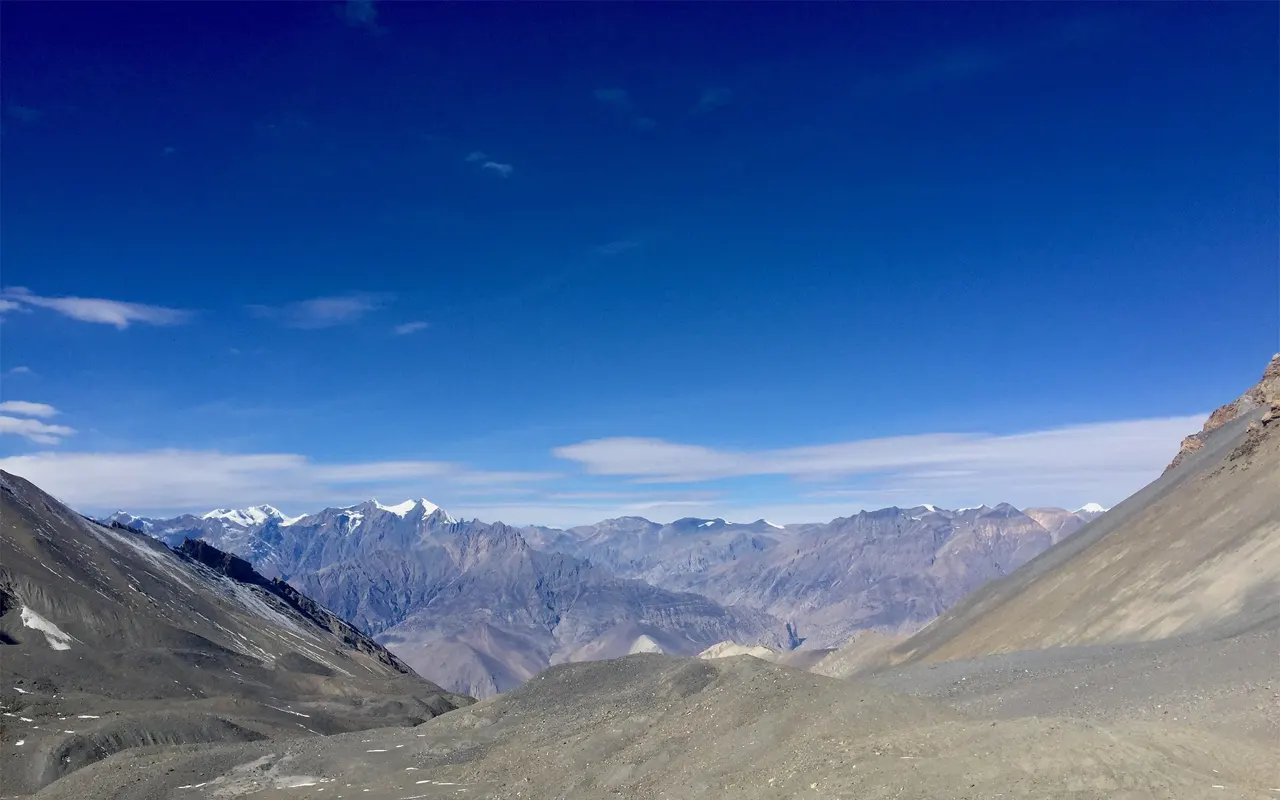
One of the biggest attractions of the Nar Phu Valley trek is the crossing of the Kang La Pass, which is approximately 5,320 m / 17,450 ft. On the summit, the stunning panoramic scenery of the Annapurna range and the beautiful Manang Valley are seen. The raised elevation requires proper acclimatization, yet the payoff is a view to remember.
The Nar Phu Valley Trek is accommodated in simple teahouses, where they are provided with basic rooms and warm meals. The route is rated as an average to difficult one due to the duration of walking and the altitude. Nevertheless, effective pacing and planning have seen many trekkers accomplish it.
The other unique thing about the Nar Phu Valley trek is that you feel isolated and in the wilderness throughout the trek. This trail is not full of lodges, as on commercial trekking routes of trekking, there is also less road access and large areas where you might be walking for hours without encountering another group. Being in a tranquil state enables you to experience the whole nature, as well as see blue sheep on mountainous terrain, and experience continuous Himalayan views in their pristine state.
Nomad Adventure Treks has been conducting the Nar Phu Valley trek with the necessary permits and well-thought-out plans. The experienced staff’s assistance will guarantee safety, cultural knowledge, and ease of traveling. This trek is ideal for people to have adventure, authenticity, and the peaceful beauty of the Himalayas.
Ncig ua si tseem ceeb
- Walk through the lost villages of Nar and Phu at altitudes above 4,000m/13,120ft.
- Cross the scenic Kang La Pass (5,320 m / 17,450 ft).
- Get a glimpse of the real Tibetan-infused culture and old monasteries.
- Take in views of Annapurna and the Manang valley from the top of a high mountain pass.
- Trek the less-traveled valleys with a smaller number of people than hiking trails.
- Live in traditional teahouses and relate to the local communities.
Detail Itinerary of Nar Phu Valley Trek

Hnub 01: Drive from Kathmandu to Koto (2,600 m / 8,530 ft) via Besisahar (760 m / 2,493 ft)
The Nar Phu Valley Trek starts with an early morning drive from Kathmandu (1,400 m / 4,593 ft) to Koto. The road traces the Prithvi Highway, and its way is through rivers, hill terraces, and small roadside towns. After approximately 5 hours, you arrive at Besisahar at 760 m / 2,493 ft, with the scenery beginning to become increasingly mountainous and rural.
At Besisahar, you go on a four-wheel-drive jeep on a rough mountain road. The route is bumpy and long, though scenic. On the route, there are waterfalls, narrow cliffs, and traditional villages. The road ascends further into the Manang region, giving you your first glimpses of the Annapurna peaks that are far away.
Late in the afternoon, you reach Koto at 2,600 m /8,530 ft, which is the entrance to the Nar Phu Valley trail. And then you show your permits and documentation at a checkpoint before settling in a simple teahouse. Nomad Adventure Treks makes sure that every detail of the logistics is taken into consideration in order to rest after a complete day of traveling.

Kev Ua: Scenic overland drive, permit check, 8-10 hour's drive

Max. Qhov siab: 2,600 m / 8,530 ft. Koto

Noj mov: Noj su, noj hmo

Kev pab: Teahouse
Hnub 02: Trek from Koto to Meta (3,560 m / 11,680 ft)
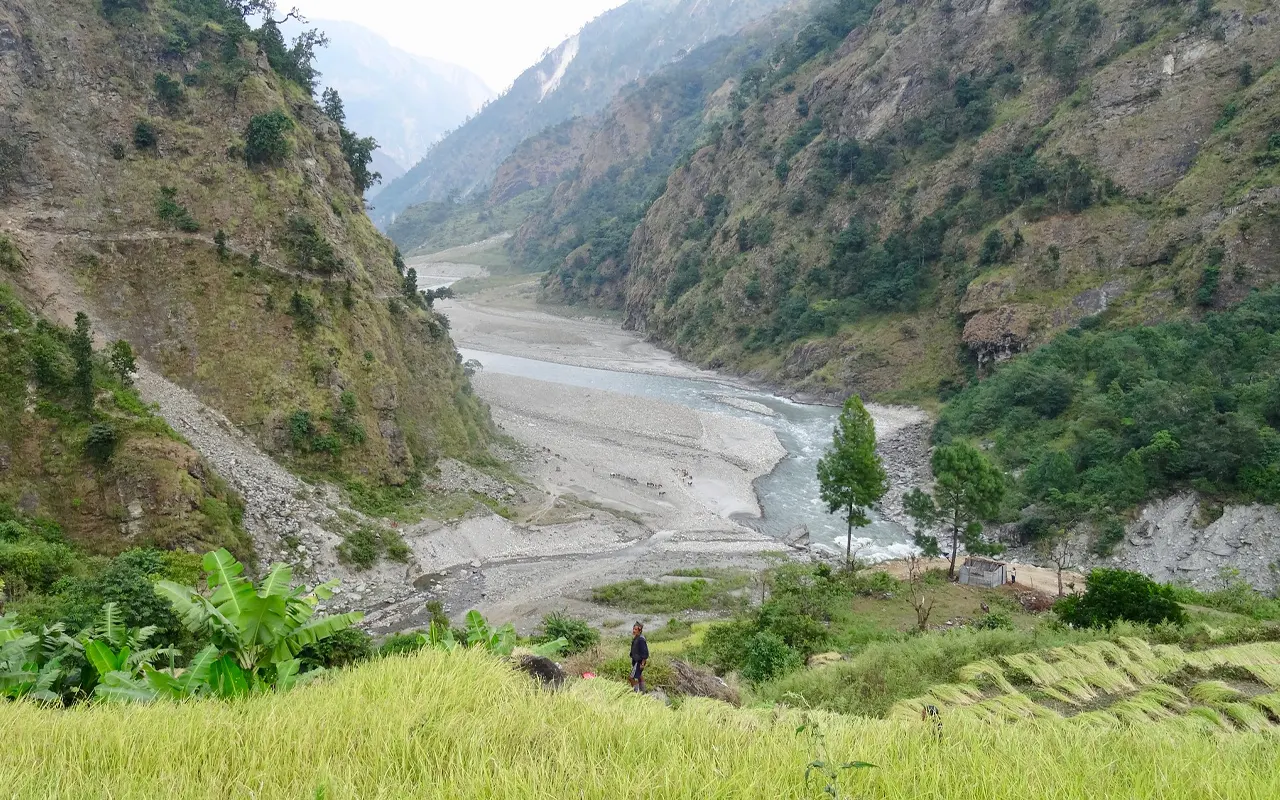
Once you have breakfast at Koto, you leave the Annapurna Circuit trail and go into the restricted Nar Phu Valley. The route goes through pine forests along the Nar Khola River through small canyons.
You pass through several suspension bridges and walk through rocky trails that cut into precipitous cliffs. After 3 or 4 hours, you have your lunch at Dharamsala. The afternoon walk is steeper, and it has several switchbacks.
The trees become sparser as you ascend, and spread out, and the mountain scenery emerges. Such peaks as Annapurna II and Pisang Peak can be seen on clear days. By mid-afternoon, you arrive at Meta, at 3,560 m /11,680 ft, a silent village of stone huts inhabited by herders.
The relaxing environment is the first night at the elevated landscapes during the Nar Phu Valley adventure.
Kev Ua: Trekking through forest and canyon, 6-7 hours
Max. Qhov siab: 3,560 m / 11,680 ft. Meta
Noj mov: Noj tshais, noj su, noj hmo
Kev pab: Teahouse
Hnub 03: Trek from Meta to Phu Village (4,050 m / 13,287 ft)
The trek goes further into the remote land. Leaving Meta after breakfast, the trail ascends slowly through high tracks above the river.
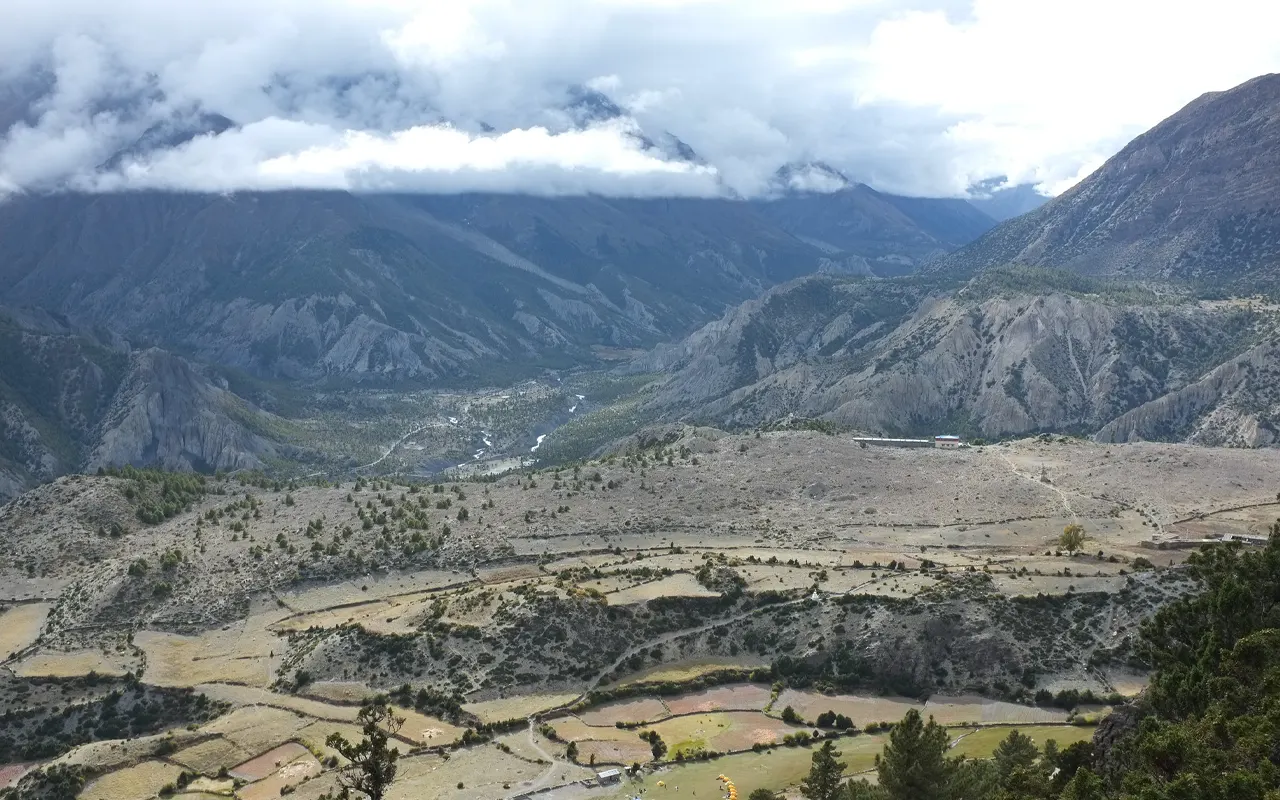
You go through deserted seasonal pastoralist villages such as Chyakhu and Kyang. The landscape is drier and more dramatic, forests are substituted with rocky cliffs and open scenery. You are on a steady rise on the numerous suspension bridges before you reach the Phu Khola.
Having reached lunchtime on the road, the valley contracts into a canyon and abruptly broadens into a plain. The village of Phu (4,050 m / 13,287 ft) is in sight with rugged mountains around it.
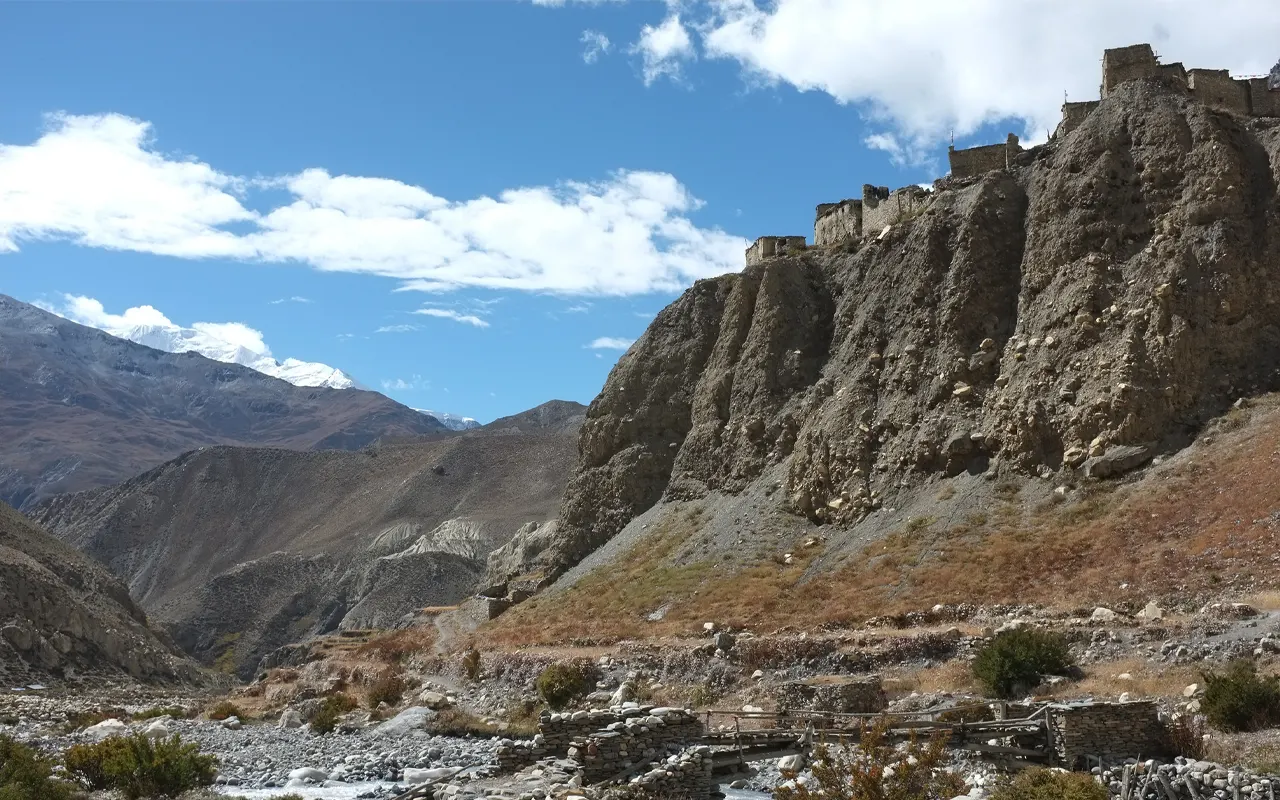
Phu is a traditional village with stone houses, a hilltop fort, and the old Tashi Lhakang Monastery. The guides will assist you in respectfully touring the village.
Kev Ua: Remote high-altitude trekking, 7-8 hours
Max. Qhov siab: 4,050 m / 13,287 ft. Phu
Noj mov: Noj tshais, noj su, noj hmo
Kev pab: Teahouse
Hnub 04: Acclimatization in Phu (4,050 m / 13,287 ft) – Optional Himlung Base Camp (4,800 m / 15,748 ft)
It is a major acclimatization day in the Nar Phu Valley trek today. Staying in Phu at 4, 050 m / 13, 287 ft gives the body time to acclimate to elevation.
It is possible to visit the village, the Tashi Lhakang Monastery, and see the lifestyles that are influenced by Tibetan traditions. There is still the practice of yak herding and wool weaving by locals.
This day has an optional hike to Himlung Himal Base Camp (4,800 m / 15,748 ft) for those who feel strong. The path ascends gradually through the alpine and glacial moraine. The view of Himlung Himal is impressive from the base camp.
Once back to Phu, you sleep and set out onto greater heights ahead.
Kev Ua: Acclimatization and exploration, 5-6 hours
Max. Qhov siab: 4,800m/15,748ft. Himlung Base Camp
Noj mov: Noj tshais, noj su, noj hmo
Kev pab: Teahouse
Hnub 05: Trek from Phu to Nar Phedi (3,490 m / 11,450 ft)
You start your way down through the spectacular scenery of the valleys from Phu after breakfast. The morning walk revisits part of the path beyond Chyakhu and Kyang, where there are old stone herding shelters on the dry hills. The lunges find it easy to walk downhill, though caution should be taken when walking on a rocky path.
You pass through suspension bridges across the Phu Khola and have various views of the canyon walls along the way. The path goes off the main valley after a few hours and heads to the east towards Nar. It is a gradual yet constant ascent to Nar Phedi at 3,490 m / 11,450 ft.
The peaceful monastery of Nar Phedi is famous for its basic guesthouse. It is one of the cultural highlights to stay in this place during the Nar Phu Valley trek. During the evening, you can hear a group of monks and nuns reciting their prayers, and this makes the place serene and spiritual.
Kev Ua: Trekking and monastery stay, 5-6 hours
Max. Qhov siab: 4,050 m / 13,287 ft. Phu
Noj mov: Noj tshais, noj su, noj hmo
Kev pab: Teahouse
Hnub 06: Trek from Nar Phedi to Nar Village (4,110 m / 13,484 ft)
It starts today with an ascent from Nar Phedi to the Nar Village. The trail rises over 600 meters within a matter of a few kilometers, thus a gradual and progressive speed matters. No teahouses are on the way, so it is thought to be necessary to carry a sufficient amount of water and snacks.
You find that the higher you climb, the larger vistas of the valley open before you. Then, after 3 or 4 hours, you come to a ridge, where prayer flags are hung. This is where Nar Village can be seen on an extensive plateau at an altitude of 4,110 m / 13,484 ft.
Nar is bigger and livelier than Phu, and consists of stone houses, chortens, mani walls, and barley terraces. Afternoon is at your free time to see the village and the surrounding monasteries.
During the evening, have a warm meal and go to bed early.
Kev Ua: Steep ascent and village exploration,3 to 4 hours
Max. Qhov siab: 4,110m/13,484ft. Nar
Noj mov: Noj tshais, noj su, noj hmo
Kev pab: Teahouse
Hnub 07: Trek from Nar to Ngawal (3,660 m / 12,008 ft) via Kang La Pass (5,320 m / 17,454 ft)
This is the hardest and most rewarding day in the Nar Phu Valley trek. You leave early from Nar, usually before sunrise. The path leads slowly up through yak pastures and rocky passes to Kang La Pass (5,320 m / 17,454 ft).
The last part of the pass is challenging, considering the thin air and steep slopes. At the summit, there is a spectacular view of Annapurna, Gangapurna, Tilicho Peak, and the broad Manang Valley below.
Having rested on the pass for some time, you come down cautiously by loose trails of rocky paths. Eventually, the long downhill leads to the Ngawal at 3,660 m / 12,008 ft, where cozy teahouses can be found.
Kev Ua: High-pass trekking, 8-9 hours
Max. Qhov siab: 5,320m/17,454ft. Kang La Pass
Noj mov: Noj tshais, noj su, noj hmo
Kev pab: Teahouse
Hnub 08: Trek from Ngawal to Lower Pisang and Drive to Besisahar (760 m / 2,493 ft)
You have breakfast at Ngawal (3,660 m / 12,008 ft) and start a slow descent into Lower Pisang on this day. The route goes through pine woods, mani walls and small settlements. This is a shorter walk, which provides the time to rest and admire the landscape following the challenge of the day before.
On arrival at the Pisang Lower, a jeep is boarded to get back. The drive takes you along the Marsyangdi River through the varying landscapes and mountain villages. The air grows warmer and more comfortable as you get to Besisahar (760m /2, 2493 ft).
Today, the Nar Phu Valley trek has officially finished its walking part. At Besisahar, you spend a pleasant evening with your team and rejoice over the successful adventure.
Kev Ua: Short trek and jeep transfer, 7 hours total
Max. Qhov siab: 3,660 m / 12,008 ft. Ngawal
Noj mov: Noj tshais, noj su, noj hmo
Kev pab: Teahouse
Hnub 09: Drive from Besisahar to Kathmandu (1,400 m / 4,593 ft)
You start the scenic journey back to Kathmandu at 1,400 / 4593ft from Besisahar after breakfast. The highway follows the Marsyangdi River and is later extended to the Prithvi Highway, which follows the Trishuli River.
The journey is approximately 6 to 7 hours long, and it goes through terraced hillsides, towns along the riverbanks, and greenery. It is a smoother and more comfortable stretch than the previous mountain roads.
In the afternoon, you reach Kathmandu, and the Nar Phu Valley Trek officially comes to an end. It is with this that Nomad Adventure Treks would like to thank you and hope that you will keep the memories through the years as you take this amazing adventure in the Himalayas.
Kev Ua: Scenic drive back to the city, 6-7 hours
Max. Qhov siab: 1,400 m / 4,593 ft. Kathmandu
Noj mov: Noj tshais

Nco ntsoov:
Yog tias koj muaj ib pab pawg neeg ntiag tug thiab xav tau kev paub tus kheej, peb tuaj yeem npaj ib qho kev mus ncig ua si raws li koj xav tau thiab qhov loj ntawm pab pawg, khiav nws txhua hnub uas koj xaiv.
Detail Information about Nar Phu Valley Trek
How difficult is the Nar Phu Valley trek?
The Nar Phu Valley trek is neither easy nor difficult since it is long, remote, and at high elevation. On the majority of days, you are walking 6-8 hours through rocky trails, narrow paths, and landslides. No technical climbing is involved, and slow uphill and downhill walking may be challenging, particularly with a backpack. Lodges are minimalist; thus, comfort is easy, and recovery is based on good sleep and warm-up.
The greatest challenge is added by altitude. You are sleeping in villages of altitudes usually higher than 3500 m/11480 ft, and you pass through Kang La Pass with an altitude of 5320 m/17450 ft, and breathing becomes more difficult, and the weather may shift rapidly. Knee strain is lowered by poles and broken boots.
If you have done a few multi-day hikes before, it will help you a lot on this trek. Even if you are new, you can complete it with good training, a slow and steady pace, and proper acclimatization days to adjust to the altitude safely.
The licensed guides will assist in finding the way and ensure safety. Nomad Adventure Treks is able to organize the Nar Phu Valley trek without hurrying the experience.
Huab cua thiab lub caij zoo tshaj plaws
Climatic conditions in the Nar Phu Valley trek may change within a short time as you relocate from the lower valleys to the dry and high villages.
The most popular season is Autumn (late September to November), when it is clearer, the air is cooler, and the trail conditions are stable. The spring (March to May) is also good, and the days are warmer, and there are colorful flowers on the trail.
The monsoon (June-August) is always accompanied by rain, clouds, and an increased possibility of landslides along road sections and lower trails. It is extremely cold in winter (December-February), and snow may block the path around Kang La Pass (5,320 m / 17,450 ft). It is better to leave early to have clear skies, because the wind and the clouds may accumulate in the afternoon, around this area.
Foods and Drink
Eating in the Nar Phu Valley trek is easy and prepared to keep you active. Dal bhat (rice, lentil soup, and vegetables) is the most eaten meal in teahouses, and it is cooked fresh and is fulfilling. Noodles, fried rice, soups, pasta, potatoes, eggs, and chapati might also be an option. The higher you go (above 3,500 m / 11,480 ft), the smaller the menu is, as the materials are being transported by people or animals; you have to be adaptable.
During the Nar Phu Valley trek, drink safe water on a daily basis. Filter, purify, or purchase boiled water for drinking. Adequate consumption of water helps your body to adapt to the altitude and headaches. A popular beverage in the afternoons is hot lemon-ginger tea. Limit alcohol and excessive caffeine, which may cause dehydration and worsen sleep.
Also, take a snack or two, such as nuts or energy bars, when the villages are long distances apart. Nomad Adventure Treks offers a guide that will assist with ordering and food hygiene. Eat at every stop, avoid meat, and wash your hands or apply a sanitizer before eating.
Altitude Mob Siab
On the Nar Phu Valley trek, the risk of altitude sickness is high since the path ascends to high altitudes and spends many days above 3000 m. Problems can start at around 2,500 m / 8,200 ft, and the chances of feeling sick increase as you sleep at higher elevations.
The typical initial symptoms are headache, lack of appetite, nausea, dizziness, strange fatigue, and sleeplessness. The most important fact is that there is one rule, and it is not to disregard the symptoms.
Avoid problems by climbing at a steady pace, consuming an adequate quantity of safe water, and taking frequent meals. Acclimatise yourself by taking planned days and do not walk very fast.
When the symptoms are mild, rest, hydrate, and do not increase in altitude until you feel better. In case of worsening symptoms, or when you cannot walk straight, are confused, or have trouble breathing when you are at rest, go down and get assistance.
Kang La Pass, at about 5,320 m / 17,450 ft, is a demanding crossing, so keeping a flexible schedule is very important. Sleep warm and on time each night.
Kev npaj thiab qoj ib ce
The Nar Phu Valley trek will be more enjoyable than dangerous when prepared in advance. Train your body 6-8 weeks before the trek starts. Perform cardio workouts such as walking, hiking, biking, or running up the stairs, and incorporate strength training in the legs, hips, and core.
Practice walking with the backpack you plan to carry, and begin with very minimal weight, and then add weight gradually. Leg strength on rocky surfaces and long slopes is assisted by strong ankles and knees.
Since you are likely to sleep at altitudes of 4,000 m / 13,120 ft and traverse across Kang La Pass at the altitude of 5,320 m / 17,450 ft, you should train on endurance and not speed. Broken in shoes, trekking poles, layered clothes, a warm sleeping bag, and rain and wind jackets are essential.
Always have your daypack well-packed with water and snack packs. Carry along any common medicines that you may have and keep them in your daypack. Plan permits, route timing, and acclimatization days in advance. Nomad Adventure Treks will be able to move the logistics and assist you in maintaining a reasonable speed in the Nar Phu Valley trek.
Visa thiab Daim Ntawv Tso Cai
The majority of the travelers require a Nepal tourist visa in the first place. You can normally get it when you arrive at Tribhuvan International Airport or the overland border. Carry a passport with at least six months’ validity and a few passport-sized photos.
Nar and Phu, being a restricted area, require special trekking permits (RAP), as well as permission to enter the Annapurna Conservation Area (ACAP). There are strict rules and permit checkpoints along the route, and it cannot be done alone. It is best to trek with a licensed guide who understands the permits and knows the trail well.
Nomad Adventure Treks does the arrangements of permits and guide support, and you would not have to waste time in Kathmandu offices.
Health and Safety
The health and safety are a concern when trekking the Nar Phu Valley due to the remoteness of the valley, and the trail remains elevated for several days. The villages are usually above 3500m / 11480 ft, and chilly nights may decrease your power.
Before leaving, share allergies and emergency contacts with the guide. To assist your body to adapt, walk slowly, consume treated water, and take regular meals. Symptoms of altitude sickness include headache, nausea, dizziness, or unusual fatigue, which should be monitored and not concealed.
Pack a small personal first aid kit, painkillers, rehydration salts, and the medicine that was prescribed. Apply hand sanitizer to prevent stomach problems and only eat freshly cooked food. There might be a sudden change in weather around those open areas and the pass itself, so carry along a warm and windproof layer.
When crossing Kang La Pass (5,320 m / 17,450 ft), you need to begin early and maintain a slow, steady pace. A developed strategy will be a safety measure during emergencies, Nomad Adventure Treks will have the capacity to offer trained personnel and clear evacuation protocols in case of an emergency.
Tsheb thauj mus los
The Nar Phu Valley trek has a transport option that typically starts from Kathmandu by road to the location of the Annapurna region. The majority of itineraries go by using a private bus or jeep to the trailhead, usually via Besisahar and the Marsyangdi Valley.
The road is picturesque, though the mountain route may be bumpy, dusty, and slow with construction or landslides holding it up, particularly following heavy rain.
It is helpful to keep your schedule flexible and carry water, snacks, and a light jacket in the vehicle. Most of the visitors drive back after the trek from (3,540 m / 11,614 ft) by jeep to Besisahar and Kathmandu. Some routes revert back to the starting point as a result of weather conditions or time constraints.
Nomad Adventure Treks manages all your transport that fits your budget, be it a local-style shared ride or a more comfortable ride in a private jeep. Early on travel days helps to save time and allows you more time in the day to make unplanned stops.
Kev Tiv Thaiv Mus Kev
The Nar Phu Valley trek requires travel insurance because help can be far away, and costs can rise quickly in an emergency. Select a policy that includes trekking at high altitudes, such as days of more than 4,000 m/ 13,120 ft, and a pass such as Kang La Pass (5,320 m/ 17,450 ft). Most of the standard policies limit the altitude to which they cover; therefore, read the policy before purchase.
The insurance has to cover the medical care, helicopter rescue, and hospital care in Kathmandu. Covering delays, cancellations, and lost or damaged baggage is also a clever idea, as mountain conditions and road conditions may alter the plans.
During the Nar Phu Valley trek, you might require the contact of your insurer in case the symptoms deteriorate. Before leaving for the trek, share your policy information with your guide. Good insurance is not paperwork; it is peace of mind.
Lwm Txoj Kev
The Nar Phu Valley trek is a one-way trek, which can be undertaken independently, although a lot of trekking enthusiasts combine their trek with popular Annapurna trails. One of the possible routes is to cross Kang La Pass and go down to Manang (3,540 m / 11,614 ft), where you join the Annapurna Circuit route. This provides diversity, whereby the wider valleys, bigger lodge networks, and access to transport have become simpler.
Provided that you have more time and are well-acclimatized, you can go on with the circuit to Thorong La Pass at 5,416 m / 17,769 ft, and then progress to Muktinath and Jomsom. This stretch adds distance and elevation tension, and additional days of rest give significance.
In a shorter route, some individuals go back the same direction through which they entered, and the Nar Phu Valley route is a narrow pathway that allows flexibility in case of weather.
Discuss alternatives with your guide to ensure that you are on route, pace, and safety. Nomad Adventure Treks will be able to draw an itinerary that should include a balance of culture, scenery, and acclimatization.
Koj Cov Nqi Ntxiv
In addition to the principal trip cost, you need to budget for personal “additional expenses” on the Nar Phu Valley trek.
Some of the typical small extras include hot showers, battery charging, Wi Fi, snacks, a bakery, and additional beverages like tea or hot lemon. You can also spend on a bottle of boiled water in case you do not have a filter. Prices tend to increase with the altitude, particularly in the villages above 3,500 m / 11,480 ft, since the supplies are either taken by mule or walker.
Get sufficient Nepal rupees in cash, as there are no ATMs beyond Kathmandu. Set aside guide and porter’s tips as it is customary and welcomed after the trek. You can also add to your total by purchasing gear rentals in Kathmandu, such as a warmer sleeping bag.
Finally, keep a few extra days in your plan in case a crossing like Kang La Pass at about 5,320 m / 17,450 ft is delayed due to snow or strong wind.
Lus thiab kev sib txuas lus
In the trek of Nar Phu Valley, you will be able to hear a blend of languages as the culture is highly Tibetan-influenced.
In Nar and Phu, the local people tend to use a Tibetan dialect in their homes, but the national language is Nepali, through which they communicate on a broader basis. Simple English is understood in most of the teahouses, particularly in the areas frequented by more trekkers.
When you go further into the valley and remain in villages at elevations of over 3,800 m / 12,467 ft, communication may seem more primitive and silent, and it becomes part of the experience.
It is much better to learn some friendly words: Namaste (hello) and Dhanyabad (thank you). Talk slowly, make clear gestures, and wait long in case the answers are not quick. Bring a notebook to write down names, prices, and directions. Never take photographs of people without seeking consent.
Your guide will translate and tell you about the etiquette of the place and the monasteries, the festivals, and everyday life. Nomad Adventure Treks provides highly trained guides who help to make the Nar Phu Valley trek more comfortable without ever making contact disrespectful and authentic.
Mobile Network, Internet, thiab Charging
The Nar Phu Valley trek have mobile network that is not very strong, and you cannot expect regular calls and messages. A signal can be received in the lower parts, but in the valley and in the villages above 3,500 m / 11,480 ft, coverage tends to become weak or is lost. Lodge-provided Internet is typically slow and can be an additional expense, so only short updates should be made.
Many teahouses have the facility to charge your phones, cameras, and power banks, but in most cases, you pay a very small fee per item. Turn off airplane mode to conserve battery. In the upper elevations, electricity can be provided using solar energy, and hence, rainy seasons can decrease the time of charging. Carry a powerful power bank, charge the devices before going to sleep, and save maps, tickets, and emergency contacts so that they can be used offline.
Stay in touch with your family, but let them know you may not be able to call for several days, especially around the pass area at about 5,320 m / 17,450 ft. Safety can be included in a guided team; the guides of Nomad Adventure Treks can carry emergency backup kev sib txuas lus gadgets, but no guarantee of day-to-day connectivity.
Tsis txhob mus ncig no
On the Nar Phu valley trek, as much as it is important to know what to do, it is also important to know what not to do. It is important to move slowly when walking beyond 3,500 m / 11,480 ft. Moving with excessive speed may aggravate the chances of altitude sickness and fatigue. Walk slowly and you can give your body time to adapt.
Early symptoms of illness, like headache, nausea and dizziness, should not be overlooked. Never forget to report to your guide when feeling unwell. Consumption of alcohol at elevated altitude, especially around Kang La Pass (5,320 m / 17,450 ft), should be avoided since it may aggravate dehydration and acclimatization.
Do not disrespect local culture. Ask permission before taking close-up shots of people and visiting monasteries. Wear modest clothes and remain quiet near places of worship.
Plastic materials should not be thrown randomly and should be discarded properly. Use reuseable water bottle and put garbage in the right location. The Nar Phu Valley Trek is carried out under fragile mountain environments, and it must be maintained.
Is it a Trip beginner-friendly?
The Nar Phu Valley trek is rated moderate to difficult, yet beginners can succeed in it with proper training and a positive attitude. Long walking days and multiple nights spent in high altitudes (usually above 4,000 m / 13,120 ft) are a part of the trail. Kang La Pass is the peak of the trek, approximately 5,320 m / 17,450 ft, and one must acclimate before it.
If it is your first time trekking, it is good to exercise before the trip. Walking, jogging, or hiking are some of the cardio activities that would develop stamina. Psychological preparedness is also a factor since the area is isolated and the accommodation is easy.
The Nar Phu Valley trek is not technical, and that is, you do not need to have climbing skills. Nevertheless, patience and stamina are required.
Choosing an organized trip with Nomad Adventure Treks provides proper guidance, planned acclimatization, and strong safety support throughout the journey. Through proper training and gradual progress, first-time trekkers will manage to accomplish this beautiful Himalayan trek successfully and develop the confidence to trek to high altitudes.
Trip Extension
The Nar Phu Valley trek is extended by many trekkers to cover the rest of the Annapurna region. On passing Kang La Pass (5,320 m / 17,450 ft), you can go down to Manang (3,540 m / 11,614 ft) and then move onward along the Annapurna Circuit Kev. Such an extension provides mountainous scenery and cultural diversity.
The other, more popular alternative is to cross Thorong La Pass, which elevates to 5,416 m / 17,769 ft. The path involves additional days of acclimatization and great physical training.
It can also have shorter side trips to higher viewpoints of around 4,000 m / 13,120 ft, which can be used to take panoramic shots and do exploration. The Nar Phu Valley trek can be extended to take in more time in the remote villages and spectacular scenery.
Nomad Adventure Treks will tailor your trip according to your time, budget, and fitness level without forgetting safety and the adjustment to altitude.
Kev yees duab thiab Drone Cov Cai
The Nar Phu Valley trek provides a beautiful mountain range, old monasteries, and stone villages. Mornings and afternoons offer the most desirable lighting, particularly in villages, snow peaks, and prayer flags, and they form lovely pictures.
Never take pictures of local people or religious events without having their permission. Photography might be prohibited in some monasteries, and that is why one should respect local regulations.
In Nepal, drone flying has been very tightly regulated, particularly in certain restricted regions such as Nar and Phu. A drone flight is subject to special government permission. Drones can be seized or fined without due permission. High-speed winds around Kang La Pass (5,320 m / 17,450 ft) may become unsafe to fly a drone.
Regulations are being changed, and this should be confirmed before a drone is carried on the Nar Phu Valley trek. Nomad Adventure Treks can assist in giving new permits so that you can abide by the rules.
Cultural Festival on the Trails
The Nar Phu Valley trek cuts across culturally rich villages that are influenced by Tibetan Buddhism. Provided that your visit coincides with local celebrations of special occasions, you can observe a colorful festival in monasteries and in the village courtyards. The traditional dances, chanting, and prayer ceremonies create an exciting atmosphere and are spiritual.
The festivals are held in villages where old monasteries are situated with backdrops of spectacular mountains. The locals dress in the traditional attire and cook special foods for the community.
These occasions are not tourist demonstrations but real religious events. Visitors are acceptable; however, they should be respectful. Never interrupt rituals and do as your guide advises.
By attending a festival in the Nar Phu Valley trek, one gets better cultural insight. The guides of Nomad Adventure Treks can clarify the interpretation of ceremonies and make you feel these things in a respectful and meaningful way.
Lub tswv yim rau thawj zaug Nepal tuaj xyuas
In case it is your first time in Nepal, when exploring the Nar Phu Valley, be ready for differences in culture and straightforward mountain life. Roads can be bumpy, and facilities can be bare and simple compared to those in large cities. The experience will be rewarding through patience and an open mind.
Bring a little Nepalese currency in small notes to buy tea and personal expenses. There are no ATMs in isolated regions after Manang.
Wear a light jacket as the weather keeps fluctuating, particularly around Kang La Pass (5,320 m / 17,450 ft). Consume freshly cooked food and drink treated water to stay fit.
Adhere to the local traditions, and do not go around stupas and prayer wheels anti-clockwise. The Nar Phu Valley Trek is more of a cultural than a scenic one. Nomad Adventure Treks will make sure that you have a guide and protection, and that you know about the area as you walk.
Cov Lus Nug
What is the location of the Nar Phu Valley trek?
It is in the Manang district of Nepal, in the north of the Annapurna range. This path is a detachment of the popular Annapurna Circuit path.
What is the difficulty level of Nar Phu Valley?
The Nar Phu Valley Trek is moderate to difficult because of the length of walking days and the elevation. A safe journey should be accompanied by proper fitness and acclimatization.
What is the highest point of the journey?
Its peak is Kang La Pass at 5,320 m /17,454 ft. The crossing at this pass is high and has sweeping mountain vistas.
What is the duration of the Nar Phu Valley Trek?
The itineraries last 9 to 14 days based on acclimatization and extensions.
Am I supposed to have some special permission for this trek?
Yes, it will need a Restricted Area Permit and an Annapurna Conservation Area Permit to do the Nar Phu Valley trek. You will have to walk with a certified guide.
What is the most appropriate time to go on the Nar Phu Valley trek?
The best seasons are spring (March-May) and autumn (September-November). These are the months when the weather is not very unpredictable, and the mountains are clear.
Txoj kev taug kev no puas muaj kev mob nkeeg ntawm qhov siab?
Yes, but slow uphill ascent and rest days are helpful in minimizing the risk of altitude sickness over an altitude greater than 3,000 m / 9,842 ft.
Can first-time trekkers do the Nar Phu Valley trek?
It can be done by beginners who are well prepared in terms of physical fitness. Nonetheless, previous experience in trekking is useful.
Qhov chaw nyob yog dab tsi?
The accommodation is in simple teahouses with basic rooms and communal facilities. Dinners are warm and freshly cooked.
Does it have Wi-Fi services on the trek?
Internet connectivity is limited and slow in remote villages. In remote locations, mobile signals cannot be trusted either.
Puas muaj ATMs ntawm txoj kev?
No, there are no ATM beyond the main road areas. Bring enough Nepali rupees in small bills from Kathmandu.
What kind of food will be provided on the trek?
Teahouses serve dal bhat, noodles, soups, rice, and basic Western foods. There is a large selection of vegetarian alternatives.
What is the coldest it gets on the trek?
At a higher altitude, such as 4,000 m / 13,120 ft, temperatures become lower than freezing. Warm clothes and a sleeping bag are necessary.
Is it necessary to have travel insurance?
The high altitude of 5,320 m / 17,454 ft requires high altitude travel insurance, which is highly advisable. It must cover emergency evacuation.
Is it possible to add this trek with Annapurna Circuit?
Yes, lots of trekkers join the Nar Phu Valley trek with the Annapurna Circuit. It introduces additional scenery and adventure.
Do I need guides to go through this trek?
Yes, it is necessary to hire a guide who has a license since the region is restricted. Individual walking is not allowed.
What is so unique about this trek?
The Nar Phu Valley trek is less crowded and culturally unique. It offers a chance to experience real daily life in traditional Himalayan villages.
Puas muaj kev nyab xeeb haus dej thaum mus ncig ua si?
One should treat tap water and then drink it. Safety precautions include purification pills, a water filter, or boiling water.
Reviews on Nar Phu Valley Trek
 Sau ntawv mus xyuas
- Koj txoj kev nyab xeeb, peb qhov tseem ceeb thib 1
- Zoo tshaj qhov guarantee
- Pab neeg uas muaj kev paub dhau los thiab mob siab rau
- Kev teem caij yooj yim, tsis muaj nqi zais
- Koj tuaj yeem kho qhov kev mus ncig no
Tham nrog Tus Kws Tshaj Lij Txog Kev Mus Ncig Ua Si Samundra Rimal (+ 977-9843127084)