





Tiger Nest Monastery Tour – 3 Days

Duration
3 Days

Max Altitude
3,120 m. / 10,236 ft.

Difficulty
Easy

Group Size
2-16 Pax

Meals
- 2 Breakfast
- 2 Lunch
- 2 Dinner

Accommodation
- Hotel

Transportation
Flight

Activities
- Sightseeing

- Your safety, our no 1 priority
- Best price guarantee
- Experienced & dedicated team
- Easy booking, no hidden charge
- You can customize this trip



Talk to Travel Expert Samundra Rimal (+977-9843127084)
Introduction of Tiger Nest Monastery Tour – 3 Days
The Tiger Nest Monastery tour is a brief yet memorable experience of the Bhutanese culture and some of the most beautiful sceneries that the country has to offer. Within three days, the visitors tour the mystical Paro Valley, which has ancient fortresses, peaceful temples, and one of the most important monasteries in the world, high on a hill. The tour is an ideal combination of adventure, culture and picturesque beauty for people who have a limited time in Bhutan.
Nomad Adventure Treks is an operator of this well-thought-out tour, where all logistics are taken care of, and one can concentrate on the experience. The majority of the travellers will start in Paro, where one of the most scenic flights globally will bring them to a place where the Himalayan ranges can be seen below.
On arrival, you are greeted by a local English-speaking guide who guides you to a nice hotel. The first afternoon involves visiting Kyichu Lhakhang,a 7th-century temple surrounded by legends. Stroll through Paro town later. You can enjoy the local cuisine, which is an option, or simply unwind with a classic hot stone bath – a warm welcome to Bhutan hospitality. You can also pay a visit toThangjingmo monastery.
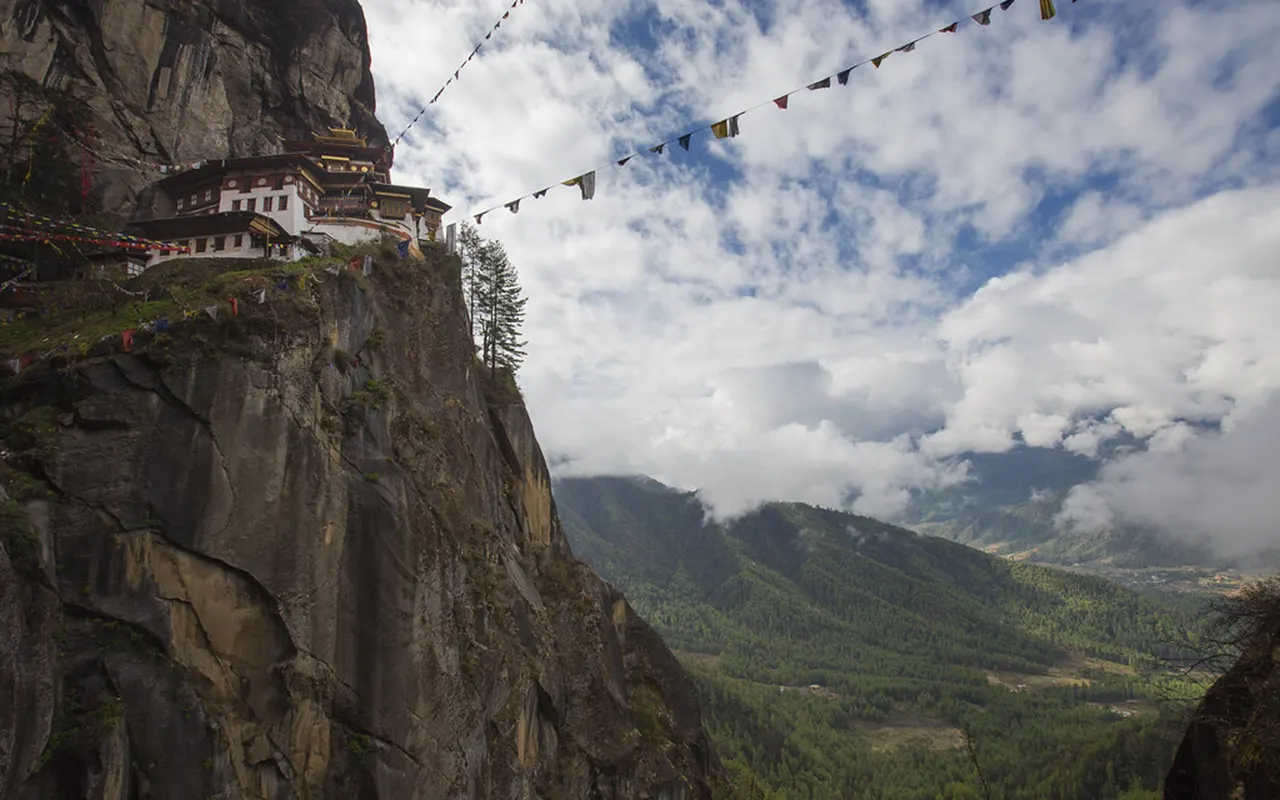
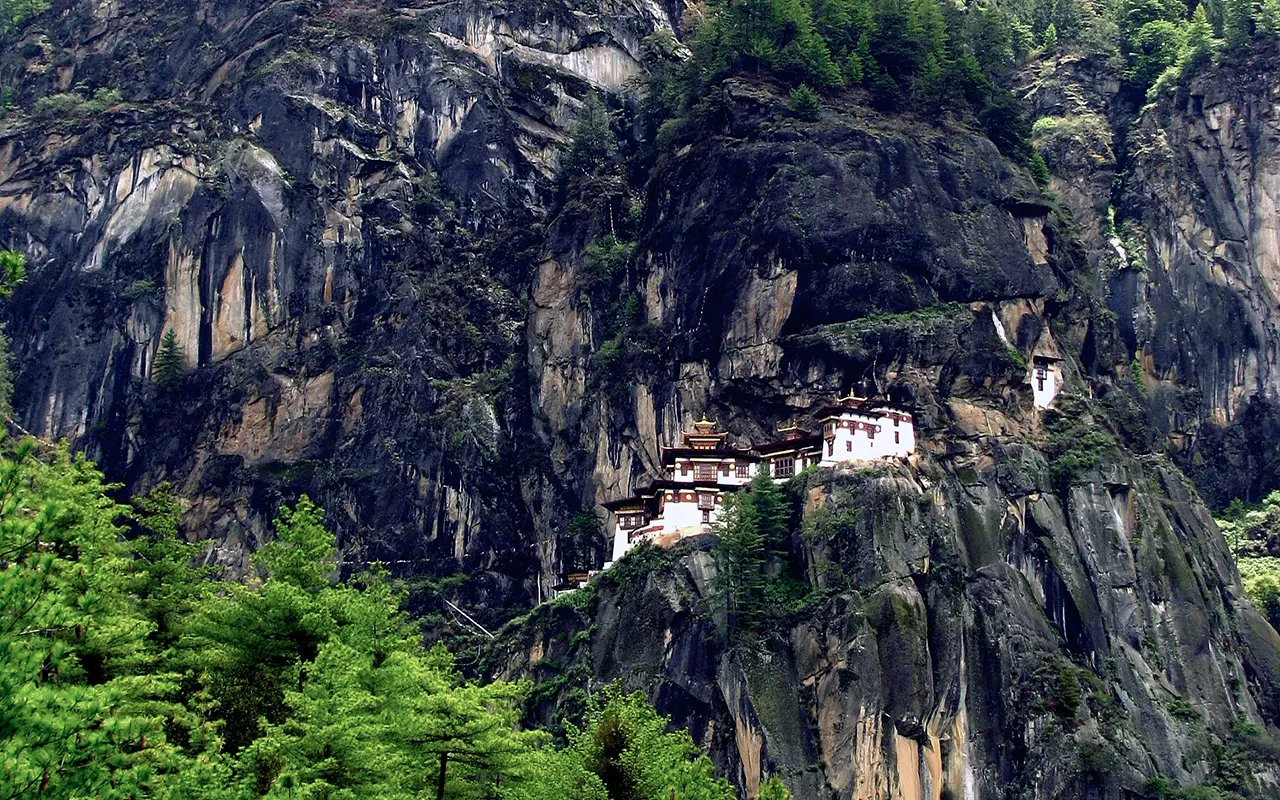
The best experience of the trip is the hike to Tiger Nest Monastery or Taktsang Monastery on the 2ndday. It is located 900 meters above the valley floor, where it is said that Guru Padmasambhava rode on the back of a tigress in the 8thcentury and that this is what gave the distinctiveness of its name to the monastery.
Hiking in the pine-forests with prayer flags, each step gives a panoramic scene of the Paro Valley. The architecture in the monastery is magnificent, and it was constructed in the 17thcentury around the meditation cave of Guru Rinpoche. All the necessary plans are made by your guide, and you will have time to enjoy the peaceful air.
Other than Tiger Nest, the tour also takes care of other cultural spots in Paro. You will see the grandiose Paro Rinpung Dzong castle and the National Museum (Ta Dzong), where you will hear about the Bhutanese history, art and life.
Spacious transportation, full board meals, and attentive guides will make the experience smooth. The tour and the hikeare rated as Easy, and the walking paths are properly maintained with railings and views, so the seniors and even children can experience this tour easily.
Within three days, you will have the recollection of the impressive views, divine experiences, and the hospitality of Bhutan people. Small but in full colour, this tour is an adventure, cultural and nature tour that will be an unbeatable introduction to Bhutan and would leave the travellers in awe to go through more of the Himalayas.
Trip Highlights
- Climb to the cliff, Tiger Nest Monastery (Paro Taktsang) at 3,120 m, the most symbolic spiritual place in Bhutan.
- Historical sightseeing of the ancient places of Paro,like Rinpung Dzong medieval fortress and the National Museum.
- Scenicround-trip sightseeing flight from Kathmandu to Paro with breathtaking views of the Himalayan range.
- Sightseeing of ancient temples such as Kyichu Lhakhang and enjoying the local culture and food.
- Witnesscolourful festivalsor have a conventional hot stone bath as an even greater adventure.
- Explore the cultural and natural beauty of the world’s happiest country.
- Stay in comfort, eat warm food and explore Bhutan in comfort.
Detail Itinerary of Tiger Nest Monastery Tour – 3 Days

Day 01: Arrive in Paro (2,200 m / 7,218 ft) – Cultural Sightseeing
Your Bhutan Tiger Nest Monastery Tour starts with a dramatic landing in Paro. During clear days, you will enjoy the incredible view of the Himalayan Mountain ranges and snow-capped giants,which help to get a taste of the adventure.
A representative of Nomad Adventure Treks at the Paro international airport will receive you with a traditional ceremonial scarf and then transfer you to the hotel. Have a little rest and experience the refreshing air of the mountains.
After a little rest and settling in, we will visitKyichu Lhakhang, the temple constructed during the 7thcentury, one of the oldest temples in Bhutan. It is said by legend that the temple holds down a demoness who once hindered the spread of Buddhism. Wander among the prayer wheels and orange trees and hear your guide telling you some interesting stories about the place.
We will then go into the courtyard of Paro Rinpung Dzong, a fortress-monastery of the 17thcentury, overlooking the Paro Chu River. It has a splendid front that provides an ideal preview of the Bhutanese culture and architecture.
An evening walk in Paro town shows some beautiful wooden storefronts, artisans of the area, with the opportunity to taste local liquids, such as butter tea or arra, a grain alcohol of the area.
Designed after an exhaustive travel, a relaxing and soothing Bhutanese hot stone bath, whereby heated stones are put into a wooden tub, which emits minerals that relieve weariness caused by travel. The end of your day is marked by a welcome dinner of the local Bhutanese dishes.
Sleep soundly this night, as the next day is the best part of your hike up to Tiger Nest Monastery, this time standing 900 meters (2,953 ft) above the Paro Valley (4.29).

Activity: Arrival, cultural exploration, acclimatization & 1-hour scenic flight; half-day sightseeing

Max. Altitude: 2,200m/7,218ft. Paro

Meal: Lunch, Dinner

Accommodation: Hotel
Day 02: Full-Day Hike to Tiger Nest Monastery (3,120 m / 10,236 ft)
Greet the day with an earthly breakfast and prepare yourself for the most important thing on your Bhutan trip, the Tiger Nest Monastery hike. Post breakfast, there will be a trail for 20 minutes to the starting point of the hike,to the north of Paro.
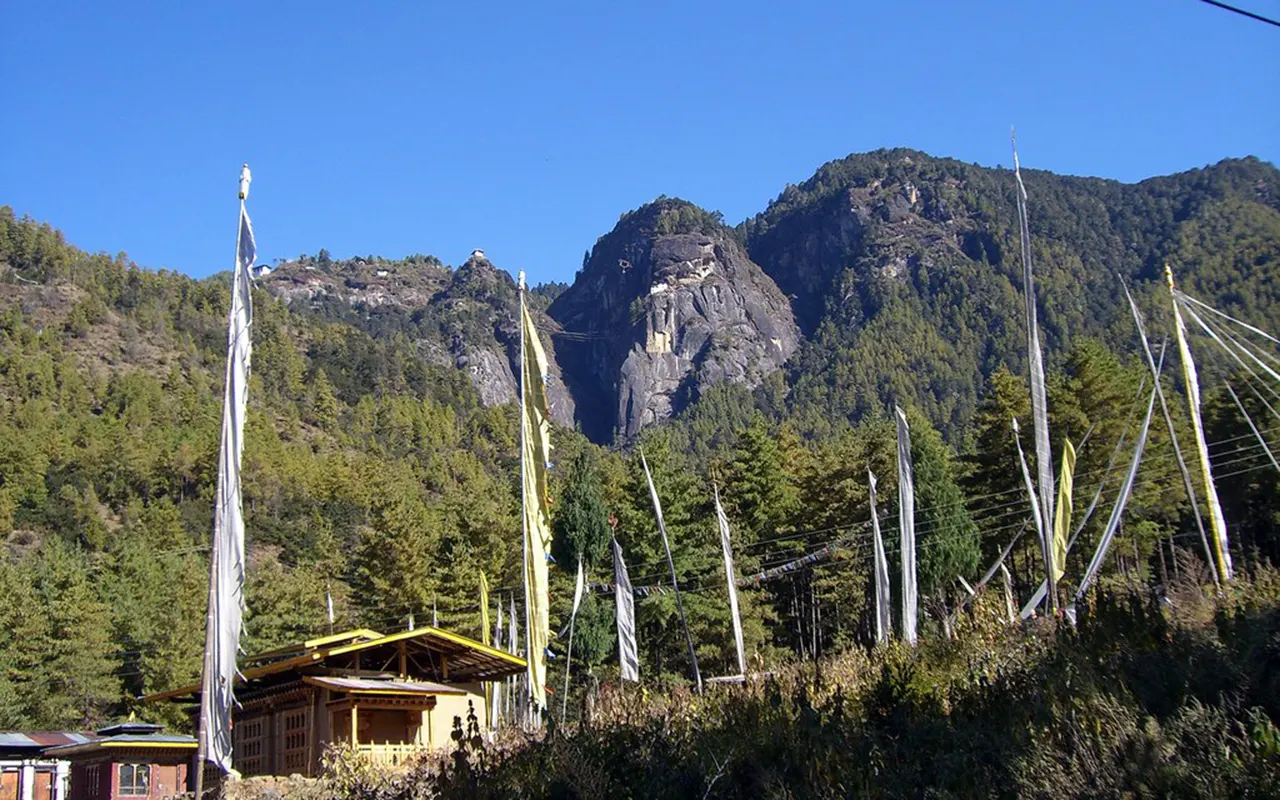
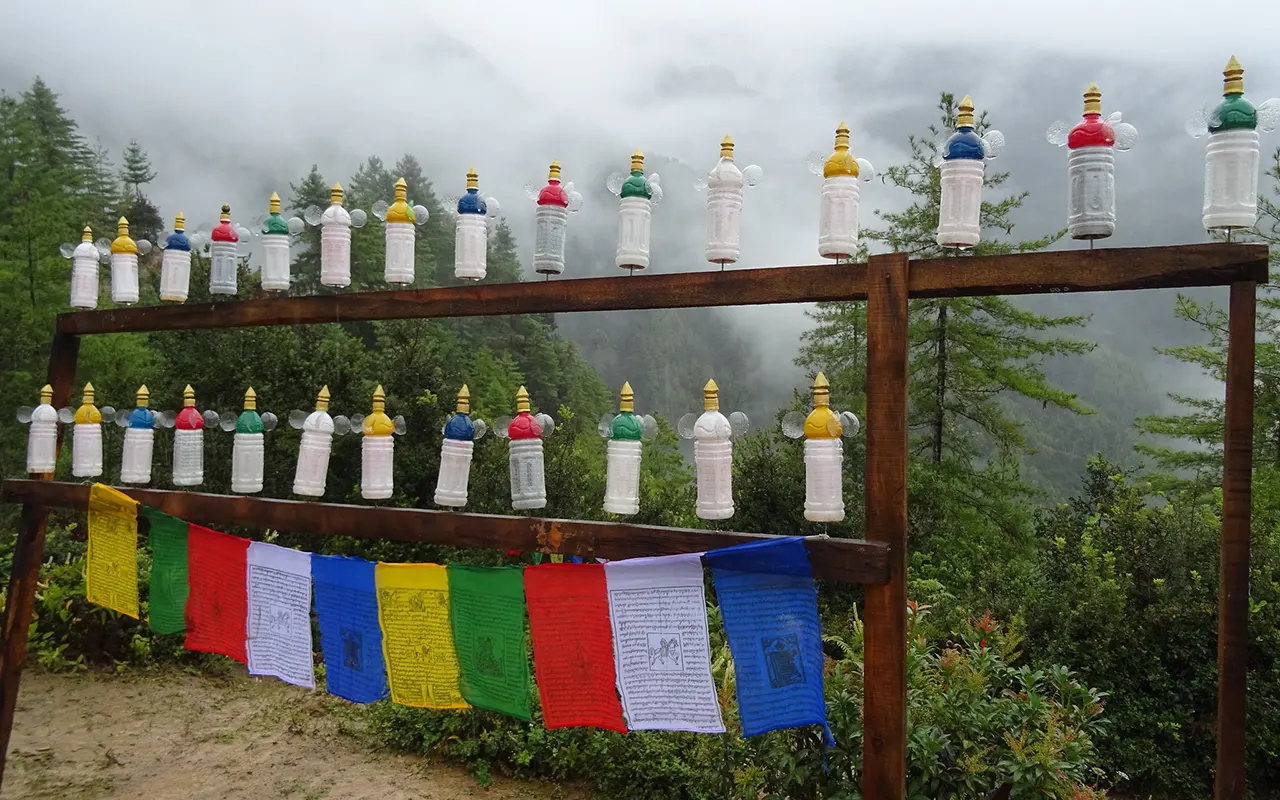
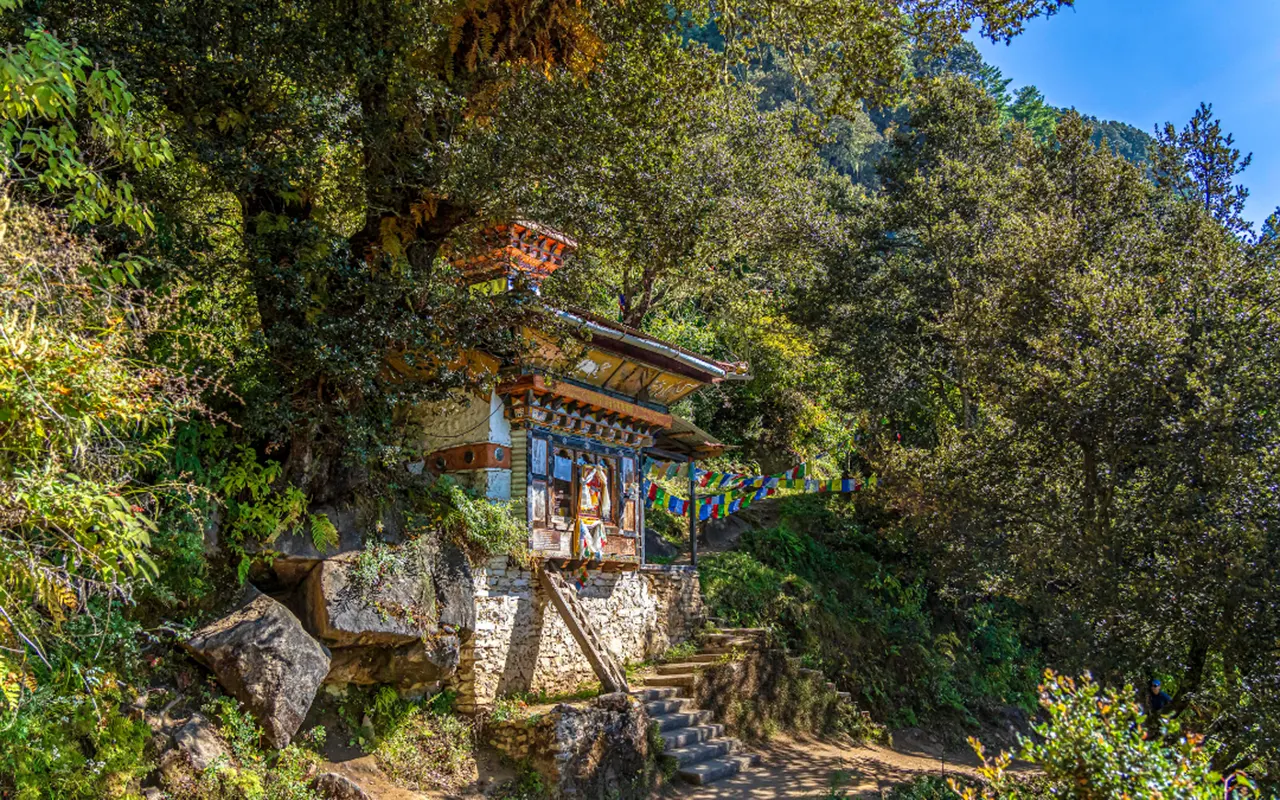
The trail starts with a pine forest of aromatic trees, and the sound of the trees and the waterfall in the distance creates a quiet and soothing atmosphere. Colourful prayer flags are planted at parts of the trail, and they are fluttering in the wind in the mountain and this also contributes to the feeling of sacredness as you go on the journey of climbing up the mountain.
The climb gradually goes upwards, and it provides various scenic points of view on the way. As you come to every stop, Tiger Nest Monastery is brought into clearer focus, hanging dramatically onto the granite rocky cliff that is 900 meters (2,953 ft) above the valley floor.
During the journey, have a rest-break midway at Taktsang Cafeteria, one of the most beautiful tea houses that has spectacular views of the monastery located on the other side of the ravine. Espresso, Bhutanese milk tea or coffee, and take a few pictures of this traditional location on the opposite side – it is one of the most photographed parts in Bhutan.
Restored, proceed with the last bit, consisting of a series of stone steps towards the entrance of the monastery. It is a trip of a lifetime standing in front of Paro Taktsang, which is a building erected in the cliff face. Your guide will do all the entry permits, and after being inside, you will see its silent halls and shrines where you may leave your cameras and bags at the gateway, as it is within the local tradition.
Experience the spiritual power of the site when your tour guide is telling you the legends of Guru Rinpoche, who sat and meditated in the cave of the cliff during the 8thcentury, and how the monastery was rebuilt by monks after a fire in 1998. Pause and light a butter lamp to have good luck, or just enjoy the calmness of the situation.
It is mostly downhill and faster when coming back, which is a relief to your legs. Head back down the valley to a well-deserved lunch, whether you picnic or head to one of the local restaurants in the town of Paro.
In the afternoon, still be a tourist of cultural marvels of Paro, by going to the National Museum of Bhutan in the circular Ta Dzong watchtower above Rinpung Dzong. It has the exhibits of complex thangkas (religious scroll paintings), traditional costumes and historical relics presenting the insight of Bhutan art, religion and history.
Then continue walking to Rinpung Dzong, a conventional wooden cantilever bridge still decorated with prayer flags. Provided the time of the year is appropriate, you may find local archers training, because archery is the national game in Bhutan. You can even see how well people can fire arrows using a bamboo bow under the supervision of the local personnel. It is a great cultural activity which also brings a lot of fun.
In the late afternoon, go back to your hotel and have a full day of adventure rest. In the evening, enjoy the day you have managed to accomplish with a Bhutanese dinner. The trip to Tiger Nest Monastery is not only a physical feat but also a spiritual one, with stunning views, cultural experiences, and emotional attachment to the Bhutanese tradition, a day you will never forget once your trip is finished.
Activity: Hiking, monastery visit, cultural sightseeing & 5–6 hours total hiking (approx. 2–3 hours up, 1.5–2 hours down) plus sightseeing
Max. Altitude: 3,120m/10,236ft. Tiger Nest Monastery
Meal: Breakfast, Lunch, Dinner
Accommodation: Hotel
Day 03: Paro – Departure from Bhutan
The Bhutan Tiger Nest Monastery Tour ends after breakfast. Our team will drive you to Paro Airport and will help you with the check-in and departure process. Have a last look at the emerald Paro Valley beneath when you get on the plane as it flies in the air. When the weather is fine, the flight gives you one of the last beautiful panoramicviews of the Himalaya ranges, with sight views of Mount Everest, as a befitting goodbye to the marvellous landscapes of Bhutan.
This in-depth tour will provide you with enormous insights about the rich culture of Bhutan and its beautiful natural landscape in a short period. You have visited old abbey monuments, walked through mountain pine forests and found the friendliness of the locals. All the steps on the path and all the cultural experienceswill leave a scar on your memory, which makes this little adventure unforgettable.
Should your trip proceed to Kathmandu, our own personnel are available to help you with further transportation or transfer to the hotel. To those of you who are travelling to other places, take with you peace, wisdom and the colourful recollections you got in the Land of the Thunder Dragon.
Nomad Adventure Treks is pleased to welcome you and hopes you have an excellent time with us. Tashi Delek – We wish you good luck on your way, and wish you a safe visitation wherever your new adventure leads you!
Activity: Airport transfer, farewell & 1-hour flight (Paro to Kathmandu) or per your travel plans
Max. Altitude: 1,350m/4,429ft. Kathmandu
Meal: Breakfast
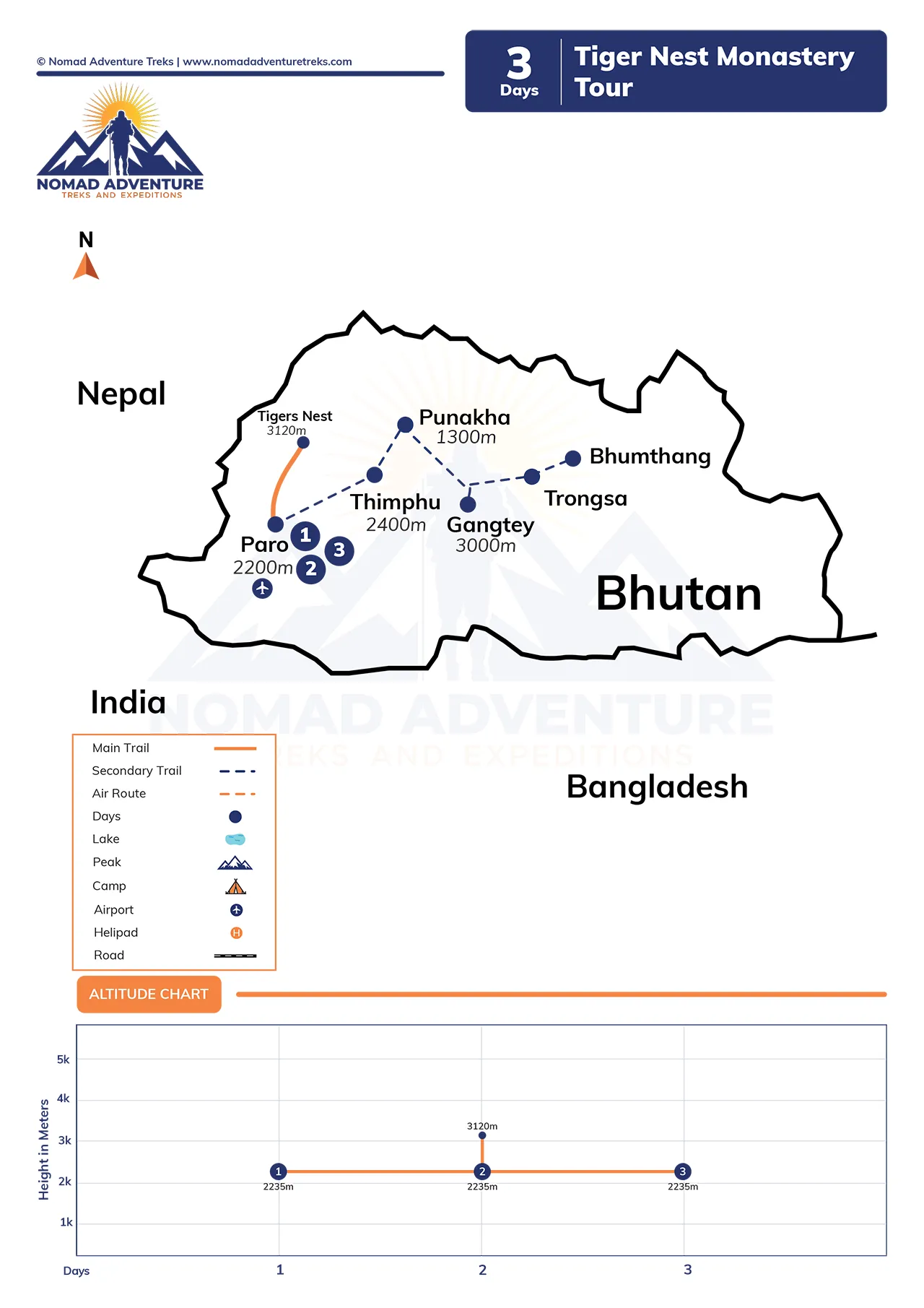
Trip Route Map

Note:
If you have a private group and prefer a personalized experience, we can organize a custom trip tailored to your requirements and group size, running it any day you choose.
Detail Information about Tiger Nest Monastery Tour – 3 Days
Weather and Best Season
The Tiger Nest Monastery Tour in Bhutan is good throughout the year, though there are seasons when the tour is best. It is said to be best during spring (March to May) and autumn (September to November). The weather is normally clear, mild, and has great visibility in these months, and the view of the Paro Valley and the surrounding Himalayan peaks is breathtaking.
During spring, the rhododendrons start blooming on the hills, giving the trail a colourful touch. The autumn season is characterised by cold weather and dark blue skies, which are ideal for taking pictures and hiking to the monastery.
It can also be visited either in winter or summer, but changes are required. The winter (December to February) has cold mornings and sometimes snowfall, particularly in the higher locations. It may be a slippery trail here and there, but it is an experience never forgotten to see the monastery covered with snow. Warm outerwear is also necessary, and the fewer tourists there are, the more silent.
Summer (June to August) is the same time as the monsoon, making the valley green and beautiful. Rationally, it would be rainy, muddy, and there might be leeches in the woods. Rain clothing is not superfluous, though the back trail is sometimes worthwhile. Hiking early mornings, whether it is spring, summer or even in winter, will avoid the heat in the middle of the day or afternoon storms.
Our team offers tips and suggestions on how to be prepared to have a good for the Tiger Nest Monastery Tour, regardless of the weather you choose.
Altitude Sickness and Difficulty.
The Tiger Nest Monastery Tour is described as being of an easy level and is also suitable for most travellers with a basic fitness level. The path is about 4 km (2.5 miles) one-way, and it has about 700 meters of ascent. It normally takes hikers 2-3 hours to arrive at the monastery at a gradual speed.
The stairs are mostly in good condition, and there are steps and railings on the steeper parts. Guides do not want people to hurry up, and they take breaks and appreciate the numerous points of view throughout the walk. Children and elders are able to do the trek with guidance, and horses are available on the first part of the trail to the cafeteria sightseeing,if required.
Altitude sickness is not common on this tour. The Paro Valley is located 2,200 m below most of the risk zones, and the monastery is located 3,120 m below most risk zones too. Tourists can be slightly out of breath on the last staircases. Coming early on a day will grant time to rest and become used to the surroundings.
Do not overwork and drink alcohol on arrival day. The guides bring first aid and keep an eye on the welfare of all, speeding up or slowing down as need be. Drink enough water, proper eating and taking things slowly are all that is needed to have a safe and enjoyable hike. All in all, the hike to the Tiger Nest is an achievable one, and there are guides to assist you through the hike.
Insurance, Visa and Permits
The last thing to do prior to beginning the Tiger Nest Monastery Tour is to ensure that all the necessary documents and insurance are in place. This tour is compulsory to be covered by travel insurance to have all guests carry a valid policy that will cover medical emergency, evacuation (even to moderate level or to isolated places) and cancellation or delays of the trip.
Bhutan is a relatively safe country, although insurance is a guarantee in case of unforeseen events. It is important to remember to carry a copy of your policy details when you go out on a trip.
Bhutan has a visa too, which must be obtainedbefore coming into the country. The positive thing is that Nomad Adventure Treks provides the visa process to you.
Once you have booked your tour, we will ask you to send a scanned copy of your passport so that we can help you with the Bhutan visa and other paperwork. The visa processing and fee are normally part of the package cost. When you reach the Paro Airport, the Bhutan visa that had been pre-arranged will be stamped on your passport.
Moreover, every tourist will pay a fee known as the Sustainable Development Fee (SDF) every day, and this will be part of your tour package. To visit Tiger Nest, you have to hike, and this hike requires a special permit or an entry ticket, which our guide will obtain on your behalf, so you will not need to bother with any paperwork when visiting them.
When you visit Nepal during your trip, say, visiting Kathmandu by air, remember Nepal has its own visa requirements. At Tribhuvan Airport, tourists have the option of acquiring a Nepal visa on the spot by paying a fee in USD and carrying a photo of the passport.
The Bhutan tour package does not cover the cost of a Nepal visa, so be prepared to spend USD 30-50 according to your length of stay. Our team would help you with the Nepal and Bhutan visa procedures, making it hassle-free. You will be fully geared to have fun in Bhutan conveniently and without problems after having the visa and the insurance.
Health & Safety
In the Tiger Nest Monastery tour, Nomad Adventure Treks prioritises your health and safety when exploring Bhutan. The level of crime in Bhutan is extremely low, and personal security in this nation is never a problem.
Nevertheless, our guides are who are awake and give advice on any safety measures that can make your trip hassle-free and tension-free. They have professional guides who speak Englishand provide you with cultural and historical explanations, in addition to helping with any issues.
Each guide has some basic first aid training and has the necessary medications of bandages, antiseptics, pain relievers and altitude medication. This Tiger Nest Monastery Touris meticulously structured to take into account the rest and acclimatisation periods, which minimise the chances of health hazards that come with high altitude trekking.
Your guide also provides a safe and comfortable pace on the uphill hike to Tiger Nest Monastery. There are areas of a trail with an extreme fall, yet there are railings, and instructors remind all of them against losing footing.
In case some of us feel tired or unwell, we can stop or revert – but first, you always come first. It is also important to be hydrated and sun-protected; water is brought all through the hike, and sunscreen is suggested since the high-altitude sun can be fierce even on cool days.
There is a no-littering policy that has been made very strict to ensure that the travellers and the environment are safe, maintaining the Bhutan nature in its pristine form.
Our partner hotels and restaurants are thorough with meals and consumption of water. There is generally no danger with food, even though those with sensitive stomachs are recommended to eat cooked or vegetarian food bought in Bhutan, including the Bhutanese vegetable curries or the well-known ema datshi chilli-cheese meal.
Bottled or boiled water is only served to avoid any health consequences. Although Paro has an adequate hospital where one can get emergency medical treatment, some medical cases can be severe enough to warrant evacuation to a hospital in another country, hence the need to have travel insurance.
Its structures will make you come back to the Tiger Nest Monastery Tour with a lot of memorable moments, with the help of your guide and taking into consideration some simple precaution measures.
Transportation
There will be no transport hassles with this tour, as it will be smooth and comfortable to enjoy Bhutan to its fullest. The majority of international tourists start in Kathmandu, Nepal and fly to Paro, Bhutan. The flight from Kathmandu to Paro and back are included in the package of Nomad Adventure Treks. The flight round trip alone is an attraction – on clear days, you can see the Himalayan peaks, including Mount Everest, from the plane, and therefore, the journey forms part of the adventure.
We can offer Bhutan flights in the same way, should you be travelling between another gateway like Delhi or Bangkok.
In Bhutan, transport on the ground is undertaken through personal vehicles. In the case of the Tiger Nest Monastery tour, we will use a comfortable car, jeep, or van with a professional domestic driver, depending on the size of the group.
Although due to the small size of this 3-day tour, your destinations are close – they are usually less than 30 minutes apart between your hotel, Paro town, the airport, and the trailhead, but with the presence of a personal vehicle, there is more freedom.
Car/van drivers will be able to visit the village to take photos or have a quick visit (where time permits it). Vehicles are in excellent condition, and they have seat belts, bottled water, and hand sanitisers. The trail to the Tiger Nest is mostly steep, and though winding, it is a trail well-travelled by our drivers and is safe.
Concisely, every transportation logistics is included in the package. Flight to Bhutan,return flights, private vehicle, it is all the same, you are safe and comfortable, and with no stress. Our professional drivers and our well-thought-out routes make travelling to the different parts of Bhutan easy, safe, and at no hassle, with you having all the time to be part of the sights, culture, and serenity that Bhutan offers.
Your Extra Expenses
The Bhutan Tiger Nest Monastery Tour is the most inclusive and worry-free; however, there are some personal expenditures to consider. The additional charge that most tourists bear in mind is that of tipping. Although not an obligatory practice in Bhutan, you should introduce the act of tipping to your guide and driver as an expression of gratitude to them to have served well. Several visitors tend to tip at the end of the journey; most of them tend to provide USD 5-10 per day to guides and USD 3-5 per day to drivers based on their experience and satisfaction.
Drinks and other snacks not included in the meals should also be budgeted. The tour includes breakfast, lunch, and dinner daily, but the prices of speciality coffees or soft drinks, beer, wine, or additional bottled water are charged independently. They tend to be small but may end up being quite significant in the case of regular refreshments.
Another personal expenditure is shopping and souvenirs. There are numerous shops in Paro selling Bhutanese handicrafts, textiles, prayer flags, incense, local honey and handcrafted goods. Stocks of big size accept US dollars and credit cards, whereas small vendors take cash. It is good to carry around some Ngultrum or small USD bills. The exchange of currency can be performed at the airport and the local banks.
Activities that are not in the itinerary are also left out. These can be cultural performances, spa treatment or other hot stone baths. A traditional farmhouse hot stone bath is estimated to cost USD 20 each. When visiting a place where you need to enter Nepal, you need to make sure that you leave some money to pay the Nepal visa fee, which is normally USD 30-50.
Finally, it is also prudent to have a buffer in the short term to accommodate shows of unknown costs, like weather, additional meals or simple healthcare requirements. In general, the expenses in Bhutan are not excessive, and the majority of the significant expenditures are already included in the tour.
Language & Communication
The use of language is something that you would not have to worry about when you tour the Tiger Nest Monastery. The official language of Bhutan is Dzongkha, although English is so considerable all over the country and in tourist destinations of Bhutan in particular. The majority of individuals in the hotel, shopping, and restaurant industries are comfortable speaking English, and therefore, it is easy to interact on a day-to-day basis.
The guides of all Nomad Adventure Treks in Bhutan speak English, Dzongkha, and other local dialects. You will not lose any significant information since your guide will explicitly tell the history of the places you will visit, the culture, and the spiritual interpretation of your destinations. There are numerous signs, menus, and information boards in both Dzongkha and English in such towns as Paro, which make independent walks and exploration easy.
It can be better to learn some words about the local area. The proper way of saying hello is to say kuzuzangpo la, and thank you is to say Kadrinchey. Locals are very thankful for even such minor gestures, which can result in a smile and even a chat. People in Bhutan are usually friendly, appreciative, and glad to narrate about their culture, provided that you are interested in knowing.
It is also easy to remain in touch during the trip. Paro also has good mobile network connectivity, and international roaming service can also be possible based on the provider. In the country, a B-Mobile or TashiCell local SIM card can also be purchased at the airport or within town. These SIM cards are not very expensive, and they also have data packages that can be used for calling and on the internet.
Wi-Fi is included in the majority of hotels within Paro, and it is sufficient to maintain messaging, emails,and light browsing. Though the speeds can hardly be called very speedy, primitive communication is seldom an issue. On the whole, you will always be in touch with the process of your visit to Bhutan, and a little digital holiday is a wonderful idea to enjoy the serenity and beauty of the land to the full extent.
Don’ts on This Trip
Even when visiting the Tiger Nests Monastery, Bhutan appreciates tradition, spirituality, and respect and offers the same. This attention to local traditions will allow you to experience it with pleasure and admire the Bhutanese culture. These significant things don’t help you to go on the shortlist of a respectful path.
Do not take photo shoots in temples or monasteries. Photography is also banned strictly in inner sanctums, such as in Tiger Nest. During the hiking, you are allowed to take pictures of the exterior and scenery with cameras and phones, but once you find the sacred spots, the gadgets should be placed in a deposit box and left behind so that the areas avoid being violated.
Do not wear revealing or indecent clothes. Wear decently when attending religious places. Sleeveless tops, shorts and short skirts are inappropriate. Long pants and tops, sleeves should cover the shoulders and knees. Close-fitting clothes ought to be combined with longer garments.
Do not smoke or take alcohol at places of worship. In Bhutan, smoking in public places is prohibited and is strongly prohibited around monasteries. No alcohol should go to religious locations. It is better to save smoking or drinking only when in hotels or restaurants.
Act nothing out of ways or out of bounds. Finish by hiking and staying on prepared paths, and then observing the monastery regulations. You should never disobey what you are being directed to do; your guide knows where visitors can go and how to move without disrespect.
No flaunting at all, no rude manners. The society of Bhutan is conservative. Additionally, do not make negative comments on the royal family, religion and traditions. Respect, greetings and cultural awareness will always be very well received.
Cultural Festivals during the Trip.
On your Tiger Nest Monastery Tour, you might be lucky to be there on one of the colourful religious festivals in Bhutan, which are the Tshechus, provided that your travel days coincide. The most popular festival in the Paro Valley is the Paro Tshechu that usually occurs in March or April. It is held in the great Paro Rinpung Dzong, and occupies a few days; crowds with spiritual, colour, and music fill the courtyard.
The traditional costume of the monks and local performers during the festival is a brightly crafted costume and beautifully painted masks to dance some sacred dances that were handed down over centuries. These dances narrate Buddhist teachings, and they are thought to bless everyone in the audience. The locals come in wearing their best traditional attire, bring food, greet the family members, and embrace the celebratory but religious spirit.
Even though you may miss Paro Tshechu, there are festivals year-round in Bhutan. Another of the major festivals is Thimphu Tshechu, which is held in the fall, and numerous other local festivals are organised by villages. The location known as the Nest of the tiger is more of a pilgrimage area; however, on good days, you can encounter devotees who are lighting butter lamps and offering prayers, which further enhances the experience.
In case festivals are not so appealing to you, the Nomad Adventure Treks can alter your schedule and add festivals to it. You can include more days or join this tour with a cultural trip. Grand and intimate, Bhutanese festivals present a unique and valuable understanding of living traditions in the country.
Top Tips for a First-Time Nepal Tourist.
Most tourists who travel to Bhutan are required to transit Nepal as well, or visit it before or after their trip to the Tiger Nest Monastery. Assuming that this is your first time in Nepal, there are several easy things to remember so as to make your stay better and easier.
Most nationalities have a visa on arrival to Nepal at Kathmandu airport. Carry passport size photograph and the visa fee in US Dollars. It is simple, and lines are long at rush times. Once within the city, you can predominantly use the Nepalese Rupees that can either be drawn from the ATMs or can be changed in the airport.
Kathmandu transportation may be anarchic. official cab rides, hotel transportation, or ride-hailing applications are the best. You must always give yourself time regarding traffic. Health-wise, not recommended to use tap water or any raw food without trust in the source, and it is good to have a mask because of the dust and air pollution.
The culture of Nepal is very hospitable and friendly; however, one should dress modestly and act respectfully, particularly at temples. Always take off your shoes when visiting religious places, and don’t take pictures without permission from people.
Nepal is not very dangerous, but it is necessary to use a minimum of caution in crowded places, such as Thamel. Provided that they have time, they may want to visit the UNESCO World Heritage Sites in Kathmandu Valley to experience the culture around the place more deeply. It only takes a few days, and you will see that spending at least some time in Nepal will be able to give your visit to the Himalayan region.
Reviews on Tiger Nest Monastery Tour – 3 Days
 Write a Review
- Your safety, our no 1 priority
- Best price guarantee
- Experienced & dedicated team
- Easy booking, no hidden charge
- You can customize this trip
Talk to Travel Expert Samundra Rimal (+977-9843127084)