



8 Days Bhutan Tour

Duration
8 Days

Max Altitude
3,140 m. / 10,302 ft.

Difficulty
Moderate

Group Size
2-5 Pax

Meals
- 8 Breakfast
- 7 Lunch
- 7 Dinner

Accommodation
- Guest House

Transportation
Car/Jeep

Activities
- Driving
- Sightseeing

- Your safety, our no 1 priority
- Best price guarantee
- Experienced & dedicated team
- Easy booking, no hidden charge
- You can customize this trip



Talk to Travel Expert Samundra Rimal (+977-9843127084)
Introduction of 8 Days Bhutan Tour
Bhutan is one of the most secluded countries in Asia, not secluded geographically but politically. Our 8 Days Bhutan Tour lets you peek into the country. The government there has strict laws on tourism, and you will never see a heap of tourists just roaming around the city.
The government of Bhutan has the tourism ideology of “High Value – Low Impact,” which translates to a great tourism experience with low environmental impact on Bhutanese nature and culture.
The Bhutanese authorities are very concerned about their heritage, traditions, practices, and customs. They are one of the last remaining monarch countries in the world, and their Buddhism-influenced culture has remained pure over the ages. Taking a look at other cultures that have been influenced by the West, Bhutan has taken a rather strong stance on protecting its identity.
The geography and the Buddhism-inspired tradition of Bhutan are very similar to the highlands of Nepal since they share the same roots, but the major difference is that Bhutan does not allow anyone to climb their mountains.
In Nepal, all of the top 10 highest peaks have been climbed; the Everest is full of dead bodies. But Bhutan has played it smart and has not let anyone scale it ever.
The King of Bhutan strongly believes that nature is something that you must appreciate from afar and not something you must try to conquer. We should keep that same ideology throughout the 8 Days Bhutan Tour. He is also very interested in gardening, the arts, and photography. Fun fact: the current King of Bhutan, Jigme Khesar Namgyel Wangchuck, was born in Kathmandu, Nepal.
People often assume that Bhutan is a boring visit since they are seldom a topic of conversation in the global scene, and also because of the fact that they are a landlocked country. But that is not the truth at all; in fact, it’s the opposite. Bhutan is one of the most scenic visits you can experience in Asia.
Moving on, Bhutan has never been in a religious riot or political unrest, which speaks about the stability and security of traveling there. Crime rates are very low, especially against tourists; the streets are safe, the officials are reliable, and so on. It’s a really great country to visit, and if you want to see what this monarchical country is like, hop on our 8 Days Bhutan Tour.
Trip Highlights
- Hike up to the famous Tiger’s Nest Monastery for a scenic and relaxing treat.
- Visit a bunch of historic Dzongs (fortresses) all around Bhutan.
- Day sightseeing tour around the vibrant and cultural capital city of Thimphu.
- Explore the town of Paro visiting sites like Rinpung Dzong, Paro Taktsang, National Museum of Bhutan, and more.
- A day trip to the conserved nature of Phobjikha Valley for a relaxing time in nature.
- Cross a bunch of mountain passes and enjoy panoramic scenes of the hills, valleys, and mountains.
Detail Itinerary of 8 Days Bhutan Tour

Day 1: Arrival In Paro And Drive To Thimphu
On the 1st day of your 8 Days Bhutan Tour, we will fly to Paro, the only city in Bhutan with an international airport. At the airport, you will have to get your tourist visa validated before you are allowed to leave.
Citizens of India, Bangladesh, and the Maldives are not required to get a visa before their arrival; they can just have their citizenship or any other document proving their nationality.
For the rest of the people, you have to book through an authorized travel agency (such as ours) to get a visa to visit Bhutan. You need to provide a photocopy of your passport, a recently taken passport-sized photo, and proof of travel insurance.
The Government of Bhutan has set the visa fees to $40 per person, and an additional $100 per person per night will be charged as a Sustainable Development Fee (SDF).
We will submit your visa application, attached to all the necessary documents that are required by the Immigration Department of Bhutan, and wait for their response.
This typically takes around 5 business days, and we will update you on the matter as soon as we get a response. Tourists who apply individually are not accepted under any circumstances.
After you have your visa to visit Bhutan, only then should you book your flights. You will not be able to book your flight tickets for 8 Days Bhutan Tour unless you can prove to the airlines that you have your visa clearance.
Since Bhutan likes to stay close to most tourists, it only has one airport and two airlines that fly in and out of the country. Druk Airlines and Bhutan Airlines are your only options.
After your arrival at the Paro International Airport, you should have your visa clearance paper on standby to present to the immigration officers at the checkpoint. An officer will validate it and stamp it, which is the actual clearance visa you need to roam around the country.
Getting out of the airport, we will get you a jeep that will take you to Thimphu. The capital city of Bhutan, Thimphu, is about 50 km away from Paro. We will get there in about an hour’s drive. On the way to Thimphu, you will be accompanied by scenes of terraced farmed slopes and the Paro River. Most of the hills are farmed, while the rest are dominated by trees of Pine and Fir.
Bhutan is a Buddhist country, and you will notice this throughout your 8 Days Bhutan Tour as you see the multi-colored prayer flags and Chortens by the roadsides and houses.
You will also see Tachog Lhakhang, which roughly translates to the temple of the excellent horse. This monastery has a history that dates back to the 15th century. It was commissioned by Thangtong Gyalpo, a Tibetan monk, who is also responsible for the iron chain bridge that leads to the entrance of the monastery.
An iron chain bridge is basically a suspension bridge with iron chains linked together instead of steel plates and wires. It looks very unreal and unsafe, but it is 100% safe, it has been used for years, and no accidents have occurred. There are many bridges of this type throughout the high Himalayan routes of Bhutan, all thanks to Thangtong Gyalpo.
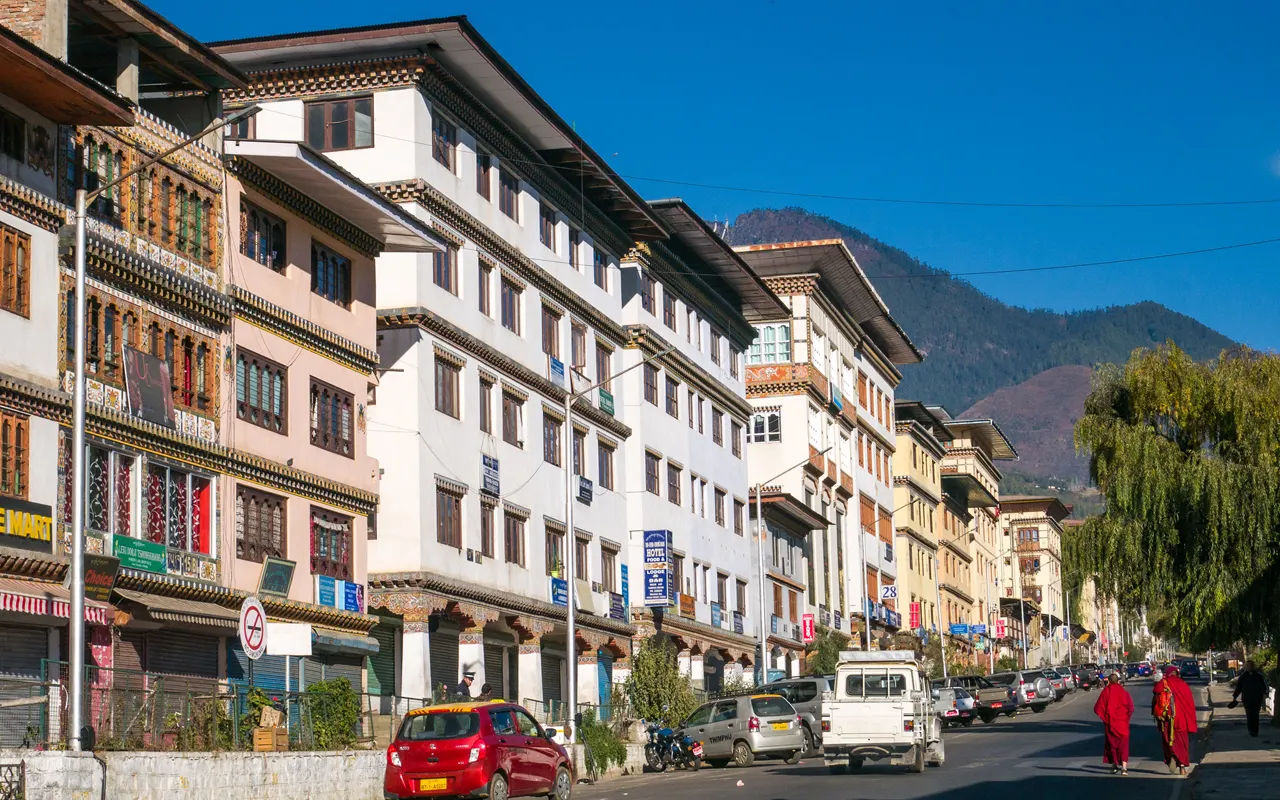
Depending on your time or arrival, if we have some time to spare, we will visit this monastery before getting to Thimphu. Once we set foot in Thimphu, the traditional fusion architecture of the city will definitely get your attention. Inspired by Tibetan Buddhism, there are many references to the religion that you can see all across the city and the whole nation.
Did you know that Thimphu is the one and only capital city on the planet that does not have even a single traffic light installed? Sounds amazing and it is. Traffic police wearing white gloves direct traffic all day long.
Traffic lights are not installed as they harm the aesthetics of the traditional architecture of the city. Every building in the city has to be designed in a certain way to preserve the integrity of its ancient designs.
For the time being, we will leave you to rest, as tomorrow we have a big travel day.

Activity: Drive for 1 hour 30 minutes

Max. Altitude: 2,320m/7,612ft. Thimphu

Meal: Breakfast, Lunch, Dinner

Accommodation: Guest House
Day 2: Full-Day Sightseeing In Thimphu
Sightseeing in Thimphu is a day to remember on your 8 Days Bhutan Tour. We will take you to visit a number of amazing attractions that are sure to leave you wanting more.
Buddha Dordenma
Unlike most of the other sites we will be visiting throughout the day, the Buddha Dordenma was built in 2008, which is not long ago when it comes to historic buildings and religious sites. The idea of building Buddha Dordenma came as a prophecy told by Sonam Zangpo, a 12th-century Yogi who was one of the important Buddhist figures of his time.
The Government of Bhutan acted on this prophecy to celebrate the 60th anniversary of Jigme Singye Wangchuk, the 4th ruler of the country.
Standing a total of 51.5 meters tall, this statue is enlisted among the tallest Buddha statues on the planet. The statue is made of bronze, coated in gold, and is hollow from the inside. The inside of this statue is filled with over 100,000 tiny statues of Buddha. These mini statues are 7 to 10 inches tall.
The Buddha Dordenma is a religiously very important site; people from all over the city come here to pray. The actual base of the statue is a three-story high building that houses a museum, meditation hall, and prayer hall. It’s a site that holds the teachings of Bhutanese Buddhism.
In addition to being a religious site, Buddha Dordenma is also a great viewpoint overlooking the vibrant city of Thimphu. It’s a great spot for a photo session. The surrounding environment of the Buddha Dordenma is the Keunsel Phodrang Nature Park. The protected natural site only adds to the beauty of the site.
Tashichho Dzong
Nicknamed the Fortress of the Glorious Religion, the Tashichho Dzong monastery is a centuries-old site that was first built in 1216. It was commissioned by Lama Gyalwa Lhanangpa and was initially named Do-Ngon Dzong.
Later, in the 17th century, this first building was enlarged under the order of Shabdrung Ngawang Namgyal. After the expansion project was completed, it was renamed Tashichho Dzong.
Since then, the name has stuck around, but the building itself has undergone several minor changes following disasters and fire accidents. In the 60s, the building has a major remake under the commission of Jigme Dorji Wangchuk, the third ruler of Bhutan.
The architectural design of Tashichho Dzong reflects the traditional Bhutanese style that was influenced by Tibetan Buddhism. The large white walls, the golden spire, and the detailed carving on the wooden structures are all characteristics of the traditional Bhutanese style. This complex is filled with several temples, a central tower, and prayer halls.
In addition to being a religious and historic site, the Tashichho Dzong is the official room of the present Bhutanese king. The building also houses several other important offices and functions as a governmental body.
Every year, the festival of Thimphu Tsechu is celebrated at this site. Traditional Bhutanese dance performances paired with traditional instrumental music are the main attraction of this event. The performance site is vibrantly decorated, which never fails to attract locals and international tourists alike.
Memorial Chorten
Often referred to as Thimphu Chorten, this site is yet another important religious building in Thimphu. The building follows the traditional Tibetan style architecture from back in 1974, the year it was built. Built in the name of Jigme Dorji Wangchuk, the 3rd ruler of Bhutan, the Memorial Chorten is full of symbols from ancient Buddhist scriptures.
The unique thing about this site is the fact that it does not display relics like most monasteries do; instead, there is a huge picture of the late king Jigme Dorji Wangchuk clothed in traditional attire. All the other chortens built in memory of the late kings have some kind of the King’s remains.
As one may expect, this chorten is visited by the locals on a daily basis, religious followers can be seen chanting mantras and spinning the giant prayer wheels, going in a clockwise direction.
Just like Tashichho Dzong, the Memorial Chorten is also a site for festivals. Notably, the Monlam Prayer Festival is celebrated there, devotees gather in masses while the Chief Abbot of Bhutan blesses them. It’s a long-standing traditional ritual that has been around for decades now.
Simtokha Dzong
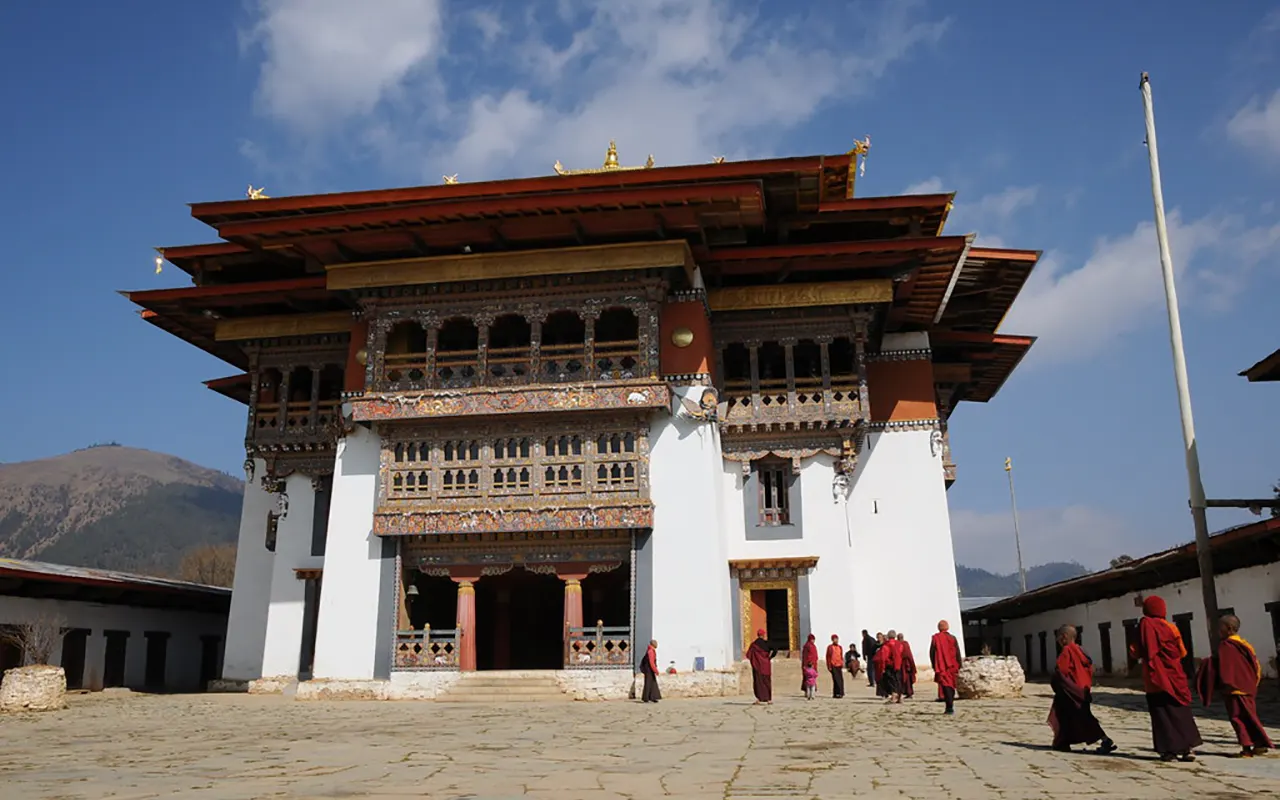
Simtokha Dzong, sometimes referred to as Sangak Zabdhon Phodrang, is a relatively small fortress that dates back to 1629. It was built under the commission of Zhabdrung Ngawang Namgyal, the one who unified the nation of Bhutan. Despite its size, it is a very important historic site.
After the unification was complete, this was the first ever dzong built in the “country”. Sure, there were many others before it, but it was not “Bhutan” back then, it was several small kingdoms. The Simtokha Dzong was an official building in addition to being a religious site.
Just a few years following its construction, the Simtokha Dzong was captured by the Tibetan army but their reign did not last very long. The Bhutanese soldiers reclaimed the fortress, and it resumed being the official building that it was before.
Located on a ridge, this Dzong has huge walls to protect it from invaders. The complex inside houses accommodations for monks, temples, offices, and gardens. There’s also a central tower, and the detailing on windows and doors is very intricate. It was built on a slope so that they could oversee the valley and know where the enemies were coming from.
Activity: Sightseeing for 6-7 hours
Max. Altitude: 2,320m/7,612ft. Thimphu
Meal: Breakfast, Lunch, Dinner
Accommodation: Guest House
Day 3: Drive From Thimphu To Gangtey
Leaving the rich cultural city of Thimphu, we will get on a 125-kilometer road trip to Gangtey, which should take about 6 hours to cover.
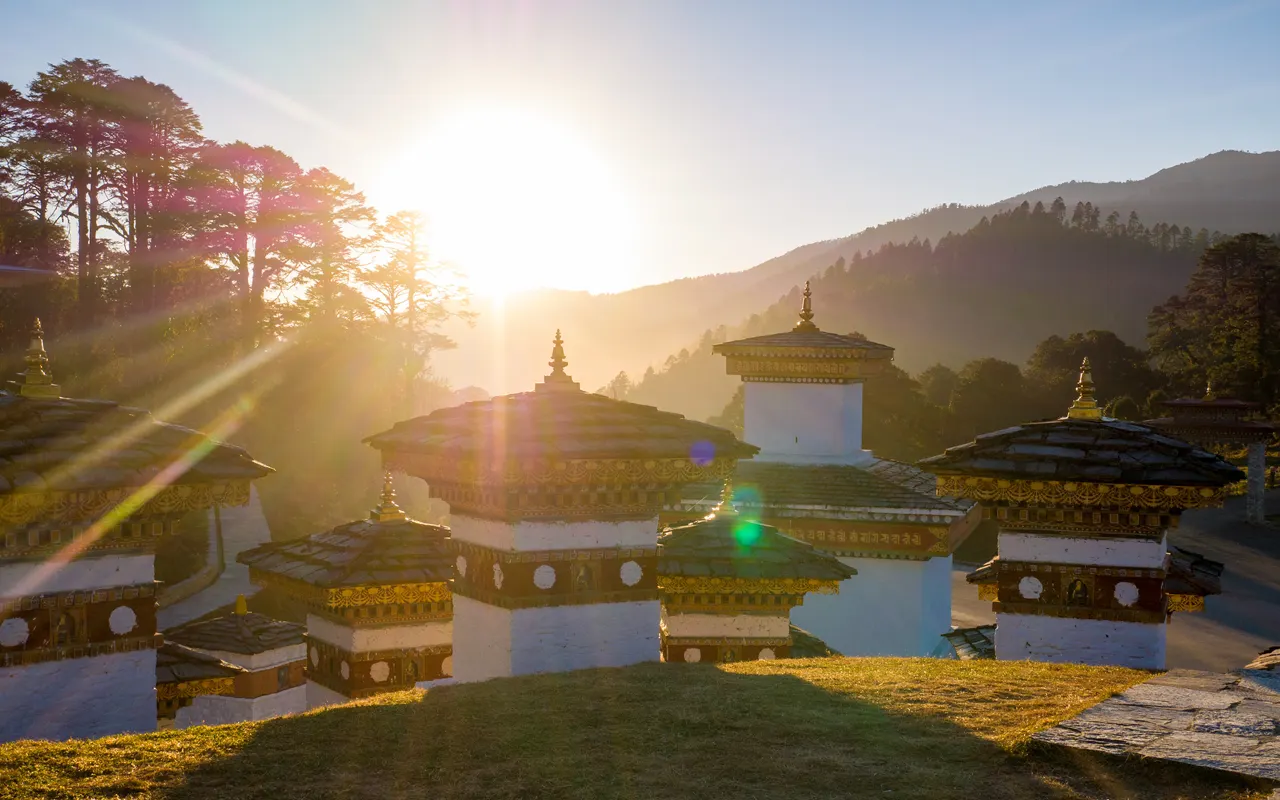
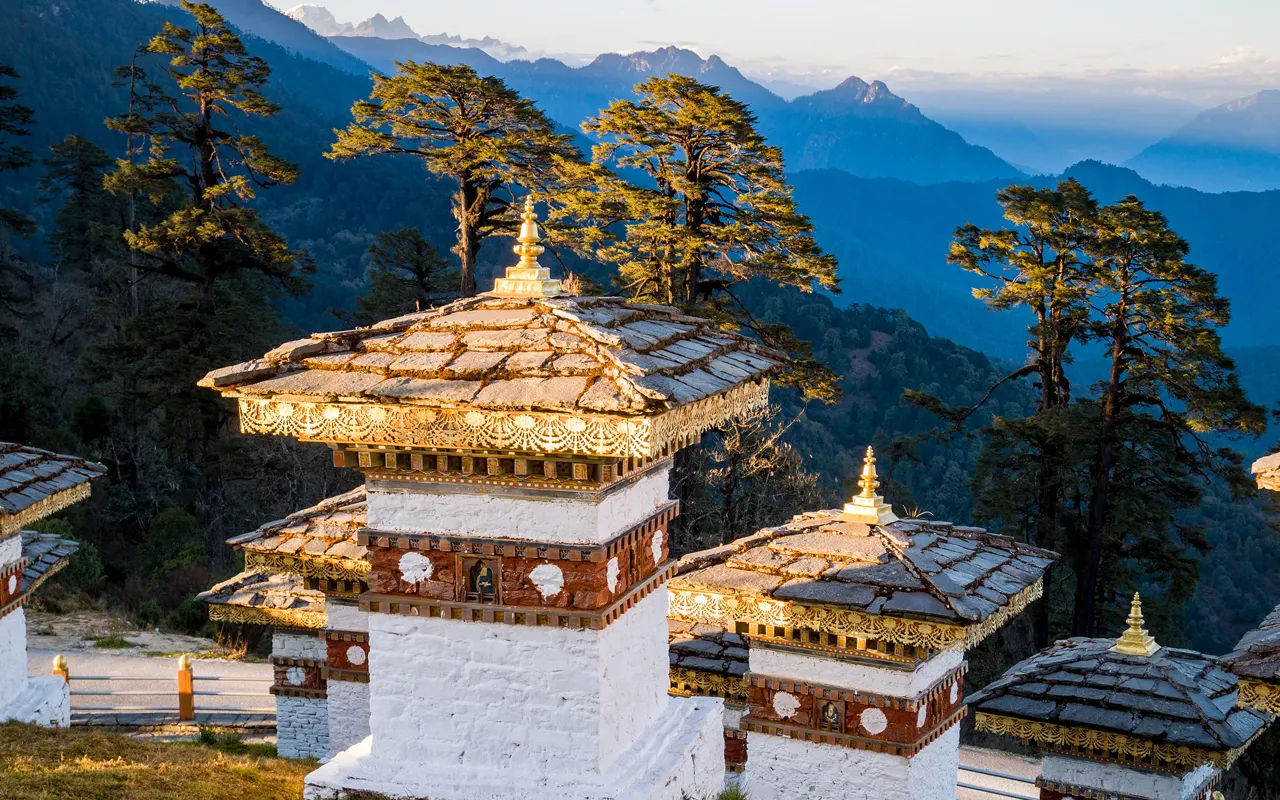
Our first stop on the 3rd day of the 8 Days Bhutan Tour will be at Dochu La Pass, a popular spot for the wide panoramic scenes it offers. The pass is at a height of 3140 meters above sea level, and Druk Wangyal Chortens is also another nearby attraction. There are 108 mini stupas that were built to appreciate the sacrifices of Bhutanese army personnel.
We will explore both sites before descending to Wangdue Phodrang. Passing lush hillsides and terrace farmlands, overlooked by countryside villages, we will reach Wangdue town shortly, where our lunch stop is located. The town is really low in altitude, only 1350 meters from sea level, and has a Dzong like most other towns in Bhutan.
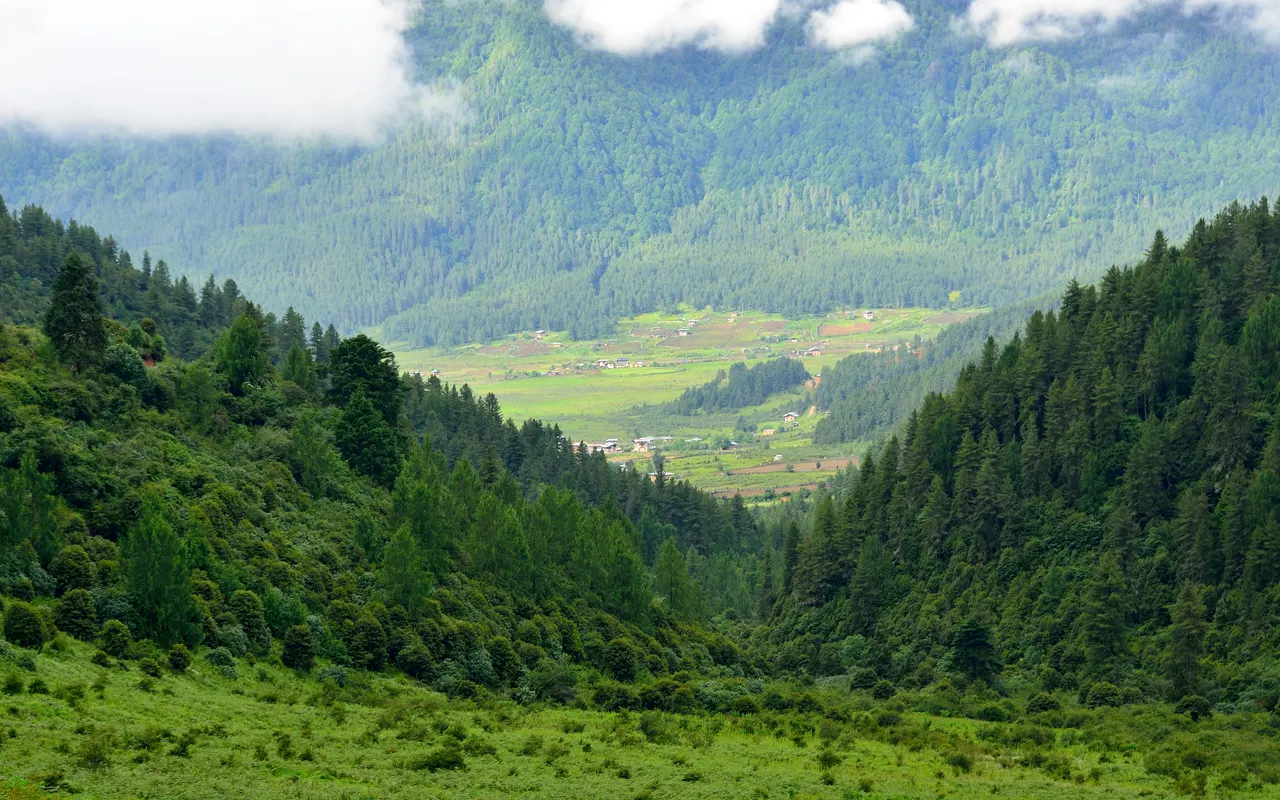
From there, the road trip takes a sharp ascend and we climb up to 3250 meters of elevation to get to Lawala Pass. You will get to see dwarf bamboo forests near the pass and cattle grazing in the small pastures. Crossing Lawala Pass, the road descends sharply as we enter Phobjikha Valley, a beautiful conserved area sitting at an altitude of 3000 meters.
Phobjikha Valley is the other name for Gangtey. This area is protected by the local government and is popular for having the rare black-necked crane. However, those birds only migrate to this valley in the winter season. Those birds come to Gangtey from Tibet to escape the extreme winter conditions.
The valley is also a popular visit for nature excursions, and trails like Gangtey Nature Trail offer a peaceful and intimate nature exploration experience. You will pass through well-kept forests, farmlands, and traditional villages, witnessing the lush vegetation of the valley.
The villages in the region have traditional Bhutanese countryside houses, and they show off traditional daily practices as well. Festivals and events held in the village are truly a sight to see.
Activity: Drive for 6 hours
Max. Altitude: 3,000m/9,843ft. Gangtey
Meal: Breakfast, Lunch, Dinner
Accommodation: Guest House
Day 4: Drive From Gangtey To Trongsa
Day 4 of the 8 Days Bhutan Tour is a long driving day as we leave Gangtey to get to Trongsa. This ride is about 120 km long and takes around 5 hours to cover. The road ride begins with an ascent that leads us back to Lawa La Pass (3250 meters). This portion of the road is slightly rough since construction work is ongoing.
Crossing the Lawa La Pass, we will soon join the east-west primary, which is the major highway of Bhutan.
Continuing the ascend, we will reach Pele La Pass, which is 3420 meters above sea level. Pele La is not only a mountain cross but also an indication that separates central and western Bhutan. The views from the pass are great as well, offering views of Jichu Drake, Jumolharu, and Kangbum mountains.
We will follow that up by descending a windy road, accompanied by a dwarf bamboo forest on one side and a vast valley on the other. After about 80 km of travel, we will reach Chendebji Chorten. This stupa is different from the ones you previously visited in your 8 Days Bhutan Tour because it is built following Nepalese architecture. The stupa has a large dome and 4 eyes, one facing each direction.
This stupa was commissioned by Lama Shida about 200 years ago to protect the valley from the evil spirits that were residing there. People often visit this place to take a breath of fresh air or just to relax a little while traveling somewhere. With only 40 km left to cover, our destination is not that far away.
The town of Trongsa sits at an altitude of 2200 meters; it is a historic town as many events that shaped Bhutan occurred there. At present, the town is the gateway to central Bhutan. Sitting on a ridge, the Trongsa Dzong oversees the town while the Mangde Chhu River flows beneath.
In addition to being the largest fortress in Bhutan, the Trongsa Dzong is also an important administrative building, keeping a watch on the trade between the east and west regions.
The dzong was built back in 1648 and at present houses a number of temples and gardens. The architecture style is traditional Bhutanese, where the wood workings are very detailed and the view from the dzong is quite remarkable.
Upon the hilltop, you will find Taa-Dzong, a watchtower that was built as a defensive resource to let people know when enemies are approaching the Trongsa Dzong. At present, the watchtower has been turned into the Royal Heritage Museum, which houses a number of ancient tools and artifacts related to the Bhutanese royalty.
Activity: Drive for 5 hours
Max. Altitude: 2,200m/7,218ft. Trongsa
Meal: Breakfast, Lunch, Dinner
Accommodation: Guest House
Day 5: Drive From Trongsa To Punakha
The 5th day of the 8 Days Bhutan Tour takes us up to Pele La Pass (3420 meters), driving up windy roads accompanied by lush hills. After crossing the pass, we will get down to Wangdue Phodrang, you will notice the change in vegetation as we get down from the coniferous to the subtropical level.
Passing the Chendebji Chorten along the way, we will get to Punakha, the ex-capital city of Bhutan. The city of Punakha is full of farmlands, as the land there is much more fertile in comparison to other cities.
There is also a dzong named after the city, which is the most beautiful one you will see during your 8 Days Bhutan Tour. It was built in the early 1600s and is regarded as a “Palace of Great Happiness.”
The Punakha Dzong is one of the best places to visit in the whole country of Bhutan. The beautiful temples within, the impressive wood carvings, and the beauty of the whole palace are not fully describable in words.
In addition to being a mesmerizing site, it is also a historic site as it served as the coronation building of the Bhutanese kings. It is also the main building for national events and festivals.
Activity: Drive for 6 hours
Max. Altitude: 1,200m/3,937ft. Punakha
Meal: Breakfast, Lunch, Dinner
Accommodation: Guest House
Day 6: Drive From Punakha/Wangdue To Paro
On the 6th day of the 8 Days Bhutan Tour, we will get back to Paro, where it all started. The road trip begins with an uphill drive to Dochu La Pass (3100 meters), from the pass we will enjoy a beautiful scene of the Himalayas in east Bhutan. From Dochula Pass, we will move towards the Thimphu Valley following a descending road full of countryside scenes.
We will not be spending any time in Thimphu, instead we will get to Paro. If you really want to, we can stay in Thimphu for lunch. The distance from Punakha to Paro is 115 km which can be covered under 4 hours of ride.
Activity: Drive for 4 hours
Max. Altitude: 2,200m/7,218ft. Paro
Meal: Breakfast, Lunch, Dinner
Accommodation: Guest House
Day 7: Full-Day Sightseeing In Paro
Day 7 of the 8 Days Bhutan Tour will be our final day of sightseeing and exploring the country of Bhutan. We will start the day sightseeing tour with a visit to Paro Taktsang.
Paro Taktsang
The creation of Paro Taktsang, also known as Tiger’s Nest Monastery, is associated with the growth of Buddhism in Bhutan.
As per the mythology, Guru Rinpoche arrived at the location of Paro Taktsang, flying on the back of a Tigress, and started meditating. He meditated for 3 years, 3 months, 3 days, and 3 hours to turn the native deities and locals to Buddhism. This is the first account of Buddhism in Bhutan and to celebrate the birth of Buddhism in the country, the people built a monastery there.
There are 4 primary temples within the complex and a bunch of housing for devotees to rest and stay in. The building blends in very well with the rocky surroundings while the temples stand beautifully apart. Although the monastery is high up at the top of a hill, the authorities have made sure that the devotees who stay there are provided with modern facilities.
To get to Paro Taktsang, we will have to climb a hill for about 3 hours (back and forth). The climb is not particularly difficult but it is tiring which is why we will take several breaks to get to the top. You can also hire a pony to take you up to the midpoint of the hike, it can not go any further because the trail is narrow.
Rinpung Dzong
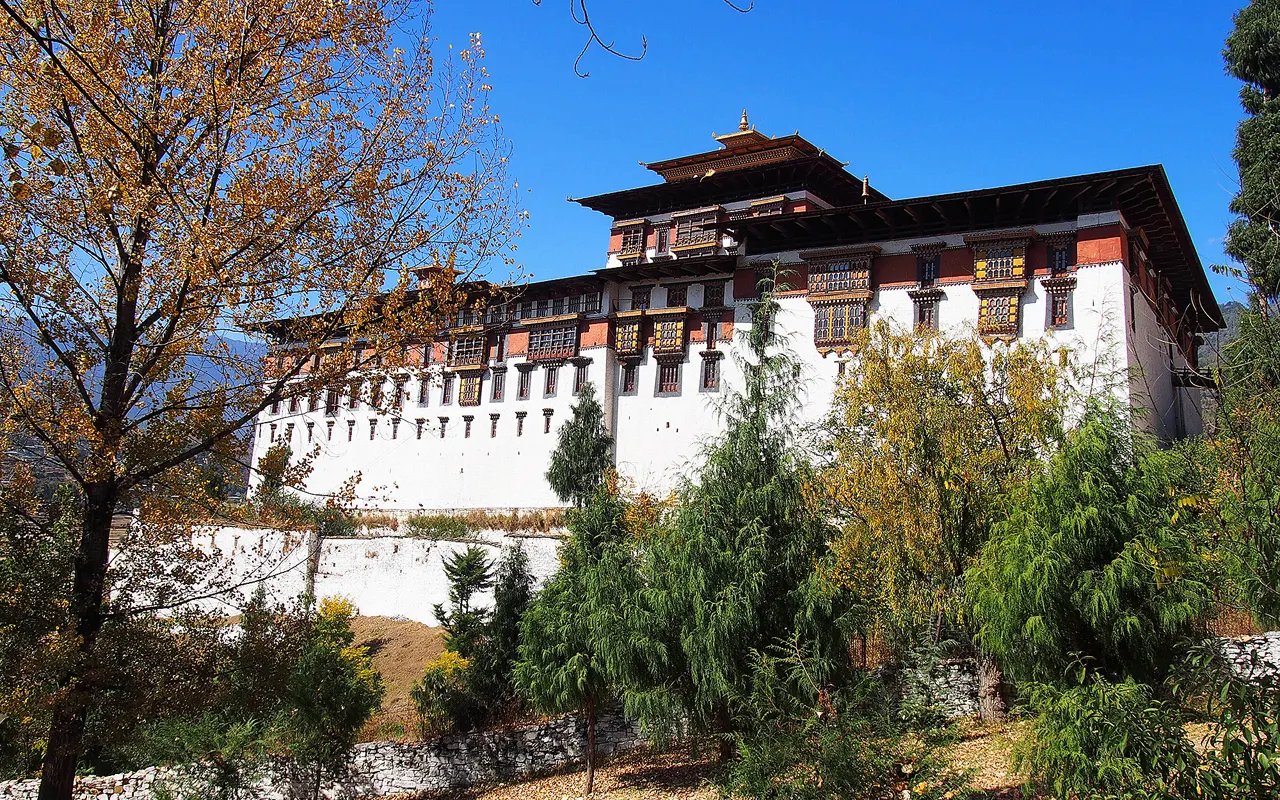
This 17th-century fortress has the nickname “Fortress of the Heap of Jewels.” It is an architectural heritage of the country and overlooks the city of Paro being located atop a hill. Before the building of the fortress, it was a small temple that dated back to the 5th century.
The tiny temple was later built into a giant 5-story tall building under the commission of Hungrek Dzong, in the 17th century. In the same century, he handed it over to Zhabdrung Ngawang Namgyal, who was in the process of unifying the small kingdoms into the country of Bhutan.
Seeing that the temple was located in a strategic position for war and defense, Zhabdrung Ngawang Namgyal commissioned the building of a massive fortress incorporating the temple.
At present, the fortress is a cultural and historic body; it is the official building of Paro and the administrative hotspot. Every year, people celebrate the Paro Tshechu festival with grand celebrations and vibrant decorations. Monks and performers dance with masked faces to celebrate this festival; it’s an amazing experience to see it live.
The interior of the dzong is decorated with traditional murals and beautiful woodwork that are inspired by the teachings of Buddhism and traditional Bhutanese culture.
National Museum of Bhutan
The National Museum of Bhutan was built in 1968 within the Paro Ta Dzong building. The dzong itself was built in 1649 under the command of the 1st governor of the town. Ponlop Tenzin Drukdra built this watch tower to oversee the valley of Paro for potential enemy infiltration.
At present, the government of Bhutan has turned it into a museum showcasing a number of historic items and preserving the culture of Bhutan.
The dzong is shaped like a conch, which is believed to be an auspicious sign according to Bhutanese Buddhism. All of the 7 floors of the building are safeguarded with 2.5-meter-thick concrete walls. Built in the era of war, this was a serious preventive measure to safeguard the people within the building.
The museum has different sections, each with impressive artifacts and items; the Natural History Gallery, Thangka Gallery, Weaponry Display, Textile Exhibition, and Statuary and Relics are the sections within.
The Bhutanese government makes active efforts to preserve their cultural identity which is why many of the watch towers and dzongs have been turned into a place of cultural preservance.
Kyichu Lhakhang
Dating back to 659 AD, Kyichu Lhakhang is one of the most popular temples built under the commission of Songtsen Gampo, a Tibetan King. It was believed that a huge demon was living in Paro, and this temple was built to get rid of the demon. The demon was an obstruction to the spread of Buddhism across the country, so it is considered a great piece of the history of Bhutanese Buddhism.
The temple was visited by Guru Rinpoche after about 100 years of its establishment. People believe that he has hidden spiritual treasures under the temple, but no one has tried digging cause it is sacred.
The architectural design of the temple is a mix of traditional Bhutanese style and Tibetan style. The temple has been renovated many times over the span of its life and is very huge at present compared to its original size.
Activity: Sightseeing for 6-7 hours
Max. Altitude: 2,200m/7,218ft. Paro
Meal: Breakfast, Lunch, Dinner
Accommodation: Guest House
Day 8: Dropoff At Paro International Airport
The 8th day of the 8 Days Bhutan Tour is the last day of the journey. We will have a celebratory breakfast and get on the flight to Kathmandu. Only two airlines are permitted to operate flights within the country so timing for flights can be limited.
Max. Altitude: 2,200m/7,218ft. Paro International Airport
Meal: Breakfast

Note:
If you have a private group and prefer a personalized experience, we can organize a custom trip tailored to your requirements and group size, running it any day you choose.
Detail Information about 8 Days Bhutan Tour
How does our trip start?
Our trip starts in Paro, where the only international airport in the country, the Paro International Airport, is located. But before you put on your boots to travel to Bhutan, you must get your visa clearance permit.
You can only get this permit if you apply for it via an authorized travel agency. Our document experts know it all and will help you obtain your visa permit, so we can book a flight to Paro for you. Without a visa clearance, you can not even book a flight to Bhutan.
At the airport, the visa officer will stamp a clearance permit on your visa clearance slip, which will allow you to travel within the country of Bhutan.
From there, our Bhutanese rep will be waiting for you outside the terminal. He will call you out, escort you to your hotel room, and call it a night. If the time is sufficient, he will take you to visit a couple of attractions on the way to Thimphu.
Best seasons
The country of Bhutan is generally great to visit in autumn, spring, and summer. However, if you are not able to make it during those seasons, you can choose to travel any any other time of the year.
However, since the other seasons are winter and monsoon, you might be in for a cloudy scene. Winter snow can alleviate the appeal of certain Himalayan scenes but overall it can keep you from seeing the scenes of the lush hills.
Autumn, spring, and summer, on the other hand, offer a great view of lush green hills and giant white mountains in the northwestern part.
Altitude Sickness
We will be reaching a maximum altitude of 3420 meters above sea level, which is safe from altitude sickness. Altitude sickness usually gets you at great altitude (5000 meters and above), so you are more than safe during your 8 Days Bhutan Tour.
Accommodation, Food and Drink
Accommodation during your 8 Days Bhutan Tour is going to be pretty standard unless you want to upgrade it. Our tour package offers you a 3-star hotel stay for the entirety of the tour but you can upgrade it to 4-star/5-star hotels.
Transportation
Your flight to and from Paro International Airport and jeep ride within the country of Bhutan are covered by our 8 Days Bhutan Tour. Anything outside of that is not inclusive.
Permit
The only permit you need for this 8 Days Bhutan Tour is a visa clearance. Without being approved for a visa to Bhutan, you can not even book a flight to the country.
Cost & Budget
Our 8 Days Bhutan Tour will cost you USD ________ per head. This figure has been chosen after carefully considering the day-to-day expenses of your stay and transport, and the daily wages of the guides, among other many things. We can provide you with a breakdown if you want all the details.
Your Extra expenses
Your extra expenses include visa fees, Sustainable Development Fees, tips for the crew members, extra meals, extra accommodation/stay, additional services at hotels, and more.
Things to Remember Before Doing 8 Days Bhutan Tour
- Bhutan is a religious country with conservative people and society. Please refrain from public affection of any kind and do not wear revealing outfits at any time during the 8 Days Bhutan Tour.
- Double-check that your passport is valid for at least 6 more months and that you have your visa clearance slip with you before you board the flight.
- Travelers are legally required to have Bhutanese guides while traveling within Bhutan. We will arrange the guide for you, but you must not go on side quests alone during the 8 Days Bhutan Tour.
- Carry a little cash with you while traveling to remote villages since they do not have the technology to work out your VISA or Mastercard.
- Smoking cigarettes is a legal offense, public smoking is strictly prohibited, and so is the sale of tobacco.
Frequently Asked Questions
Can I go solo traveling to Bhutan?
No, solo travelers are not allowed to enter the country of Bhutan; the Government of Bhutan does not even approve visas applied by individuals. They only give clearance to those who have applied for a visa via a trusted travel company. Their motto of “High Value – Low Impact” is one of the reasons they do not want heaps of tourists visiting the country. That also explains their hefty $100 per night charge to tourists who visit the country.
What is the $100 SDF charge?
The country of Bhutan has a practice where tourists visiting the country must pay $100 per head per night as a Sustainable Development Fee. The country is self-sufficient and they do not profit much from tourism which is why they want only a limited amount of people to visit the country at a time. Or maybe they only want “high value” tourists to visit their country, just like the tourism motto “High Value – Low Impact”.
Is the internet available throughout the tour?
Yes, you can access the internet throughout the trek but do not expect to have internet connectivity during road trips. At every night stop of the 8 Days Bhutan Tour, you will have free WiFi.
Reviews on 8 Days Bhutan Tour
 Write a Review
- Your safety, our no 1 priority
- Best price guarantee
- Experienced & dedicated team
- Easy booking, no hidden charge
- You can customize this trip
Talk to Travel Expert Samundra Rimal (+977-9843127084)