


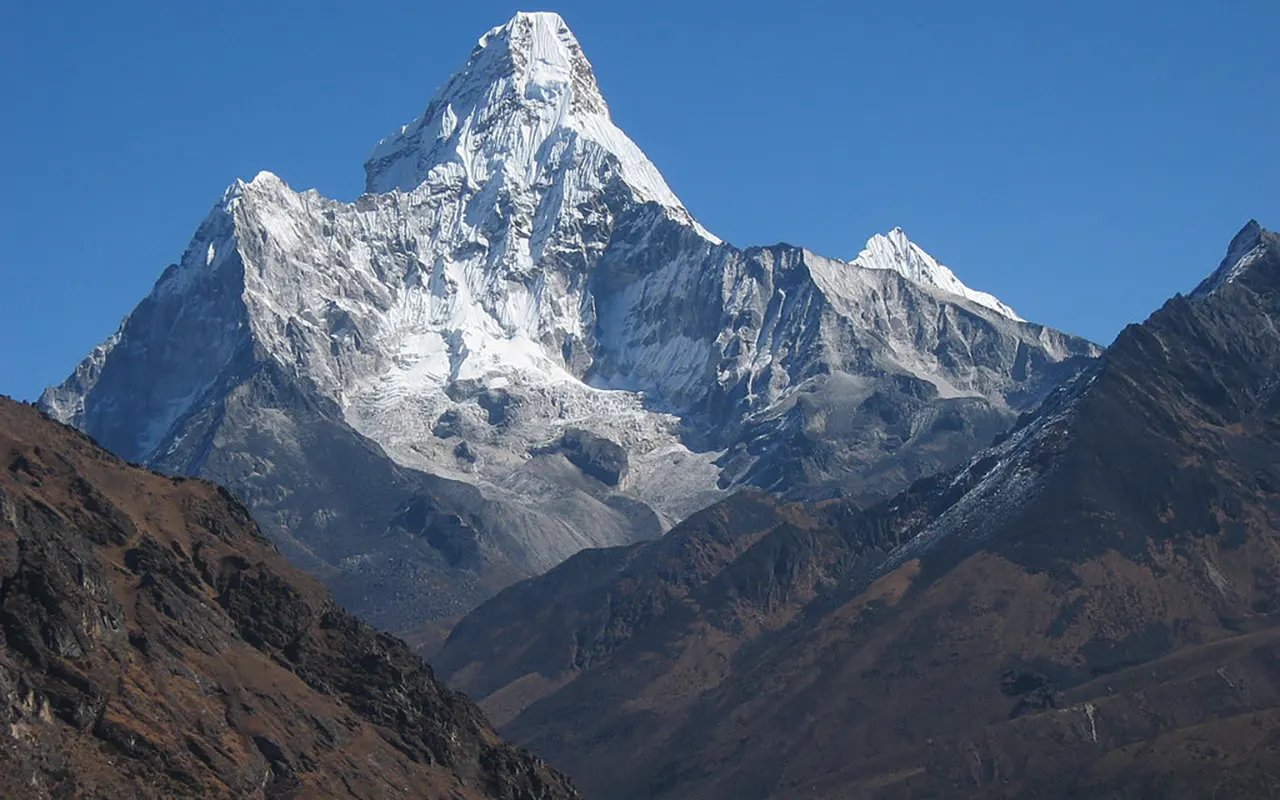


Ama Dablam Expedition

Duration
30 Days

Max Altitude
6,812 m. / 22,349 ft.

Difficulty
Moderate

Group Size
2-20 Pax

Meals
- 29 Breakfast
- 25 Lunch
- 27 Dinner

Accommodation
- Hotel
- Tent
- Lodge

Transportation
Flight

Activities
- Climbing
- Sightseeing

- Your safety, our no 1 priority
- Best price guarantee
- Experienced & dedicated team
- Easy booking, no hidden charge
- You can customize this trip



Talk to Travel Expert
Samundra Rimal (+977-9843127084)
Introduction of Ama Dablam Expedition
The Ama Dablam Expedition is a demanding Himalayan climbing program designed for experienced mountaineers who are prepared for technical terrain and high altitude. Ama Dablam is located in the Khumbu region in Nepal near the prime trekking circuit on the slopes of Everest at an altitude of 6,812 m / 22,349 ft. More than just good trekking fitness is required, as the mountain demands experience in the use of crampons, ice axe skills, fixed ropes and technical climbing.
The trip starts in Kathmandu with an expedition briefing, equipment check and final arrangements to go. The team then flies to Lukla and commences the approach trek into Lukla through Phakding, Namche Bazaar, Kyangjuma, Tengboche and Pangboche. The path slowly rises in height as you get the chance to acclimatize before arriving at Ama Dablam Base Camp (4600 m / 15092 ft).
The Ama Dablam climbing route is normally on the Southwest Ridge. The expedition consists of technical training, rotations and movements to higher camps above Base Camp. Climbing is on steep terrain, fixed ropes, exposed sections and snow and ice. Camp movement may be varied based on weather, route conditions and acclimatization of the team.
One of the key elements of the trek is acclimatisation. The crew does not go straight to the top, but rotates between Base Camp and upper camps several times. These are movements that enable the climber to spend time at higher levels before coming down to lower levels to recover. Rest days, hydration, nutrition and careful monitoring are provided during this period.
The Ama Dablam climb itinerary allows for a flexible climb window, as conditions on the mountain are not known months ahead of time. The summit attempt will be timed around a suitable weather window, safe route conditions and the climbers’ physical condition. The planned summit is 6812 m / 22349 ft, then back to Base Camp after the climb.
Once they have done the mountain route, they head back down the Khumbu route through Pangboche, Tengboche, the Namche Bazaar and Phakding all the way back to Lukla. This is then followed by a return flight to Kathmandu, a free day and a dinner before the final departure.
Throughout the program, Nomad Adventure Treks will supply the support and logistics necessary, such as preparation, trekking arrangements, climbing support and coordination during the mountain phase.
Trip Highlights
- Ama Dablam Summit Attempt at 6,812 m / 22,349 ft
- If you are interested in Technical climbing, you can enjoy it from the Southwest Ridge.
- This is a scenic trek through the Khumbu Valley.
- Acclimatizing at Namche Bazaar
- This is a visit to the monastery of Tengboche.
- Ama Dablam Base Camp at 4,600 m / 15,092 ft
- Training on fixed-rope and Crampon climbing.
- Climbing multiple times from the same point at high altitude.
- Flexible summit window according to the mountain conditions.
- Flight Between Kathmandu and Lukla
Detail Itinerary of Ama Dablam Expedition

Day 01: Arrival in Kathmandu
Arriving in Kathmandu, you finish the formalities at the airport and then meet our representative at the Tribhuvan International Airport. Our staff will get you to your hotel in a private car. The altitude of Kathmandu is about 1400m / 4593ft above sea level.
Once you have checked in to the hotel, you are able to recuperate from your trip abroad. The day is kept out of the way as the activities on the expedition get more intense from the next morning.
We will have a welcome dinner with the expedition team in the evening. This is also the time to get acquainted with the climbing staff and get a first impression of the Ama Dablam expedition.

Activity: Airport transfer, expedition introduction and welcome dinner, 30 minutes to 1 hour

Max. Altitude: 1,400m/4,593ft. Kathmandu

Meal: Dinner

Accommodation: Hotel
Day 02: Expedition Briefing, Equipment Check and Preparation
Today is for the last-minute preparations before departure from Kathmandu. The expedition team will attend an official briefing on the climbing programme, route plan, safety procedures, permits, etc. and discuss other important arrangements.
Climbing staff will be on hand to check your personal gear and ensure that you have all the necessary equipment ready for the expedition. This will include crampons, climbing axe, harness, ascender and other equipment needed for fixed rope climbing.
Also, some time will be available for buying or hiring any equipment that remains if required in Kathmandu. There is an opportunity to pack and check equipment before an early morning departure to the Khumbu area in the evening.
Activity: Expedition briefing, equipment inspection and preparation, Full preparation day
Max. Altitude: 1,400m/4,593ft. Kathmandu
Meal: Breakfast
Accommodation: Hotel
Day 03: Fly from Kathmandu to Lukla and Trek to Phakding
The adventure starts with a flight to Lukla from Kathmandu in the morning. Lukla is located at around 2840 m / 9317 ft. Once we have introduced ourselves to the trekking party and set up the equipment, we set off towards Phakding.
The trail is through small villages and forest passing through the Dudh Koshi Valley. The initial section of the hike is fairly easy, allowing the body to get used to climbing higher.
The location of Phakding is about 2610 m / 8563 ft. On arrival at the village, we stay overnight in the village lodge.
Activity: Flight and trekking, 3 to 4 hours
Max. Altitude: 2,840m/9,318ft. Phakding
Meal: Breakfast, Lunch, Dinner
Accommodation: Lodge
Day 04: Trek from Phakding to Namche Bazaar
We then head back down the Dudh Koshi Valley to Namche Bazaar following breakfast. The trail goes through the entrance complex of Sagarmatha National Park and also traverses multiple suspension bridges.
The trail slowly rises uphill as we approach Namche. The last section is a prolonged climb uphill through the woods before coming to the heart of the Sherpa lands, in the Khumbu.
Namche Bazaar is located at an altitude of about 3440 m / 11286 ft we arrive at Namche and go to the lodge for a night’s rest. The next day is an acclimatization day.
Activity: Trekking, 4 to 5 hours
Max. Altitude: 3,440m/11,286ft. Namche Bazaar
Meal: Breakfast, Lunch, Dinner
Accommodation: Lodge
Day 05: Acclimatization Day in Namche Bazaar
It’s an acclimatization day in Namche Bazaar. Instead of heading higher, we take the day to adapt to the elevation.
Short walks can be organised around the surrounding villages & viewpoints. Khumjung and Khunde may be included in the walk, depending on the group’s condition. Khumjung is approximately 3,780 m / 12,402 ft, while Khunde is approximately 3,840 m / 12,598 ft.
Namche Bazaar is a place to visit and enjoy a more relaxed day, followed by a night at the lodge. The goal is to achieve some higher elevation during the day and sleep at Namche at night.
Activity: Acclimatization hike and rest, 3 to 4 hours
Max. Altitude: 3,840m/12,598ft. Namche Bazaar
Meal: Breakfast, Lunch, Dinner
Accommodation: Lodge
Day 06: Trek from Namche Bazaar to Kyangjuma via Khunde and Khumjung
From Namche Bazaar, it’s on to Kyangjuma via the traditional Sherpa villages of Khunde and Khumjung. Another gentle climb, keeping the walking for this day moderate.
The trail goes through fields and communities and then leads to Kyangjuma. The areas above Namche, namely Khumjung and Khunde, are good acclimatization areas to consider going to before continuing into the Khumbu.
Kyangjuma is located at an elevation of about 3550 m / 11647 ft. Once at the settlement, we stay for the night in a lodge.
Activity: Trekking through Khunde and Khumjung to Kyangjuma, 4 to 5 hours
Max. Altitude: 3,840m/12,598ft. Kyangjuma
Meal: Breakfast, Lunch, Dinner
Accommodation: Lodge
Day 07: Trek from Kyangjuma to Pangboche via Tengboche
The trail heads at Kyangjuma and heads south to Tengboche passing through pine and rhododendron forest. The track runs along the Khumbu Valley and is gradually ascending in altitude.
Tengboche is also a cultural hub and the location of Tengboche Monastery. Before heading on to Pangboche, we will have a chance to explore the monastery.
The path then descends towards the river, before rising again towards Pangboche from Tengboche. Located at about 3,930 m / 12,894 ft, the village is a known way station to reach the Base Camp of Ama Dablam.
Activity: Trekking and visit to Tengboche Monastery, 5 to 6 hours
Max. Altitude: 3,930m/12,894ft. Pangboche
Meal: Breakfast, Lunch, Dinner
Accommodation: Lodge
Day 08: Trek from Pangboche to Ama Dablam Base Camp
We depart from Pangboche and make our way towards the base camp of Ama Dablam. The track slowly exits the main Khumbu Valley and heads into more open alpine country below the mountain.
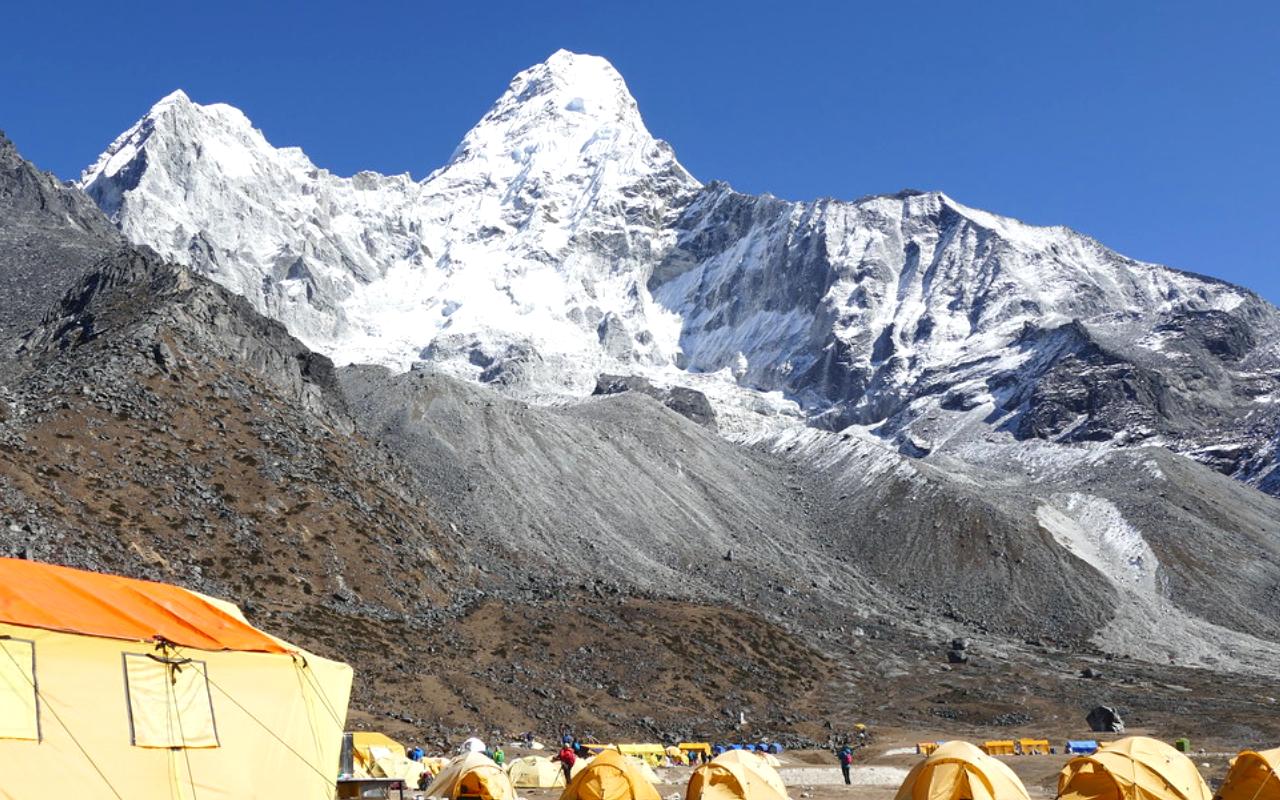
As one gets further away from the villages, the atmosphere is more pastoral and rougher. As the trail nears the expedition area, Ama Dablam rises up out of the valley.
The Ama Dablam Base Camp is located at about 4600m/ 15092 ft. Once at the camp, the expedition team will set up tents, climbing gear and personal gear.
Activity: Trekking to Ama Dablam Base Camp, 4 to 5 hours
Max. Altitude: 4,600m/15,092ft. Ama Dablam Base Camp
Meal: Breakfast, Lunch, Dinner
Accommodation: Tent
Day 09: Ama Dablam Base Camp Expedition Preparation
The day will be spent in Ama Dablam Base camp preparing to climb. The team will create camp, prepare equipment and talk about climbing strategy.
The climbing route, fixed ropes, camp movements, communication and safety procedures will be covered in detail. The team will also inspect the conditions of the mountains for their next move.
Personal climbing gear will be thoroughly inspected. Equipment such as crampons, harnesses, ice axe, climbing clothes and other necessary equipment must be prepared before climbing upward.
The day is also used to get acclimatised to Base Camp and to rest and rehydrate before starting the technical climbing programme.
Activity: Expedition preparation, briefing and equipment organization, Full preparation day
Max. Altitude: 4,600m/15,092ft. Ama Dablam Base camp
Meal: Breakfast, Lunch, Dinner
Accommodation: Tent
Day 10: Technical Skills Training and Acclimatization
The day will be spent at Ama Dablam Base Camp acclimmatizing and developing technical climbing skills. The climbing team will discuss the skills required for the more challenging areas of the mountain.
Walking with crampons, using fixed ropes with ascenders, moving on technical terrain and rappelling can be part of the training. The above Base Camp technical climbing is an important aspect of Ama Dablam and requires these skills.
The climbing leaders are also able to check on the progress each member is making with altitude and equipment. If there is any technique that needs improvement, it may be practised again prior to the team moving up.
Activity: Technical climbing training and acclimatization, Full training day
Max. Altitude: 4,600m/15,092ft. Ama Dablam Base Camp
Meal: Breakfast, Lunch, Dinner
Accommodation: Tent
Day 11: First Acclimatization Rotation
Today is the first rotation of climbing. This is part of the acclimatization program as we leave Ama Dablam Base Camp and proceed higher up the camp.
Depending on the weather, route, snow conditions and the team’s acclimatization, the exact destination and overnight camp will be determined. The decision on when to stop will be determined by the climbing leader, based on the mountain and the climbers.
The primary goal of this rotation is to gain in elevation and become acquainted with the technical areas of the route. Efficient movement and fixed ropes will also be practised by the climbers.
Once at the chosen mountain camp, the team will arrange equipment and eat and sleep for the next phase of the rotation.
Activity: Acclimatization climbing rotation, 5 to 6 hours
Max. Altitude: 5,800m/19,029ft. Ama Dablam Base Camp
Meal: Breakfast, Lunch, Dinner
Accommodation: Tent
Day 12: Return to Ama Dablam Base Camp and Rest
The first acclimatization movement is completed and then descend to Ama Dablam Base Camp. The descent provides the team with the opportunity for recovery, following an overnight stay or extended time period at a higher altitude.
Once at Base Camp, the primary things are water, food and sleep. The climbing team may also consult the previous movement and make necessary adjustments in equipment or climbing skills.
The staff of the expedition will remain on the lookout for weather and route conditions and will be getting ready for the next rotation. The rest of the time can be used to pack the clothing and climbing equipment.
Activity: Descent, recovery and acclimatization, 4 to 5 hours
Max. Altitude: 5,800m/19,029ft. Ama Dablam Base Camp
Meal: Breakfast, Lunch, Dinner
Accommodation: Tent
Day 13: Second Climbing Rotation
After recovery at Base Camp, the second climbing rotation starts. Back to the mountain and onward as per the expedition plan.
This rotation offers extra experience at altitude and on technical terrain. Fixed rope sections will be used on the route and efficient movement and safe rope technique will be continued.
This stopping point will be determined by the weather, snow and ice conditions, route safety and individual acclimatisation by the climbing leader. Actual height and overnight camp site may therefore be different from planned.
Activity: Technical climbing and acclimatization, 5 to 7 hours
Max. Altitude: 6,000m/19,685ft. Ama Dablam Base Camp
Meal: Breakfast, Lunch, Dinner
Accommodation: Tent
Day 14: Acclimatization and Technical Climbing
Today, there is still climbing and acclimatisation on the mountain. The team will rotate based on the rotation plan set up by the expedition leader.
At this point, the climbers are more familiar with the fixed ropes, technical sections and movement procedures of Ama Dablam. Good foot placement, proper climbing gear use and a slow pace are still vital.
Actual altitude and distance climbed will vary according to weather, track conditions and personal acclimatization. The leader of the expedition may alter the course of the expedition due to conditions.
Activity: Technical climbing and acclimatization, 4 to 6 hours
Max. Altitude: 6,200m/20,341ft. Ama Dablam Base Camp
Meal: Breakfast, Lunch, Dinner
Accommodation: Tent
Day 15: Ama Dablam Base Camp and Rest
Today you will descent from the mountain to Ama Dablam Base Camp. The team completes the second climbing rotation and then returns to the lower camp to recuperate prior to the last climbing rotation.
The descent is done with care on the technical aspects and fixed ropes. On the return, the climbing team will follow the instructions of the expedition leaders.
Upon arrival at Base Camp, climbers will be able to eat, drink and rest. Equipment may also be dried, inspected and repacked for the next move.
Activity: Descent, recovery and rest, 4 to 6 hours
Max. Altitude: 6,200m/20,341ft. Ama Dablam Base Camp
Meal: Breakfast, Lunch, Dinner
Accommodation: Tent
Day 16: Rest and Summit Preparation
This is a day to get ready and rest at Ama Dablam Base Camp. The team will come out of the previous climbing rotation and get ready for the last rotation.
Climbing gear will be thoroughly inspected. Before heading up to higher camps, crampons, harnesses, ascenders, ice axe, clothing for climbing, sleeping gear and other necessities must be prepared.
The expedition team will also check the weather forecast and conditions on the route. The final climbing schedule will be determined by the weather window and route conditions.
Activity: Rest, equipment check and summit preparation, Full rest and preparation day
Max. Altitude: 4,600m/15,092ft. Ama Dablam Base Camp
Meal: Breakfast, Lunch, Dinner
Accommodation: Tent
Day 17: Begin Final Climbing Rotation
The last climb around is today, depending on the weather and conditions that allow it we depart Ama Dablam Base Camp and set off for the higher camps.
The exact camp reached is dependent on the leader of the expedition. This will be a technical climb and fixed-rope section with careful movement and spacing of the group.
Items to be carried for the higher camps will be the same as those outlined in the expedition plan. The climbing team will keep an eye on each climber during the climb.
Activity: Final acclimatization rotation and technical climbing, 5 to 7 hours
Max. Altitude: 5,800m/19,029ft. Ama Dablam Base Camp
Meal: Breakfast, Lunch, Dinner
Accommodation: Tent
Day 18: Climb Toward Higher Camp
Today you will climb towards Higher Camp. more you ascend, the more challenging it becomes to climb and the more crucial it is to move carefully on fixed lines.
There are also technical areas where climbers have to use their equipment properly and be at a steady pace. The leader will determine the distance traveled depending on the weather, conditions of the route and personal ability.
The higher camps are set up at approximately 6,000m / 19,685ft; the precise position of the overnight camp will depend on the climbing programme of the expedition and the conditions on the route.
Activity: Technical climbing and movement toward high camp, 4 to 6 hours
Max. Altitude: 6,000m/19,685ft. High Camp
Meal: Breakfast, Lunch, Dinner
Accommodation: Tent
Day 19: High Camp Acclimatization and Preparation
The team will today spend time in high elevation to acclimatize and train for the summit push.
Climbers will pack their gear for the summit push and discuss the next section of the route. Clothing, climbing equipment, headlamps, gloves, crampons and other necessary equipment will be available.
This elevation is the place where rest is absolutely crucial! This team will try to concentrate on keeping fluids and food in your body and try not to waste any energy.
Activity: High altitude acclimatization and summit preparation, Full acclimatization and preparation day
Max. Altitude: 6,000m/19,685ft. High Camp
Meal: Breakfast, Lunch, Dinner
Accommodation: Tent
Day 20: Recovery and Summit Preparation
Today, there is flexibility in a final climbing rotation. Depending on the weather and the conditions on the route and the individuals’ acclimatisation to the mountain, the team can move down to a lower camp or stay at the correct mountain camp.
This will be decided by the expedition leader based on the mountain conditions as well as the team’s condition. Flexibility is key; conditions may change rapidly at high altitudes depending on the weather and the route.
The time spent at the chosen camp will be for recovery, rehydration and equipment preparation. The team will also discuss the estimated movement to the summit and necessary gear for the next step is in place.
Activity: Recovery, acclimatization and summit preparation, 3 to 5 hours
Max. Altitude: 6,000m/19,685ft. High Camp
Meal: Breakfast, Lunch, Dinner
Accommodation: Tent
Day 21: Final Summit Preparation
The team heading up to the summit today is making their final preparations. Care will be taken to ensure all climbing gear is thoroughly inspected prior to the group entering the final phase of this expedition.
This is an important time to look at the weather conditions. The climbing leader will evaluate the forecast, wind, snowfall, condition of the route and the condition of the party before finalising the summit programme.
Personal climbing gear will be put down so it’s readily available during the move to the top. Climbers will also pack food, water and other necessary equipment to be used at altitude.
Activity: Final equipment check, weather assessment and summit preparation, Full preparation day
Max. Altitude: 6,000m/19,685ft. Final Summit
Meal: Breakfast, Lunch, Dinner
Accommodation: Tent
Day 22: Summit Push on Ama Dablam
The summit push starts as per the agreed weather window and route conditions. The team is led in a controlled manner up the correct mountain camp on the designated route, with fixed ropes.
Southwest Ridge is a technical, exposed, steep route with snow and rock. Frequently, climbers need to make proper use of technical gear and maintain a controlled pace during the climb.
As the summit push proceeds, the climbing leader will check the weather and the condition of the team. This schedule may be adjusted when conditions are not suitable.
Activity: Summit push and technical climbing , 8 to 10 hours
Max. Altitude: 6,400m/20,997ft. Ama Dablam
Meal: Breakfast, Lunch, Dinner
Accommodation: Tent
Day 23: Ama Dablam Summit Attempt
The summit is planned for today on Ama Dablam. The goal is to arrive at the top of 6,812 m / 22,349 ft, if the weather, route conditions and climbers’ fitness are suitable.
The last push is a technical climb on the upper Southwest Ridge. The group will travel slowly, taking care with fixed ropes and other suitable climbing gear and under the guidance of the expedition leaders.
Once at the summit, the team starts the descent under the conditions and the expedition plan. The descent is a significant portion of today’s ride and must be maintained as well, after the highest point.
Activity: Ama Dablam summit attempt and descent, 10 to 14 hours
Max. Altitude: 6,812m/22,349ft. Ama Dablam Summit
Meal: Breakfast, Lunch, Dinner
Accommodation: Tent
Day 24: Descend to Ama Dablam Base Camp
Once the summit phase is over, the team travels down towards the Base Camp of Ama Dablam. The day-by-day schedule of descent will be determined by the amount of movement that has been made at the present day and the state of the climbers.
It is important to move carefully down the higher camps on fixed ropes and technical terrain. The group will adhere to the instructions of the climbing leaders and be kept at a safe speed.
After the challenging climbing phase, the expedition team can relax, recover and refuel at Base Camp. All personal gear and climbing gear will also be tidied up as the expedition moves from the climbing to the trekking portion.
Activity: Descent, recovery and completion of climbing phase, 5 to 7 hours
Max. Altitude: 6,000m/19,685ft. Ama Dablam Base Camp
Meal: Breakfast, Lunch, Dinner
Accommodation: Tent
Day 25: Trek from Ama Dablam Base Camp to Kyangjuma via Pangboche and Tengboche
The trek resumes after we depart from Ama Dablam Base Camp and head down towards Pangboche. From there, the trail leads to Tengboche, then to Kyangjuma.
The way runs through the woods and through old villages in the mountains. As we descend into the midst of the forest, far from the alpine setting of Base Camp, the environment gets greener.
We stop at Tengboche, another important point on the way before heading towards Kyangjuma we arrive at Kyangjuma, check in to the lodge and sleep.
Activity: Trekking and descent, 5 to 6 hours
Max. Altitude: 3,930m/12,894ft. Kyangjuma
Meal: Breakfast, Lunch, Dinner
Accommodation: Lodge
Day 26: Trek from Kyangjuma to Phakding via Namche Bazaar
From Kyangjuma to Namche Bazaar is the continuation of the descent. The path gradually descends as it follows the familiar track of the Khumbu Valley.
Namche is a helpful rest stop on the road. There is time for lunch and shopping along the way before making the trip towards Phakding.
This track from Namche passes through forest and along the valley of the Dudh Koshi. There are a number of suspension bridges and small towns before you reach Phakding.
We arrive at Phakding and stay overnight at the lodge, getting ready for the last legs of the trek to Lukla.
Activity: Trekking and descent through Namche Bazaar, 5 to 6 hours
Max. Altitude: 3,550m/11,647ft. Phakding
Meal: Breakfast, Lunch, Dinner
Accommodation: Lodge
Day 27: Trek from Phakding to Lukla
It is the last trekking day of this expedition. From Phakding, we are moving towards the Dudh Koshi Valley to Lukla.
The route passes through famous villages, and through forests until it eventually reaches Lukla. The route contains both downhill and relatively flat portions; however, there are also brief steep portions.
Lukla is located at around 2,840 m / 9,317 ft. After we come to the town, we lodge in the lodge and prepare to fly the next day.
The evening will be dedicated to rest following the trekking part and to pack away the belongings to go back to Kathmandu.
Activity: Final day of trekking to Lukla, 4 to 5 hours
Max. Altitude: 2,840m/9,318ft. Lukla
Meal: Breakfast, Lunch, Dinner
Accommodation: Lodge
Day 28: Fly from Lukla to Kathmandu
Our flight home today is from Lukla to Kathmandu. Flight times on this route will vary according to weather, visibility and operating conditions.
Once in Kathmandu, our rep will pick up the team and take them to the hotel. The capital is the end of the mountain and trekking part of the expedition.
The remainder of the day is a time to relax. After a few weeks of hiking, acclimatization and technical climbing, you can take a break at the hotel or enjoy a few quiet days in Kathmandu.
Activity: Flight from Lukla to Kathmandu and hotel transfer, 30 to 40 minutes flight time, subject to conditions
Max. Altitude: 2,840m/9,318ft. Lukla
Meal: Breakfast
Accommodation: Hotel
Day 29: Free Day in Kathmandu and Farewell Dinner
Free day in Kathmandu after Ama Dablam Expedition. You can relax, go shopping or go around the city on your own.
If you wish to visit cultural and historical sites in Kathmandu, then sightseeing of your choice will be arranged as an option. The day is flexible and you can either relax at the hotel or you can spend time in the city.
The expedition team will have dinner at the end of the day. It is a time to enjoy each other’s company after the trekking and climbing program.
Activity: Free time, optional sightseeing and farewell dinner, Full free day
Max. Altitude: 1,400m/4,593ft. Kathmandu
Meal: Breakfast, Dinner
Accommodation: Hotel
Day 30: Final Departure
The Ama Dablam expedition is to end today. Following breakfast, our team will arrange your transfer as per your international flight schedule to Tribhuvan International Airport.
Transfer time will vary depending on hotel location and flight departure time. Please allow ample time for the procedures at the airport before and after international travel.
The team has reached the end of this expedition that has taken them from Kathmandu to the Base Camp of Ama Dablam, through the Khumbu Valley, the Technical climbing phase and back to Kathmandu.
Our representative will help you to get to and from the airport and make sure that the next mode of travel is completed before departing for your next destination.
Activity: Airport transfer and final departure, 30 minutes to 1 hour
Max. Altitude: 1,400m/4,593ft. Kathmandu
Meal: Breakfast
Includes & Excludes
What are included with package?
Accommodation
- Bed and breakfast hotels in Kathmandu
- Three nights’ accommodation in a teahouse or lodge on the trek to and from Base Camp.
- Individual tent at Ama Dablam Base Camp
- Tented accommodation for the climb period, one person per tent.
- Dining or mess tent at the Base Camp
- Toilet and shower facilities at the Base Camp
Meals and Drinking Water
- Breakfast, lunch and dinner during the trek time
- Breakfast, lunch and dinner from Day 9 to Day 24 during the climbing period
- Full board meals are offered at Ama Dablam Base Camp.
- Food for climbing and high-altitude meals, energy food during the climbing period.
- A camp for drinking water used by the expedition.
Transportation
- Airport arrival/return/reward programs are available.
- Private ground transportation as necessary.
- Domestic flights from Kathmandu to Lukla.
- Domestic flight from Lukla to Kathmandu
- Domestic airport taxes, if applicable and applicable cargo charges.
- Carrying expedition gear with you to and from Base Camp.
Guide and Staff
- Two climbers with much experience in expedition climbing.
- Assistance can be provided by climbing Sherpa on the mountain.
- Base Camp Sirdar
- Guides and support personnel for trekking.
- Necessary porters and crew for the expedition
- Government Liaison Officer and associated expenses
- The management of the expedition and government formalities.
Medical Assistance
- A comprehensive First Aid and Medical Kit.
- Emergency communication facilities
- Emergency supplementary oxygen
- Completely portable Altitude Chamber or Gamow bag at Base Camp.
- Medical and emergency assistance at a basic level on the expedition.
Permits
- Ama Dablam climbing permit
- Required expedition permits
- Sagarmatha National Park entry permit
- Khumbu Pasang Lhamu Rural Municipality permit
- Government expedition formalities
Benefits and Takeaways
- All expenses of the expedition from Kathmandu to the mountain and back.
- Expert technical climbing assistance from professional mountain guides
- Organised Base Camp facilities
- Camp support is available at high altitudes.
- Expedition kitchen/dining facilities
- Transportation of expedition equipment
- 30 kg of luggage per person for the expedition.
Administrative & Taxes
- Agency service charges
- Applicable government taxes
- Expedition management costs
- Coordinating and liaison with government costs
What are not included with package?
- International flights to and from Nepal
- Nepal entry visa fee
- International airport taxes
- Excess baggage charges beyond the included 30 kg allowance
- Lunch and dinner in Kathmandu except the specified welcome and farewell dinners
- Both bar bills and alcoholic drinks are covered.
- Laundry expenses
- Personal telephone calls
- Personal internet expenses
- Personal shopping and other kinds of personal expenses
- Climbing equipment and clothing.
- Personal travel/rescue insurance:
- Helicopter evacuation costs
- Medical evacuation costs
- Services not specifically listed, such as health care costs.
- Flight or weather delays resulting in costs.
- Unforeseen delays due to additional accommodation
- Extra meals due to unexpected needs or circumstances
- Costs resulting from early completion or abandonment of the expedition
- Summit bonus, if applicable
- Giving tips to Sherpas, guides and porters and other staff.
- Issuing film permits or special permits (if necessary)
- Services and expenses that are not specifically listed under Includes.

Note:
If you have a private group and prefer a personalized experience, we can organize a custom trip tailored to your requirements and group size, running it any day you choose.
Detail Information about Ama Dablam Expedition
Ama Dablam Expedition Route and Climbing Schedule
The Ama Dablam Expedition is a typical route from the Khumbu Valley to the technical climbing stage. The itinerary features trekking, acclimatization, technical training, rotations and a flexible summit period.
| Stage | Route or activity | Approx. elevation | Main purpose |
| Kathmandu | Briefing and preparation | 1,400 m / 4,593 ft | Equipment, permits and expedition planning |
| Lukla | Flight from Kathmandu | 2,840 m / 9,317 ft | Start of Khumbu approach |
| Phakding | Trek from Lukla | 2,610 m / 8,563 ft | Initial altitude adjustment |
| Namche Bazaar | Trek from Phakding | 3,440 m / 11,286 ft | Acclimatization |
| Khunde and Khumjung | Acclimatization walk | Up to 3,840 m / 12,598 ft | Gradual altitude gain |
| Kyangjuma | Trek from Namche area | 3,550 m / 11,647 ft | Continued acclimatization |
| Tengboche | Monastery visit | Approx. 3,860 m / 12,664 ft | Cultural stop |
| Pangboche | Trek toward Ama Dablam | 3,930 m / 12,894 ft | Approach to Base Camp |
| Ama Dablam Base Camp | Expedition camp | Approx. 4,600 m / 15,092 ft | Training and climbing preparation |
| Higher camps | Technical climbing | Around 5,800 m to 6,400 m / 19,029 ft to 20,997 ft | Acclimatization and summit preparation |
| Summit | Ama Dablam | 6,812 m / 22,349 ft | Summit attempt |
| Base Camp | Descent | Approx. 4,600 m / 15,092 ft | Recovery |
| Lukla | Return trek | 2,840 m / 9,317 ft | Complete Khumbu section |
| Kathmandu | Flight from Lukla | 1,400 m / 4,593 ft | Expedition completion |
Because of the weather, route conditions and personal acclimatization, the planned rotation is still flexible during the climbing season. This is the usual practice when climbing in the mountains at high altitudes.
Ama Dablam Climbing Route and Technical Sections
The Southwest Ridge is the main Ama Dablam climbing route. The trail features a combination of trekking, fixed rope climbing, exposed rock, snow and higher elevation climbing. Technical quality increases from Base Camp onwards.
| Section | Approx. elevation | Terrain | Main skills required |
| Base Camp | 4,600 m / 15,092 ft | Alpine moraine and slopes | Basic glacier and mountain movement |
| Camp 1 approach | Around 5,800 m / 19,029 ft | Steep mixed terrain | Crampon use and fixed rope movement |
| Camp 1 | Around 5,800 m / 19,029 ft | Ridge terrain | Rope systems and efficient climbing |
| Camp 1 to Camp 2 | Around 6,000 m to 6,277 m / 19,685 ft to 20,594 ft | Exposed rock ridge | Ascender use, rock climbing and rappelling |
| Camp 2 to upper mountain | Above 6,000 m / 19,685 ft | Technical mixed terrain | Fixed rope and high altitude climbing |
| Upper route | Around 6,400 m / 20,997 ft | Snow and ice | Crampons, ice axe and rope techniques |
| Summit | 6,812 m / 22,349 ft | Steep snow and exposed terrain | Technical alpine climbing |
The published information for the expedition suggests that Camp 1 is at approximately 5,807 m / 19,052 ft and Camp 2 is at approximately 6,277 m / 20,594 ft; however, the location of the camps may vary from season to expedition.
Previous experience with crampons, ice axe, fixed ropes and jumars and experience at around the height of 6000 m / 19 685 ft. necessary.
Expedition Difficulty and Required Experience
The Ama Dablam trek route entails a long trek approach and a technical high-altitude climb. It shouldn’t be taken as a normal trek. All mountaineers should have the proper mountaineering experience before participating in the expedition.
| Requirement | Recommended preparation |
| Technical climbing | Previous experience with steep rock, snow and ice |
| Fixed ropes | Comfortable using ascenders and descending systems |
| Crampons | Able to walk confidently on snow and ice |
| Ice axe | Familiar with basic ice axe techniques |
| Altitude | Previous experience around 6,000 m / 19,685 ft is strongly recommended. |
| Fitness | Strong cardiovascular fitness and muscular endurance |
| Pack carrying | Ability to climb while carrying personal equipment |
| Exposure | Comfortable working on exposed mountain terrain |
| Acclimatization | Ability to follow gradual altitude gain and rest periods |
| Decision making | Willingness to follow the climbing leader’s safety decisions |
Expedition guides published say it is not for beginners and requires some alpine experience and climbing ability.
Altitude and Acclimatization Strategy
Altitude Management is an integral aspect of the Ama Dablam Expedition. Starts at a comparatively low altitude and then steps up through Phakding, Namche, Pangboche and Base Camp prior to the technical section.
This route features a day of acclimatization around the town of Namche and multiple climbing rotations above Base Camp. The idea behind these rotations is to get to higher points of the summit progressively and then go back down to a lower camp to rest.
There are several crucial acclimatization tips to keep in mind:
- If possible, increase sleeping altitude to increase over time
- Don’t keep going up if signs of altitude sickness are occurring
- Drink sufficient clean water and have regular meals
- Take rest days and downhill rest elevation when the leader thinks necessary
- If you experience headaches, nausea, unusual tiredness, dizziness or breathing difficulties, report them immediately
The Nepal Tourism Board recommends slow ascents and considers AMS a potentially serious condition at high altitude.
Camp Structure and Sleeping Arrangements
Ama Dablam Base Camp is the main operational camp for the expedition. Climbers sleep in expedition tents and share camp facilities for eating, equipment storage and daily reports.
Higher camps are easier and more challenging than Base Camp. Sleeping conditions vary with the climb rotation and may modify based on route conditions. The tents, sleeping bags and personal climbing equipment must be suitable for cold high-altitude weather.
The Base Camp is scheduled to be at about 4600 m/15092 ft and mountain camps are planned during the acclimatization and summit rotations. Higher camp elevations should not be considered set in stone, as teams on expeditions may swap elevations.
The logistics of the expedition, camps and support can be arranged by Nomad Adventure Treks for the duration of the climb.
Climbing Equipment and Personal Gear
Personal gear should be well planned and tested during the days in Kathmandu, well before starting the trip.
Technical equipment
- Mountaineering boots
- Crampons suitable for the boots
- Mountaineering ice axe
- Climbing harness
- Helmet
- Ascender or jumar
- Descender carabiners and locking carabiners
- Another sling and more carabiners
- Climbing Gloves and spare gloves
Clothing and personal equipment
- The base layers and insulating layers.
- Take a down jacket and other appropriate outerwear.
- Waterproof shell clothing
- Warm hat and balaclava
- Sunglasses and glacier glasses
- A sleeping bag that is appropriate for high elevations.
- Headlamp and extra batteries.
- A water bottle or water system
- Prescribed medicines and personal first aid kits.
The climbing team is expected to check technical gear before departing from Kathmandu and get rid of inappropriate gear.
Physical Fitness and Pre-Expedition Training
The Ama Dablam expedition takes months of preparation, not just a few days of exercise just prior to departure. The session should build up cardiovascular stamina, strength in the legs, core stability and endurance to work for long hours at altitude.
A good training programme can contain:
- Very long walks with a steadily increasing load.
- Climbing up and ongoing walking uphill and down.
- Exercise (running, cycling or any other cardiovascular activity).
- Legs: squats, lunges and step-ups for leg power.
- Stability exercises with equipment while performing core exercises.
- Hiking regularly on rugged ground.
- Climbing practice using crampons, rope and an ice axe.
- Learn to carry climbing gear for long periods of time.
Expedition published guidance emphasises the importance of good physical fitness and prior technical climbing experience.
It’s also wise for the climber to undergo a medical examination prior to departure, especially for those who have medical conditions or have had altitude issues. Medical preparation and physical training for high-altitude mountaineering are recommended.
Weather Conditions and Best Season
The spring climbing season in Nepal is during April and May when these months are typically selected for expeditions to the Himalayas. Things can still shift rapidly, above Base Camp, so the allotted time for the summit is flexible.
| Month | Typical conditions | Climbing suitability | Main considerations |
| January | Very cold and winter conditions | Limited | Extreme cold and winter weather |
| February | Cold with winter conditions | Limited | Low temperatures and difficult mountain conditions |
| March | Conditions gradually improve | Possible | Cold nights and changing weather |
| April | Spring conditions develop | Good expedition period | Increasing daytime stability but mountain weather remains changeable |
| May | Spring climbing season | Good expedition period | Warmer lower valleys, but summit weather still needs close monitoring |
| June | Pre-monsoon conditions begin | Less suitable | Increasing cloud and rainfall |
| July | Monsoon | Poor for normal expedition planning | Heavy rain and cloud in lower areas |
| August | Monsoon | Poor for normal expedition planning | Wet trails and limited mountain visibility |
| September | Monsoon gradually retreats | Possible later in month | Variable weather |
| October | Stable autumn conditions | Strong expedition period | Cold at altitude and generally clearer conditions |
| November | Cooler and increasingly winter-like | Possible | Shorter suitable weather windows |
| December | Winter conditions | Limited | Very cold and challenging high altitude conditions |
The recommended April to May time period is suitable for the normal spring expedition season, but always the date of the summit should be based on the actual weather and route conditions.
Food, Hydration and Nutrition
As the trek turns into the high-altitude climbing section, food becomes more important. Walkers and climbers should eat meals that are rich in carbohydrates, protein and calories to fuel long days of activity.
On the approach trek, the meals are usually eaten at local accommodations. Meals are served at Expedition Kitchen at Base Camp and up depending on time and resources.
During the expedition, good water intake must be maintained. Self-supplied water can be used from local sources and treated accordingly prior to use.
Foods that are beneficial are rice, pasta, potatoes, noodles, bread, eggs, vegetables, soups and easily digestible foods. For climbing days, foods that are high in energy like nuts, chocolate and energy bars are helpful.
Avoid alcohol at high altitudes as it can have a negative effect on acclimatisation and hydration.
Altitude Illness and Emergency Response
Even well-trained, experienced climbers can suffer from altitude illness. Symptoms should never be ignored, during the approach and climbing rotations.
Some key indicators are:
- Unrelieved headache even after rest
- Upset stomach or lack of appetite
- Dizziness or unusual tiredness
- Difficulty sleeping combined with other symptoms
- Getting short of breath more often
- Difficulty walking normally
- Any confusion and/or change of mental status
The proper action is to halt an ascent and descend when instructed by the climbing leader when symptoms get worse. Altitude illness can be fatal if it gets too bad.
In the main trekking and climbing season, the Himalayan Rescue Association provides medical support in the Khumbu, including an aid post at Pheriche.
Medical decisions should be based on the climber’s condition, not on plans for the trip, by the expedition team.
Expedition Safety and Risk Management
Since the Ama Dablam route is technically challenging and at high altitude, with rapidly changing conditions, safety planning is a must.
The following are key safety measures:
- Climb fixed rope and technical sections to the instructions of the climbing leader.
- Maintain suitable spacing while climbing above Base Camp.
- Inspect harnesses, crampons, carabiners and ascenders prior to use.
- Check the weather forecast before making a significant change.
- Report symptoms of altitude sickness.
- Do not climb where routes are deemed unsafe.
- Take the proper emergency and communications gear.
- Maintain adequate hydration and nutrition.
- Modify the program as needed due to weather and route conditions.
There is no way to eliminate any mountain risk from an expedition schedule. The climbing Leader has the authority to either shorten a rotation, change the camp plan or halt an ascent when conditions are unsuitable.
Permits and Regulations
Ama Dablam is a permitted Himalayan climbing peak; hence, a mountaineering permit is required apart from documents required on the approach trek.
| Requirement | Purpose |
| Nepal entry visa | Legal entry into Nepal |
| Ama Dablam climbing permit | Authorization for the mountain expedition |
| Sagarmatha National Park entry | Required for travel through the protected area |
| Trekking documentation | Required for the approach route according to current regulations |
| Passport | Identification and permit processing |
| Insurance documentation | Proof of appropriate expedition coverage where required |
| Expedition documentation | Required by the organizing agency and relevant authorities |
The system of mountaineering expeditions in Nepal is administered by the Department of Tourism and the park entry system is administered by Sagarmatha National Park separately. Please note that the government may have changed the rules for trekking prior to the 2027 departure, so please double-check the current rules before departing.
As part of the expedition arrangements, Nomad Adventure Treks will take care of the relevant documentation for the expedition and arrange for the appropriate permits.
Lukla Flights and Weather Delays
Both the way to and from the resort go by flight from Kathmandu to Lukla. The flight is brief, but dependent upon visibility and operating and wind conditions.
| Situation | Possible effect |
| Clear weather | Flight can normally operate as scheduled. |
| Poor visibility | Departure may be delayed. |
| Strong winds | Flight operations may be affected. |
| Cloud around Lukla | Landing conditions can become unsuitable. |
| Operational disruption | Flight may be rescheduled. |
| Extended delay | Additional accommodation or transport planning may be necessary. |
The flights into and out of Lukla are thus flexible and the expedition programme. It is not recommended for climbers to make tight international connections right after the anticipated arrival in Lukla.
In case of delays, the expedition team will arrange the next one and make the necessary changes in the programme.
Communication, Internet and Power
As the expedition is headed deeper into the Khumbu and further up the mountain, communication is reduced. Village-to-village and lodge-to-lodge and expedition camp-to-camp mobile services and internet access can vary.
In general, remote areas of the trail tend to have fewer communication facilities than larger villages such as Namche Bazaar. Wireless internet access is available in the lodge and/or via local connections; it may be slow and/or unstable.
Internet is not guaranteed to be available at Base Camp or any higher camps. Limited charging facilities can also be found, so climbers need to bring appropriate power banks and extra batteries.
Care must be taken to manage a headlamp, phone, camera and other electronic devices to preserve battery life. The expedition team should also carry appropriate communications equipment for operation and emergencies.
Insurance and Helicopter Evacuation
Travel insurance for an Ama Dablam Expedition needs to be specifically suitable for high altitude mountaineering. Technical climbing or above a specified level may be excluded from a normal travel policy.
Ensure that the policy makes it explicit that it covers before you leave:
- Climbing at high altitude (equal to or above planned climbing altitude).
- Emergency medical treatment.
- Helicopter evacuation as medically required.
- Search and rescue was incorporated into the policy.
- Trip interruption or cancellation (as appropriate).
- Emergency costs associated with the repatriation.
- Full expedition cover for the entire expedition.
Helicopter evacuation in Nepal can be costly and it is recommended that one take full insurance that includes medical treatment and helicopter rescue.
The policy should also explicitly outline any technical climbing, expedition permits and/or altitude restrictions. Insurance documentation should be taken on the expedition and made available to the organizing agency prior to departure.
Frequently Asked Questions
What if the path for the summit isn't clear?
The dates for the summit may be modified based on conditions, weather, route conditions, acclimatization and the judgement of the expedition leader on the safety of the route.
What level of climbing experience do I need to join?
It is highly recommended that someone has experience in technical rock, snow, ice, fixed ropes, crampons and high-altitude climbing before attempting Ama Dablam.
Does training happen before higher rotations in technical climbing?
Yes. The climbing team discusses technical climbing, crampon movement, fixed ropes, ascender usage, rappelling and safe movement.
How does the team decide on rotations for the climb on an expedition?
Each rotation is determined by the weather, route conditions, snow conditions, camp availability and individual acclimatization by the expedition leader.
Are there any changes to the planned higher camps?
Yes. Overnight elevations and camp sites may be modified due to weather, route conditions, safety and acclimatization.
How do climbers cope if they are unable to continue due to altitude issues?
Depending on signs and symptoms and medical assessment, the climber might have to climb back down to a lower altitude.
Why take several days to climb to the top?
Several days provide acclimatisation, rest between moves, an opportunity to ascend to higher camps and a chance to choose a timing window within the summit weather window.
What technical equipment will they review prior to departure?
Climbing team verifies necessary gear (crampons, ice axe, harness, ascender or other necessary technical gear).
Will the leader cancel/chord a movement in climbing?
Yes. The leader may adjust, delay or halt climbing movements when it is not appropriate to continue based on the weather, route conditions or for team safety.
What are some things I can do to get ready for the long days of technical climbing?
Endurance training, hiking uphill, strength training, technical practice and pack-carrying training should be included in preparation, along with regular training over several months.
Reviews on Ama Dablam Expedition
 Write a Review
- Your safety, our no 1 priority
- Best price guarantee
- Experienced & dedicated team
- Easy booking, no hidden charge
- You can customize this trip
Talk to Travel Expert
Samundra Rimal (+977-9843127084)
Related trips you may like