




Annapurna Tea House Trek

Duration
12 Days

Max Altitude
4,130 m. / 13,550 ft.

Difficulty
Moderate

Group Size
2-16 Pax

Meals

Transportation
Flight, Bus

- Your safety, our no 1 priority
- Best price guarantee
- Experienced & dedicated team
- Easy booking, no hidden charge
- You can customize this trip



Talk to Travel Expert Samundra Rimal (+977-9843127084)
Introduction of Annapurna Tea House Trek
The Annapurna tea house trek is a well-known trek in Nepal owing to the fact that it offers beautiful mountain views with comfortable village lodges. In a period of more than 12 days, you stroll through lowland farms to the high-elevation glaciers, and each evening you are in a friendly tea house in Annapurna.
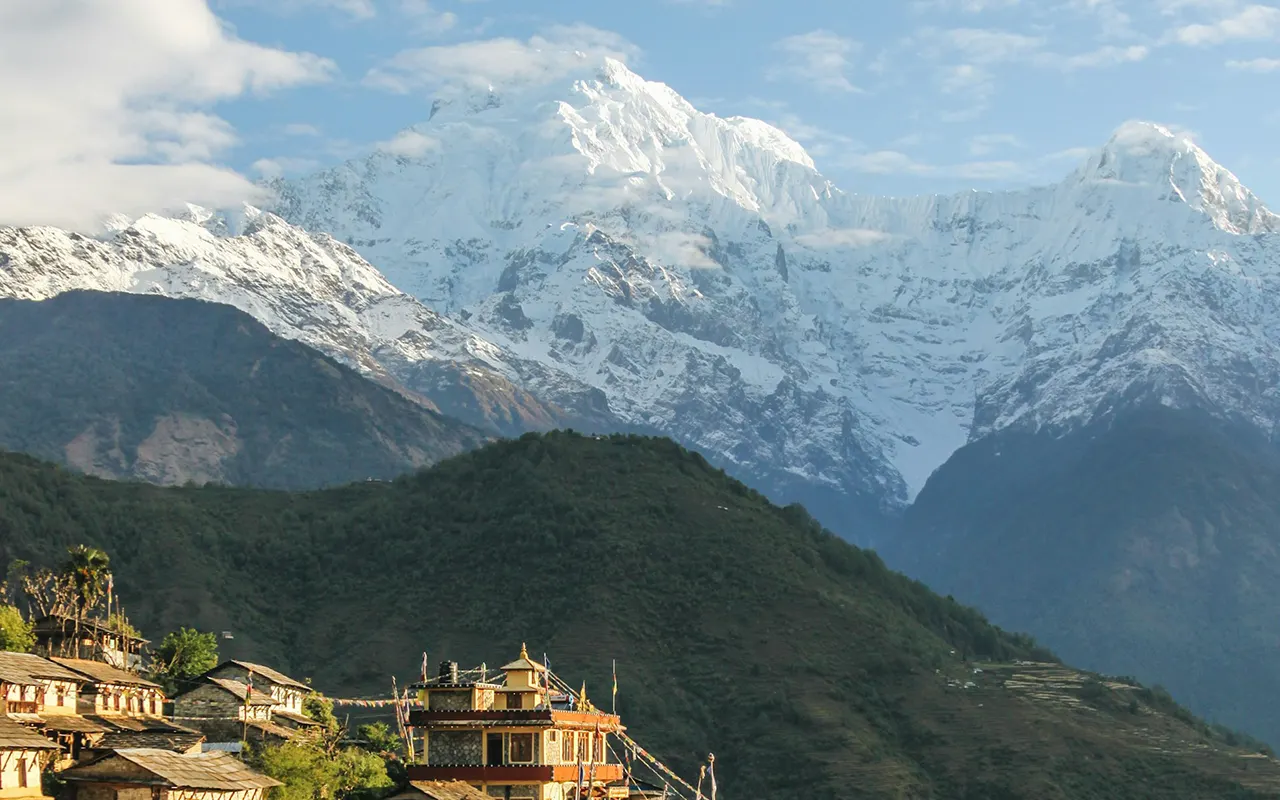
The path exposes you to different cultures of the Gurung, Magar, and other ethnic groups, as well as gives you a panoramic view of the Dhaulagiri, Annapurna I, and Machhapuchhre. In Kathmandu, you join your guide and prepare for the adventure.
There is a scenic drive leading to Pokhara and Nayapul, the place where the trail starts. The trail then follow Bhurungdi Khola across fertile valleys to Tikhedhunga, the stone staircases to rhododendron forests of Ghorepani, and Poon Hill.
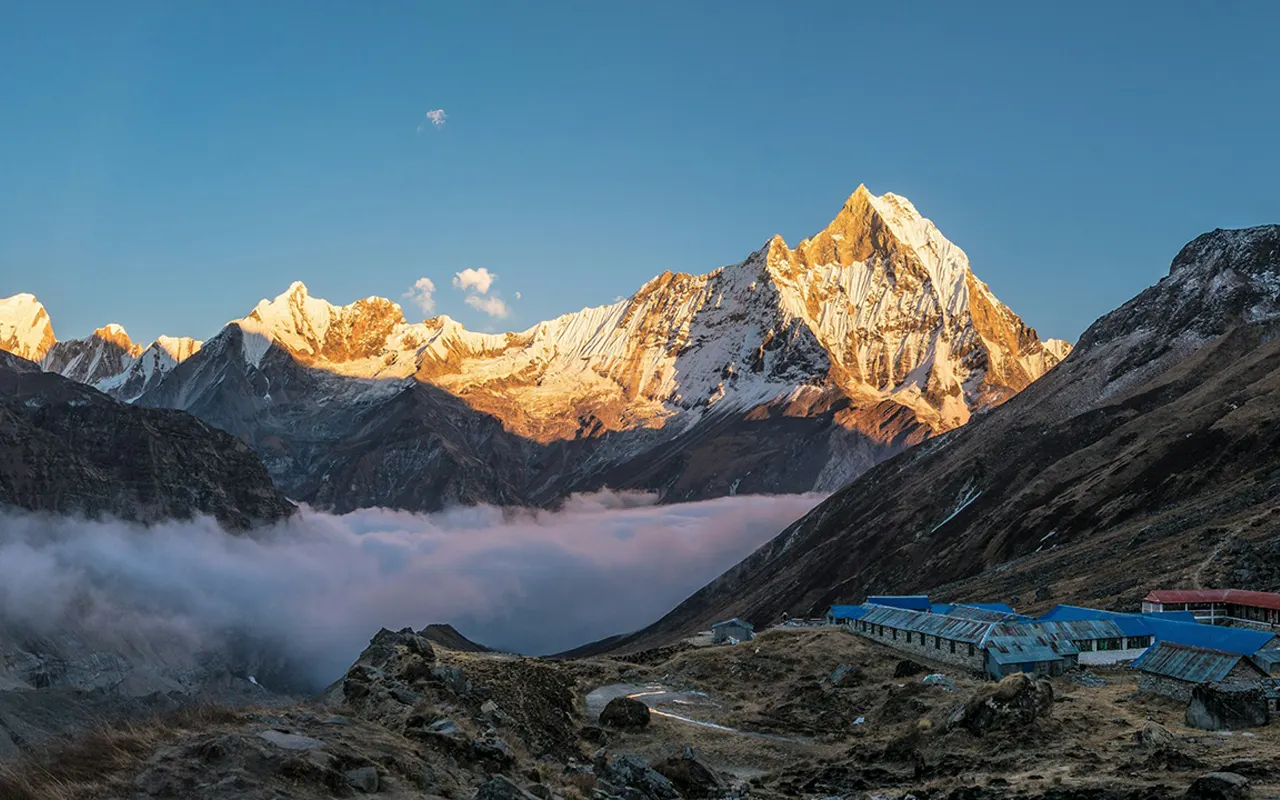
Bamboo groves and alpine meadows, as well as the spiritual stillness of the Machhapuchhre Base Camp, are some of the highlights you will encounter as you move on to the Annapurna Sanctuary. Another highlight and highest point of the Annapurna tea house trek is Annapurna Base Camp (4,130 m), a natural amphitheater encircled by towering peaks.
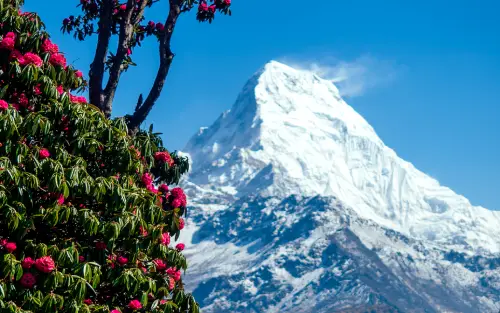
The Annapurna tea house trek is moderately difficult. So, no technical climbing ability is required, but you have to be ready to walk for 4 to 6 hours a day on up and down steep inclines. You will pass through rhododendron trees which are full flower in spring, while autumn is characterized by clear skies and golden harvest.
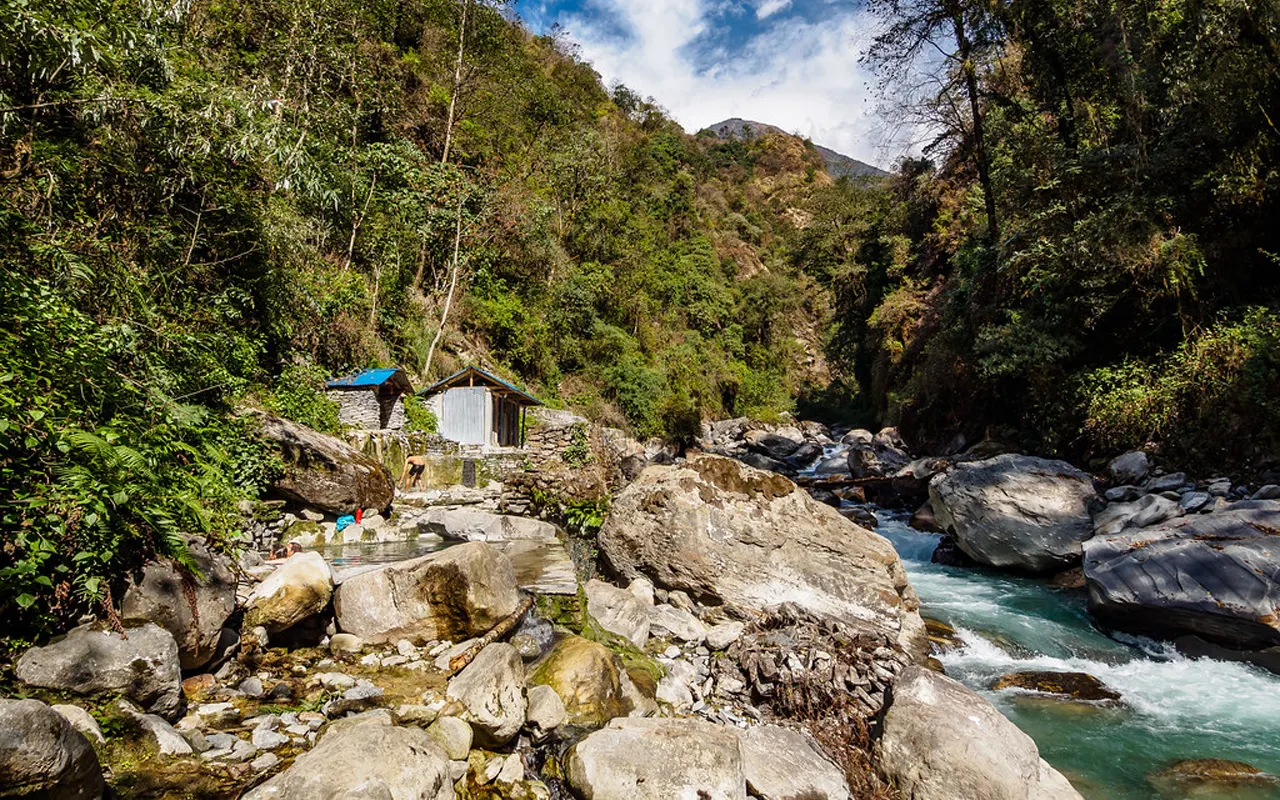
You will come back rejuvenated with natural hot springs at Jhinu Danda, and will conclude your trip back in Pokhara and Kathmandu. The Annapurna tea house trek provides amazing gateway to the Himalaya for any traveler who wants to spend time in physical well-being, cultural immersion, and inspiring scenery.
Trip Highlights
- Scenic view of Dhaulagiri and Annapurna ranges in the early
- Cozy accommodations in the traditional tea houses in Annapurna.
- Amazing views at the Annapurna Base Camp with mountains.
- Cultural encounters with Gurung and Magar villages.
- Jhinu Danda Natural Hot Springs to relax sore muscles.
- Hiking in rhododendron forests and on terraced fields.
- Lively lakeside evenings in Pokhara.
Detail Itinerary of Annapurna Tea House Trek

Day 01: Arrival in Kathmandu
Your Annapurna tea house trek starts as soon as you land at Tribhuvan International Airport. Our representative welcomes you and transfers you to a comfortable hotel in Thamel. After checking in and having some rest, you will get a briefing from our guide and see the colorful markets of Thamel. The night is free to have local food and relax before the beginning of your adventure.

Max. Altitude: 1,400m/4,593ft.

Accommodation: Hotel
Day 02: Drive to Pokhara
Leaving the busy capital in the early morning, you will move west along the Prithvi Highway. This scenic drive passes terraced fields, waterfalls, and villages clinging to hillsides.
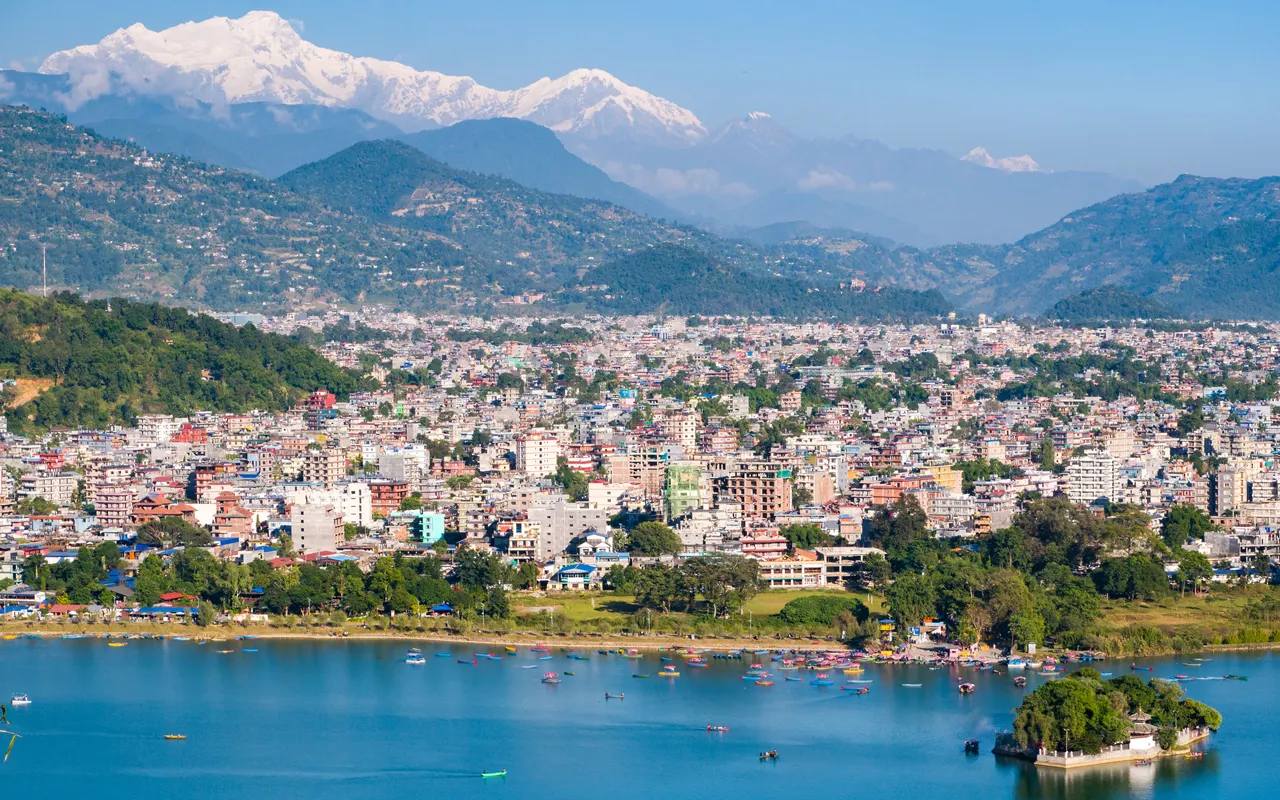
After six or seven hours, you reach lakeside Pokhara, framed by Machhapuchhre and Annapurna South. After checking into the hotel and having some rest, you will walk around the Phewa Lake and enjoy the mountain reflection at sunset. You will spend your day 2 in a hotel by the lakeside.
Max. Altitude: 827m/2,713ft. Pokhara
Accommodation: Hotel
Day 03: Drive to Nayapul & Trek to Tikhedhunga
After having breakfast, we will begin our drive approximately 1.5 hrs to Nayapul (1,070 m), the starting point of the trek. You will start your trek following the Bhurungdi Khola through Birethanti and other villages.
You can see lush rice terraces and bamboo groves line the river. Light ascends on the stone steps will land you on Tikhedhunga, where you stay the night in a tea house.
Max. Altitude: 1,540m/5,052ft. Tikhedhunga
Accommodation: Tea house
Day 04: Tikhedhunga to Ghorepani
This day of the Annapurna tea house trek begins with over 3,000 steep slate steps, which take one to Ulleri, Magar villages present at 2,050 meters. North of Ulleri, the trail goes through thick rhododendron and oak forest with birds.
You go forward passing waterfalls and trees with mosses, with a glimpse of snow-topped Annapurna South. You will reach Ghorepani, a gaily hamlet of colorful tea houses in which you will stay.
Max. Altitude: 2,860m/9,383ft. Ghorepani
Accommodation: Tea house
Day 05: Hike to Poon Hill (3,210 m) & Trek to Tadapani
You will hike early to Poon Hill to see the sunrise, holding hot tea in hand. You can see the gold light covering Dhaulagiri, Tukuche, Nilgiri, Annapurna, and Machhapuchhre.
After having breakfast at Ghorepani, you will take the forested ridges down and up to Tadapani. Endless rhododendron flowers in spring and cold mountain air are what this day of the Annapurna Tea House Trek offers.
Max. Altitude: 2,630m/8,629ft. Tadapani
Accommodation: Tea house
Day 06: Tadapani to Chhomrong
The path is steep and winds through mossy woods to a small creek, then ascends by terraced fields and Gurung villages. You will be crossing a suspension bridge and rising to Chhomrong, a well-structured village which commands a view of the Modi Khola valley in this day. Chhomrong is the entrance to the Annapurna Sanctuary in the Annapurna Tea House Trek. You will stay overnight in one of the tea houses in Chhomrong.
Max. Altitude: 2,170m/7,119ft. Chhomrong
Accommodation: Tea house
Day 07: Chhomrong to Himalaya Hotel
From Chhomrong, descend stone steps to the Chhomrong Khola, cross on a steel bridge, and climb through Sinuwa into a lush bamboo and rhododendron forest. When you pass the narrow trail, you can feel the cooler air. The cliffs are formed by waterfalls, and the jungle becomes narrower until you find the Himalaya Hotel. This segment of the Annapurna tea house trek is far-off and enigmatic.
Max. Altitude: 2,920m/9,580ft. Himalaya Hotel
Accommodation: Hotel
Day 08: Himalaya to Annapurna Base Camp
You are almost at the center of the Annapurna tea house trek. Go on up the valley beyond Hinko Cave and the avalanche-laden Deurali region. The trail climbs to Machhapuchhre Base Camp (3,700 m).
There is a gentle uphill climb to the broad open Annapurna Sanctuary. You are surrounded by an amphitheatre of giants: Annapurna I, Baraha Shikhar, Annapurna South, and Hiunchuli, to reach the Annapurna Base Camp. You will spend this night in Annapurna Base Camp.
Max. Altitude: 4,130m/13,550ft. Annapurna Base Camp
Accommodation: Camp
Day 09: Annapurna Base Camp to Bamboo
In the morning, you can see the sunrise play orange on the mountains and then walk back into the valley. Descend past Machhapuchhre Base Camp, Deurali, and the forests of Bamboo.
Even though it’s all downhill, be careful on rocky tracks. The air cools, and you fall into greenery. Tonight tea house offers another opportunity to talk with fellow trekkers and think over the Annapurna Tea House Trek at Bamboo.
Max. Altitude: 2,310m/7,579ft. Bamboo
Accommodation: Tea house
Day 10: Bamboo to Jhinu Danda
From Bamboo climb back to Sinuwa and up the familiar stone steps to Chhomrong. It is a sharp path that takes you to Jhinu Danda following lunch.
Below the village is a small road which leads to natural hot springs along the Modi Khola. A dip at these hot pools is one of the joys of the Annapurna tea house trek. During the evening, there is free time to rest and feel the flavor of the village.
Max. Altitude: 1,780m/5,840ft. Jhinu Danda
Accommodation: Tea house
Day 11: Jhinu Danda to Nayapul & Drive to Pokhara
This day, you follow the Modi Khola and walk passing rice terraces, cardamom plantations, and small hamlets. It leads into an easy downhill trail toward Nayapul, where the trekking adventure of your life finishes. There is a car that takes you back to Pokhara in time to sunset on the Phewa Lake. Celebrate your success with your dinner and a beverage in Pokhara.
Max. Altitude: 827m/2,713ft. Pokhara
Accommodation: Hotel
Day 12: Drive/Fly back to Kathmandu
You will bid farewell to Pokhara and return to Kathmandu by bus or airplane. Afternoon is free to visit some UNESCO sites or to shop for souvenirs. You and your guide have a parting dinner this day, a celebration of a successful Annapurna tea house trek at evening.
Max. Altitude: 1,400m/4,593ft. Kathmandu
Accommodation: Hotel

Note:
If you have a private group and prefer a personalized experience, we can organize a custom trip tailored to your requirements and group size, running it any day you choose.
Detail Information about Annapurna Tea House Trek
Trek Difficulty & Fitness Tips
The Annapurna tea house trek is moderate in difficulty and you will walk daily walk 3-7 hours in steep stone steps in places like Ulleri and Chhomrong. Train two months before, by walking, bike riding, or running, to improve stamina.
Strengthen legs and core with squats, lunges, and planks. Train with a loaded backpack and trekking poles because knee protection is offered by trekking poles. Take frequent breaks while walking, stretch every day, and be positive.
Acclimatization & Altitude Strategy
Altitude sickness occurs when one is at an elevation above 2,500 m, but the gradual itinerary of the trek makes the body acclimatize by spending time at the high altitude and resting at the lower altitude.
Take 3-4L of water each day, consume carbohydrates, and do not take alcohol or sleeping medications. Watch for symptoms such as headaches, nausea, or appetite loss. Rest, hydration, and consultation with guides is important during the trek.
Best season
March-May, September-November are the most suitable months of the year to go trekking as the weather is pleasant, rhododendron is in blossom, the skies are clear, and there is a clear view. In winter (December-February), there are fewer trekkers because of snow, cold nights, and icy passes.
Monsoon (June to August) is the time of lush vegetation, heavy rain, wet trails, and leeches. The seasons have their trade-offs: spring flowers, autumn clarity, winter solitude, or monsoon greenery–take your pick on how much you prefer scenery and how many are out there.
Tea Houses on Annapurna Trekking Trail
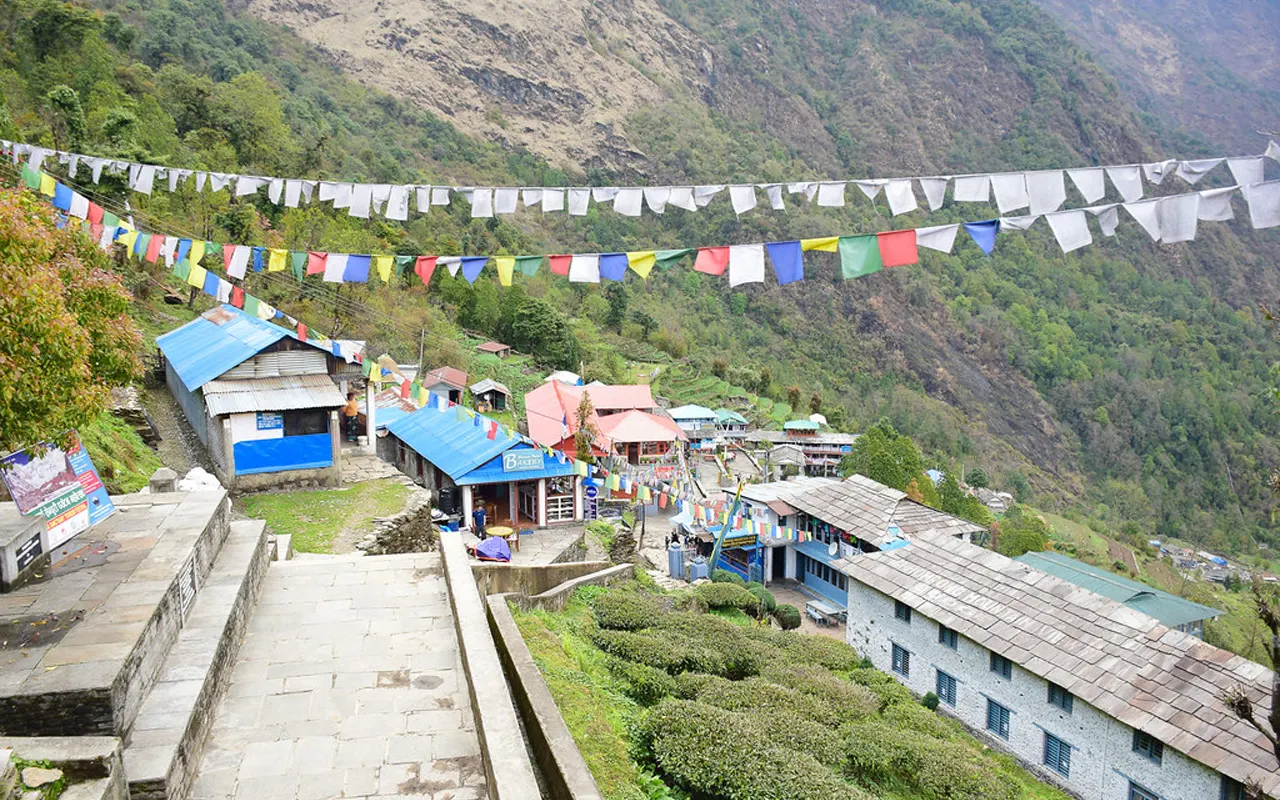
Tea houses along the trek are plain lodges which offer twin beds, a mattress, a pillow, and a blanket. Bring a sleeping bag to keep warm. You will get common shower rooms with squat or western toilets.
Diets are dal bhat, soups, noodles, pasta, and momos. You will find the majority of tea houses with communal dining, which offer you an opportunity to connect with fellow travelers and share stories. Electricity is scarce, with power chargers and patchy Wi-Fi in smaller villages.
Transportation and facilities
You will use both road travel and hiking to reach Annapurna Base Camp. A tourist bus or private car connects Kathmandu and Pokhara. A short jeep ride starts at Nayapul in Pokhara, where the trail starts.
During the journey, you walk alongside with a daypack and you have porters who carry your duffel. Snack and water shops are provided along the way. In most of the villages, mobile networks work but become weak in higher camps.
Bring cash in Nepali rupees because credit card is not accepted outside Pokhara. Tea houses provide boiled water, drinks, and basic toiletries, but you are required to carry your own sunscreen, headlamp, and personal medications.
What to expect
Expect to walk in anticipation of deep gullies, wood trails, and mountain-top rock. The daily walks go on for 5-7 hours, starting early in the morning with rests and village lunches.
The days end around 3 p.m. to relax, journal, or chat. Evening comes with good food, a fire by the hearth, and bedtime. Pack the necessary gear for variable weather and freezing. There is simplicity, nature, and local culture, which enhance the journey.
Guide and Staff
For safety and comfort, it is advisable to hire a licensed guide. Guides will helps you on permits, lodging, and meals, manage crises, and rearrange schedules as necessary.
Porters have bulky backpacks, leaving trekkers with fewer. Employing the local employees as porter increases the income of the villages. It is expected to tip 10 percent of the trek cost on guides and porters. A strong crew means a secure, fun, and educational Annapurna Tea House Trek.
Is this trip beginner-friendly?
The Annapurna tea house trek is popular among beginners because of its easy access to the Himalayas, with its most difficult point at 4,130 m, not as high as other Himalayan hikes.
Nevertheless, it requires training and equipment: durable boots, layered clothes, and a powerful backpack. Tea houses eliminate the camping requirements. Providing one is healthy and relatively in shape, this trek is a perfect way to start high-altitude trekking expeditions.
Altitude sickness
Above 3,000 m, altitude sickness may appear because of the low oxygen. Headache, dizziness, and breathlessness are mild symptoms during the trek. You can prevent altitude sickness by gradually climbing, taking water, avoiding alcohol, and with medical instruction, taking Diamox (doctor prescribed).
Life-threatening symptoms such as confusion, inability to walk, dyspnea, need for medical assistance, and rapid descent. Guides keep watch on the health of the trekkers and help evacuate them in case of deterioration of conditions, so that safety is maintained.
Gadgets charging and Internet
Solar and hydro power are sources of electricity in the Annapurna tea house trek trails. Charging your phone or camera at the dining halls costs USD 1 to 2 per device. Bring spare batteries or a power bank.
Mobile signals are effective in low-lying villages and fade away in high places. Some lodges have paid Wi-Fi, but this is often unreliable. Consider embracing a digital detox during your trek, and notify family members that they should be prepared to have less connection before climbing the isolated trails of Annapurna.
Permit Essentials & Restricted Area Rules
You must bring two permits: an ACAP (approximately USD 30) conservation, and a TIMS (approximately USD 20) trekker safety permit. Permits can be obtained through agencies or through tourism offices in Kathmandu or Pokhara.
Annapurna tea house trek does not require restricted-area permits. But it is important to keep all necessary permits with you for checkpoints. Additionally, don’t forget to follow environmental regulations: litter disposal, wildlife conservation, use existing tracks, and conserve in the Annapurna region.
Your extra expenses
Trek packages include permits, accommodation, food, transportation, and a guide/porter, but not extras, which cost USD 15 to 20 per day. Hot showers, snacks, bottled or boiled water, Wi-Fi, charging, laundry, and soft drinks are all costs.
There are ATMs in Kathmandu or Pokhara, not on the Annapurna Tea House trail, so proceed further with rupees in cash. Additional allowances, such as the cost of post-trek activities in Pokhara or Kathmandu, sightseeing, or massages, are not included in standard packages.
Photography Hotspots & Best Sunrise Views
The Annapurna tea house trek is a paradise for photographers as this trek has a number of stops, providing photography opportunities. Poon Hill has the legendary sunrise where the Himalayan peaks are gold and the valleys mist.
In Annapurna Base Camp, morning light shines on the sheer south face of Annapurna I, and on Machhapuchhre spire. You can capture a perfect shot of prayer flags, waterfalls, stone villages, and rhododendron forests. Evenings at Tadapani and Chhomrong glow with alpenglow. Ask permission to take portraits and bring extra batteries and memory cards, as the cold will drain electronics.
Wildlife & Natural Highlights
The trek goes through the biodiversity hot spots. Below the elevation, you move through terraced rice terrains, citrus orchards, and bamboo thickets. As one goes higher, there are forests of oak and rhododendron where monkeys, colorful birds such as the Himalayan monal, and barking deer can be found.
The spring has its hillsides of rhododendron. Bamboo forests that cover Sinuwa host red pandas and musk deer, and their sighting is infrequent. Beyond the tree line, there are dwarf juniper and alpine meadowlands which culminate at the glacial moraine of the Modi Khola and Annapurna Sanctuary. Jhinu Danda has natural hot springs, which offer a calming effect upon trekking.
Attractions
Annapurna tea house trek is a treasure trove of attractive places. The most outlandish is the elevated amphitheater of Annapurna Base Camp, where mountains soar at all angles.
On the way, Poon Hill rewards each trekkers with panoramic sunrise views of Dhaulagiri, Annapurna, and Machhapuchhre. Villages such as Chhomrong and Tadapani with their traditional style of buildings and hospitable people charm people.
The walk is across rhododendron wood in red and pink colour in spring and bamboo groves in full blast. The journey gives a spiritual orientation through the spiritual sites, like small gompas and prayer wheels.
Pokhara has colorful boats sailing on Phewa Lake with the snow peaks in the background. Lastly, the colorful markets of Thamel and the old temples of Kathmandu present culture in contrast to the calmness of the mountains.
Frequently Asked Questions
When is the best time for the Annapurna Tea House Trek?
The ideal time for the Annapurna tea house trek is spring (March -May) and autumn (September-November), as it has clear and mild weather.
Do I need prior trekking experience?
You don’t need technical expertise. The hike is suited to beginners able to walk for 5-7 hours a day. However, it is advisable to train in advance.
What are tea houses like?
Tea houses are rudimentary family lodges with twin share rooms, shared bathroom, meals, and a common dining area.
How high is Annapurna Base Camp?
Annapurna Base Camp sits at 4,130 meters, which is the highest point of the Annapurna Tea House Trek.
Do I need a guide?
A guide is not mandatory in the Annapurna tea house trek. Nevertheless, a guide will protect you and offer cultural insights, as well as arrange permits on your behalf.
What permits do I need?
You will require an Annapurna Conservation Area Permit (ACAP) and a TIMS card, which will be received at the Nepal Tourism Board or by your trekking agencies.
Are there ATMs on the trail?
No, ATMs are not available on the trail, but are available in Kathmandu and Pokhara. So, bring cash for extras like showers, charging, etc.
Can I charge my phone and camera?
Yes, a majority of tea houses will provide solar or micro-hydro power at a nominal fee. It is always best to carry a power bank just in case.
What should I pack?
Comfortable boots, warm and waterproof clothes, sun protection, a sleeping bag, water bottles that can be used many times, snacks, and a personal first aid kit are the most essential things to bring.
How long does the Annapurna Tea House Trek take?
This trip will be twelve days between arrival and departure and covers the days of travel between Kathmandu and Pokhara, and the days of the trek.
Reviews on Annapurna Tea House Trek
 Write a Review
- Your safety, our no 1 priority
- Best price guarantee
- Experienced & dedicated team
- Easy booking, no hidden charge
- You can customize this trip
Talk to Travel Expert Samundra Rimal (+977-9843127084)