



Everest Gokyo Lakes Trek 13 Days

Duration
13 Days

Max Altitude
5,483 m. / 17,989 ft.

Difficulty
Moderate

Group Size
5-8 Pax

Meals
- 12 Breakfast
- 10 Lunch
- 10 Dinner

Accommodation
- Lodges
- Tea House

Transportation
Car/Jeep/Plane

Activities
- Scenic Flight/Trekking

- 1 - 1 personUS$ 1430
- 2 - 4 personUS$ 1370
- 5 - 10 personUS$ 1330
- 11 over 9999 US$ 1250
Total Cost:
US$ 1430
- Your safety, our no 1 priority
- Best price guarantee
- Experienced & dedicated team
- Easy booking, no hidden charge
- You can customize this trip



Talk to Travel Expert Samundra Rimal (+977-9843127084)
Introduction of Everest Gokyo Lakes Trek 13 Days
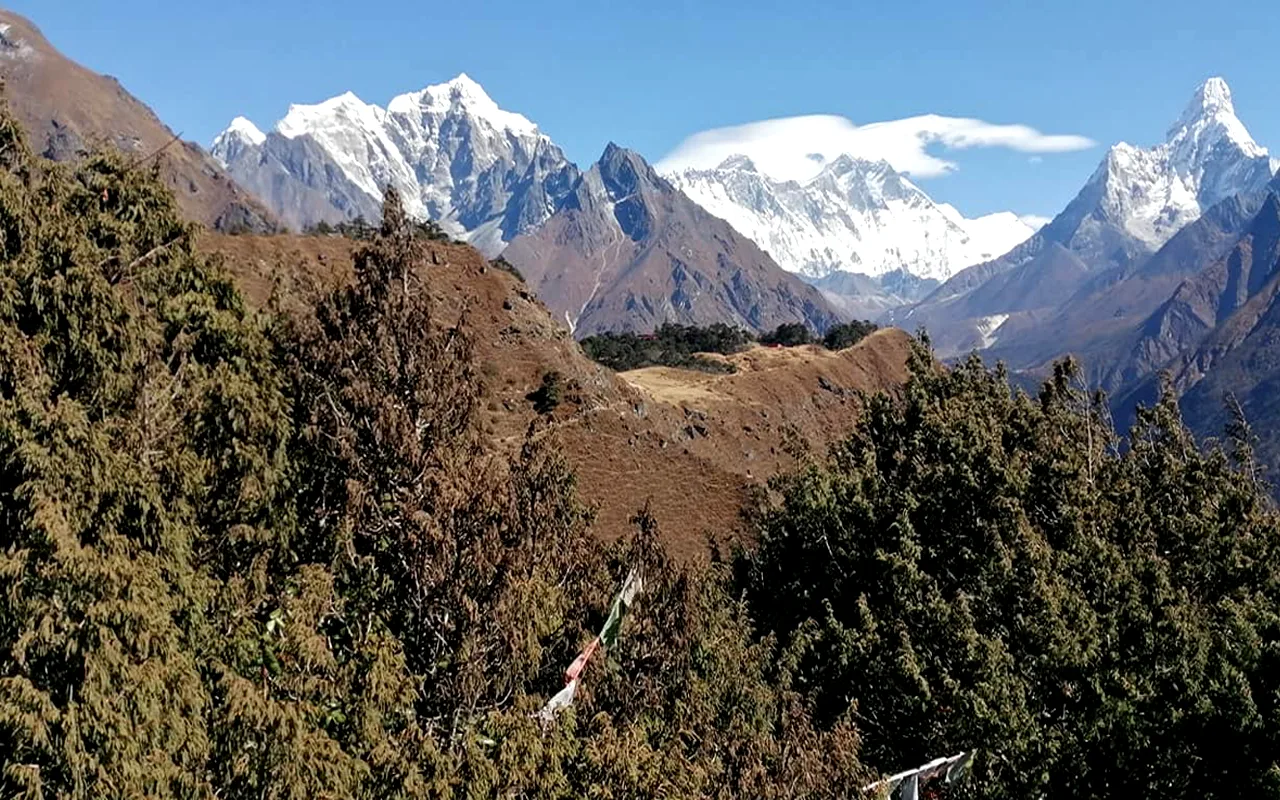
The Everest Gokyo Lakes Trekking provides visitors with spectacular mountain vistas and fascinating cultural encounters. Hikers pass through distant valleys while observing historical monasteries and admiring the captivating appearance of Gokyo Lakes’ turquoise waters. During the trekking, you will come across Everest, Cho Oyu, Nuptse, Ama Dablam, Kantega, Thamserku, Lhotse, and Makalu, some of which are the world’s tallest peaks.
The Everest Gokyo Lakes Trek begins with a thrilling flight to Lukla. Then, travelers are led through Namche Bazaar for a breathtaking walk across the Khumbu region hub. As you progress through the Dudh Koshi River, you discover Sherpa villages such as Namche Bazaar, Phortse Thanga, Machherma, Gokyo, Dole, and Khumjung together with Buddhist monuments.
Tourists choose this path instead of Everest Base Camp because it provides a quiet walking adventure.
The main difficulty of the Gokyo Lakes Trekking is reaching Gokyo Ri at 5,357 meters but the wide mountain view of Everest combined with Gokyo Lakes and Ngozumpa Glacier makes this challenge worth the effort. Other highlights include stopping for acclimatization in Namche and Gokyo to prevent the development of altitude sickness. Trekkers also interact lively with the locals and fellow trekkers.
The Everest Gokyo Lakes Trekking links an exciting outdoor experience with historical sites and magnificent landscapes. Persons who find trekking too arduous can even use a helicopter tour to experience this remarkable area at a faster pace.
Trip Highlights
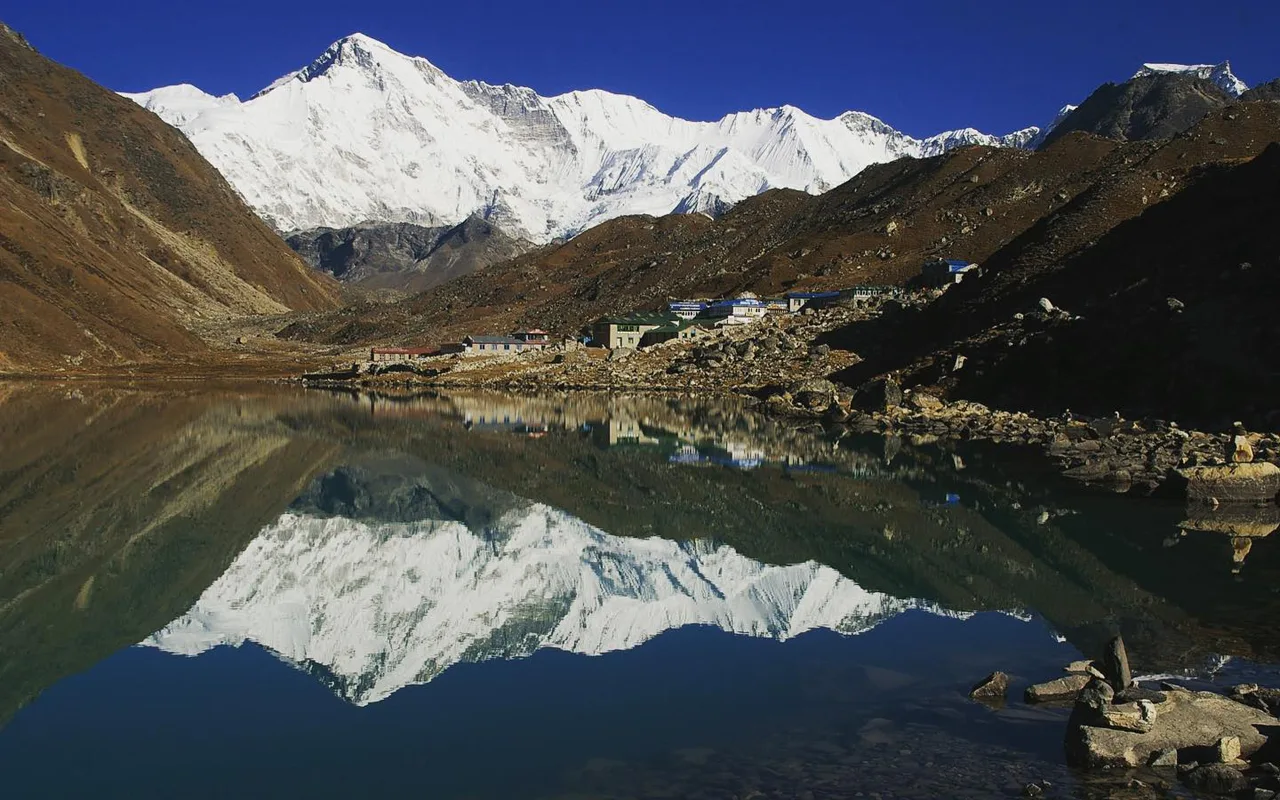
- Walk through the stunning Gokyo Lake which showcases six glacial lakes with beautiful turquoise water at high altitudes.
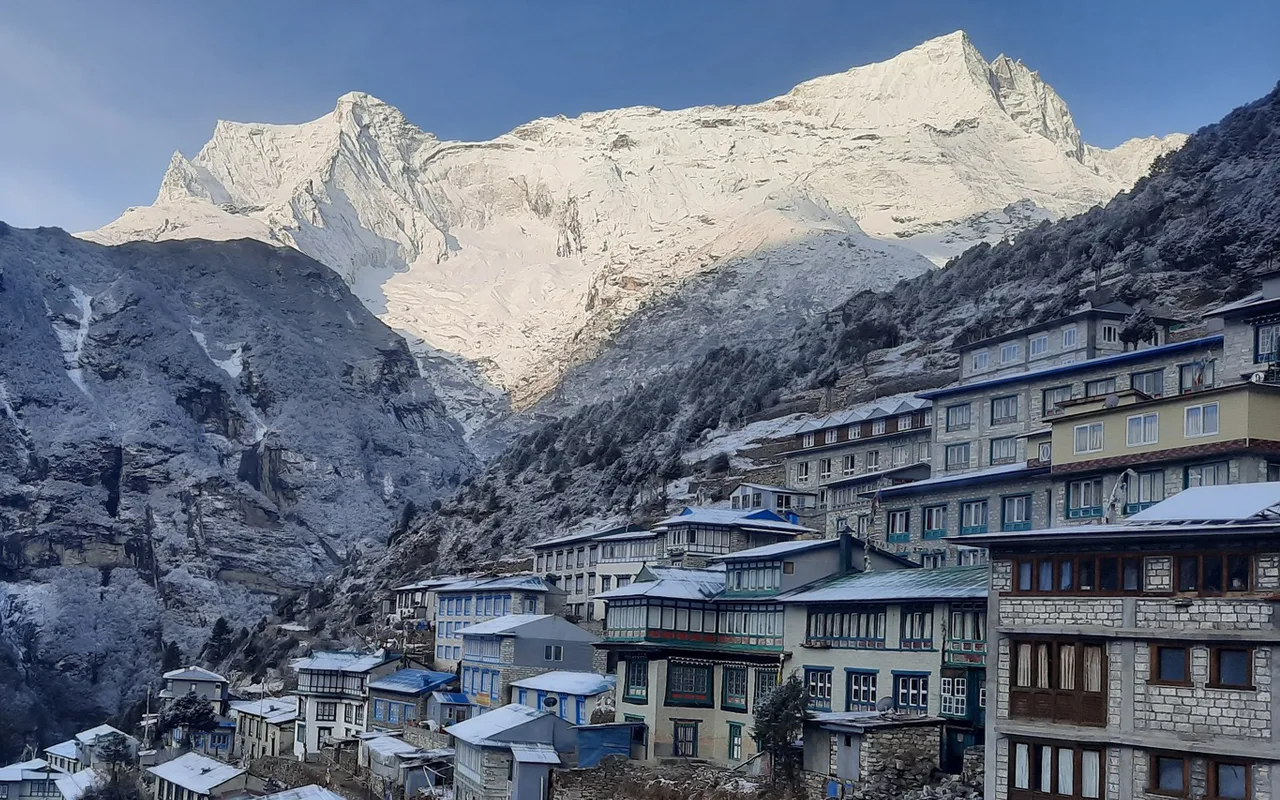
- Discover the liveliness of Sherpa culture in both Namche Bazaar and various traditional dwellings that line the trekking trail.
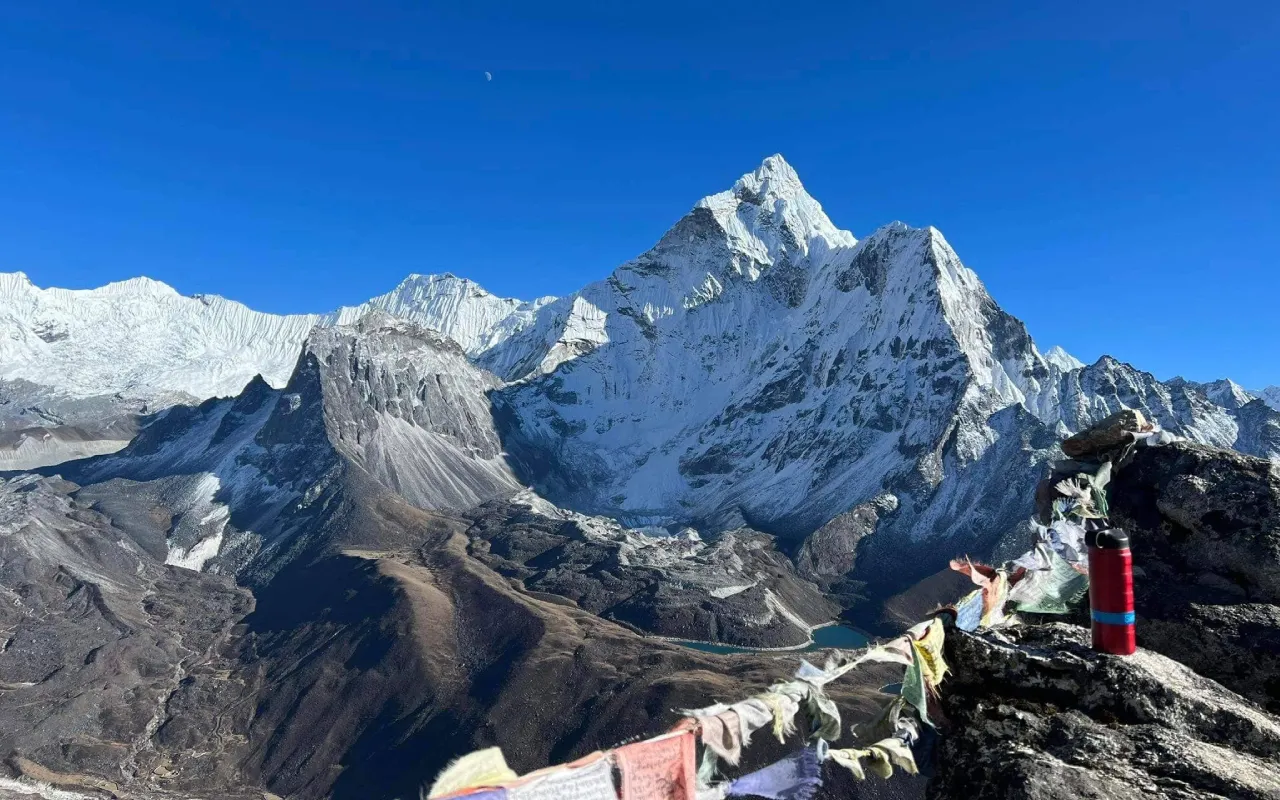
- See an incredibly broad view of Everest, Cho Oyu, Nuptse, Ama Dablam, Kantega, Thamserku, Lhotse, and Makalu from Gokyo Ri (5,357m).
- Witness a peaceful alternative to the popular Everest Base Camp trail because it provides solitude to its travelers.
- Experience stunning natural sights that include alpine valleys alongside multiple suspension bridges through mountain peaks with snow covered and forested areas.
- Chance to observe Nepal’s longest glacier Ngozumpa Glacier along its path.
- See Himalayan wildlife in this region consisting of musk deer, red panda, snow leopard, Himalayan Tahr species together with birds like Danphe pheasants.
- Explore Buddhist temples, and ancient monasteries such as Tengboche Monastery which show the reflections of Buddhist traditions alongside prayer wheels and chortens.
- If you want to experience traditional mountain life, travel to the Sherpa villages of Khunde, Namche Bazaar, Phortse Thanga, Machherma, Gokyo, Dole, and Khumjung.
- Opportunity to travel across multiple high-altitude passes where they can admire the magnificent mountain landscapes.
- Enjoy Sherpa cuisine as local folks show you their traditional guest hospitality.
- View the bright forested rhododendron lands together with multiple small waterfalls and glacial river flows.
Detail Itinerary of Everest Gokyo Lakes Trek 13 Days

Day 1: Arrive in Kathmandu (1,350m), and transfer to a hotel.
When you arrive at Tribhuvan International Airport, bothand provide transportation airport personnel and our staff will welcome you when you arrive at Tribhuvan International Airport to provide transportation that brings you to your hotel in the center of Kathmandu.
You will spend a brief period of relaxation before adapting to Kathmandu’s active atmosphere. Before checking in, you will spend time in Thamel, which offers an opportunity to experience its charming atmosphere, with shops, restaurants, and cafes lining its compact streets. You can also spend your available time exploring the UNESCO-recognized Kathmandu Durbar Square together with Swayambhunath (Monkey Temple) for the region’s history and cultural traditions.
Before starting the trek you will have the ideal setting for preparation through decisive meetings, briefs about the Everest Gokyo Lakes Trek Itinerary, and equipment assessments.

Activity: Drive For 30 Mintues

Max. Altitude: 1,324m/4,344ft. Kathmandu

Accommodation: 3 Star Hotel
Day 2: Fly to Lukla (2,860m) (or Manthali/Ramechhap), and trek to Phakding (2,610m).
After boarding the 30 to 40 minute flight in the morning, your first stop will be Lukla. Among all trekking events, the flight to Lukla’s airport stands out because it takes off from a cliff, offering breathtaking views of the Himalayan mountains.
Depending on the crowd, if Lukla is too busy, you can drive to Manthali Airport and then fly to Lukla, which is about a 15 to 20 minute flight. From Lukla,, the trail begins its first leg by following a downward slope toward Phakding through beautiful forests, passing Sherpa villages. It then crosses the Dudh Koshi River multiple times via suspension bridges.
During the hike, you will observe both typical village activities of residents and incredible mountain vistas. Once you finish your first day of trekking you will find refuge at peaceful Phakding.
Activity: Fly & Trek for 3-4 Hours
Max. Altitude: 2,610m/8,563ft. Phakding

Meal: Breakfast, Lunch, Dinner
Accommodation: Guest House
Day 3: Trek to Namche Bazaar (3,440m).
Today, our trip starts from Phakding towards Monjo at 2,835m and ends at Namche Bazaar which serves as the Sherpa capital by leading you through Sagarmatha National Park.
The path follows thick forest terrain which occasionally reveals snowy peaks on the horizon. When going toward Namche Bazaar, we need to undertake a continuous uphill walk through suspension bridge crossings and various small villages. The higher elevation reveals ever more splendid mountain views, including the distant peaks of Everest, Lhotse, Thamserku, Cho Oyu, and Nuptse.
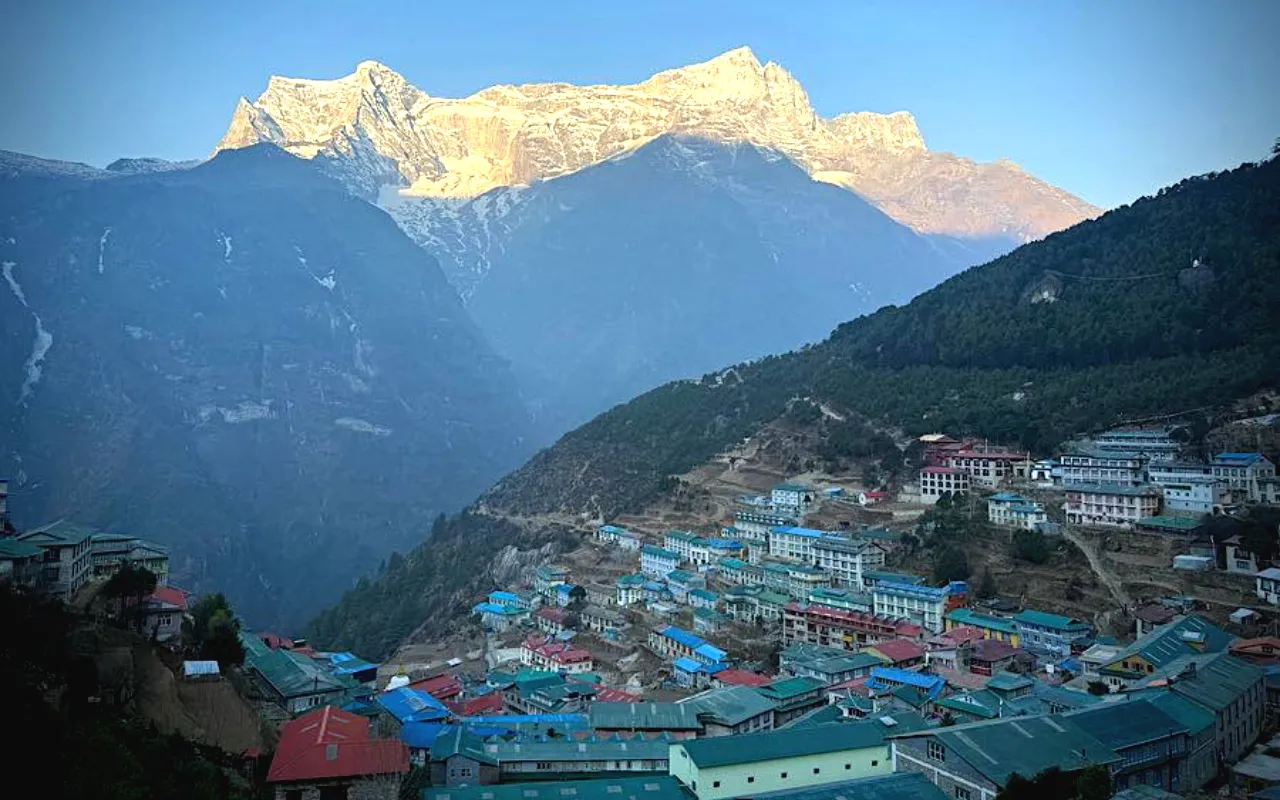
Namche is a village where traditional Tibetan heritage blends with contemporary amenities after the ascent. It features a trekking gear and a local crafts market next to multiple dining establishments.
Activity: Trekking for 4-5 Hours
Max. Altitude: 3,440m/11,286ft. Namche Bazaar
Meal: Breakfast, Lunch, Dinner
Accommodation: Guest House
Day 4: Acclimatization in Namche, hike to Everest View Hotel (3,880m).
We have our necessary step of acclimatization today that leads to trekking success and aids this process. The day starts with a relaxing breakfast, followed by a trek to the Everest View Hotel, which is among the highest hotels on the planet at 3,880m.
This quick trek allows visitors to appreciate the the Khumjung, you can visitfamous mountain views of Everest, Lhotse, and Ama Dablam. Traversing through Khumjung lets you visit both the monastery and school of this small mountain village. At the hotel, you can sip a cup of tea with a majestic view of the Everest region. In addition to exploring Namche Bazaar, visitors can visit the Sherpa Museum to study local history or spend time at neighborhood cafes before proceeding with their adventure
Activity: Hiking for 3-4 Hours
Max. Altitude: 3,880m/12,730ft. Namche
Meal: Breakfast, Lunch, Dinner
Accommodation: Guest House
Day 5: Trek to Phortse Thanga (3,680m).
Our trek on the path today ascends rapidly from the valley area until it meanders through dense rhododendron forests while the elevation grows higher. During our ascent, juniper and tall conifer trees bloom in the hills, creating one of the most picturesque views of the spring season.
We will also trek through Yak Kharkas and local settlements, allowing us to admire Khumbi La and Tawache. We arrive at Phortse Thanga, where we spend a relaxing night.
Activity: Trekking for 5-6 Hours
Max. Altitude: 3,680m/12,073ft. Phortse Thanga
Meal: Breakfast, Lunch, Dinner
Accommodation: Guest House
Day 6: Trek to Machherma (4,470m).
Today’s walk to the high altitude of Machherma from Phortse remains quite challenging. We prepare for higher elevations and pace slowly since we require time for altitude adjustment. We start our ascent before crossing a stream to climb to the hillside.
The route leads us through green pastures containing yaks and stone walls, which also feature several vacant herders’ huts. Along the ascent,, the trail follows a peaceful path that reveals stone-built huts on the mountain slope. The hike leads to additional stone huts and accommodation until we reach Luza, which is about two hours from Dole.
The path travels through Luza as it continues its ascent toward the northern basin edge and passes through more rich grazing fields with chortens and fluttering prayer flags. The location provides extraordinary views that captivate all tourists.
After a while, the trail drops into the valley, leading us across another stream. This stream leads us to the gently sloping yak pastures, and we finally reach Machhermo, where we will stop for the night.
Activity: Trekking for 5-6 Hours
Max. Altitude: 4,470m/14,665ft. Machherma
Meal: Breakfast, Lunch, Dinner
Accommodation: Guest House
Day 7: Trek to Gokyo (4,790m).
The expedition spans expansive fields, followed by tight crevices, and then ascends through difficult slopes. We witness the ablation valley, formed from glacier ice melt, bordering the Ngozumpa Glacier, which leads to several lakes.
Hikers walking along this trail can see Cho Oyu because it passes easily on top of the hillside. We are about to encounter another Kharka that has basic lodges available. The terminal moraine consisting of a rock ridge serves as an indicator for the Ngozumpa Glacier terminus.
The route descends briefly and then rises through the ablation valley that runs alongside the western glacier side. The path includes stone staircases and a wooden bridge to cross a stream. The cairns lead us through the rocky terrain, and a small tarn is on our left side.
The trail expands into the wider Taboche Tsho tarn, after which it narrows until reaching the third tarn, Dudh Pokhari. During the Janai Purnima festival, which occurs in July or August, this place becomes one of the most attractive sights. We will stay at Gokyo overnight after crossing past Dudh Pokhari which boasts relaxed natural surroundings.
Activity: Trekking for 5-6 Hours
Max. Altitude: 4,790m/15,715ft. Gokyo
Meal: Breakfast, Lunch, Dinner
Accommodation: Guest House
Day 8: Hike to Gokyo Ri (5,357m), return to Gokyo.
Our main highlight of the Everest Gokyo Lakes Trek is today, taking us on a steep yet outstanding expedition to Gokyo Ri as we start our hike very early in the morning. The path continues to slope steeply uphill,5,357 meters and providing extraordinary views along the entire ascent route. We reach the peak at a height of 5,357 meters to encounter a stunning view of the surroundings.
The vast wide views include Everest peaks, Thamserku, Kantega, and Ama Dablam which rise beside Nuptse, Makalu, Cho Oyu, and Gyachung Kang all together presenting a breathtaking horizon. Below, we find the wonderful Gokyo Valley and Ngozumpa Glacier with turquoise lakes to complete the enchanting view. Through its placement of prayer flags and cairns, the summit provides people with peaceful opportunities to observe this high-elevation attraction.
We head back to Gokyo for breakfast feeling amazed by the powerful mountain scenery that we just witnessed. Trekkers can spend the remaining time of the day resting and recollecting while making arrangements to return to Machhermo.
Activity: Trekking for 4-5 Hours
Max. Altitude: 5,357m/17,575ft. Gokyo
Meal: Breakfast, Lunch, Dinner
Accommodation: Guest House
Day 9: Trek to Dole (4,040m).
The trip brings us downward from Gokyo while we take the trail that showcases the spectacular Gokyo Valley. Along the mixed elevation route, visitors can spot Himalayan pheasants, musk deer,and Himalayan Tahrs together with other wildlife species. The Himalayan peaks slowly seem more like distant shadows as we make our way back to the start.
The route leads to Gokyo Valley in Sansa and gradually rises through forested areas filled with rhododendrons. As we proceed we will witness Mt. Cho Oyu which dominates the valley with its position at the forefront. After entering the woodlands we will climb uphill while crossing streams and yak pastures to finally reach the idyllic settlement of Dole. The yak pasture evolved into Dole by acquiring several herders’ huts which it now operates as lodges. We will spend the night in a guesthouse absorbing the rest and getting ready for our upcoming exploration.
Activity: Trekking for 6-7 Hours
Max. Altitude: 4,040m/13,255ft. Dole
Meal: Breakfast, Lunch, Dinner
Accommodation: Guest House
Day 10: Trek to Namche via Khumjung (3,790m).
The hike starts from Dole and moves back toward Namche Bazaar. The hike leads down a gentle slope that takes us through stunning alpine grasslands and multiple flowing streams. Khumjung reveals itself as a Sherpa village famous for its historical significance while presenting its customary stone buildings which face the great Himalayan range.
Visitors to Khumjung can view the preserved Yeti scalp at Khumjung Monastery while learning about Sherpa traditions. We will make a quick exploration stop before the trail leads us downhill through juniper and rhododendron growths.
Activity: Trekking for 5-6 Hours
Max. Altitude: 3,790m/12,434ft. Namche
Meal: Breakfast, Lunch, Dinner
Accommodation: Guest House
Day 11: Trek to Lukla (2,860m).
Today marks the near end of hiking our Gokyo Lake Trekking, which terminates in Namche Bazaar. Today we will stop at this location for one more night at the tea house before starting our return trip.
From Namche,, you will move backwards to start your descent towards Lukla. At this point, the trail presents familiar views that allow you to witness the Himalayan range one last time. After completing this amazing adventure, you will stay in Lukla to rest before reviewing ayour accomplishments
Activity: Trekking for 6-7 Hours
Max. Altitude: 2,860m/9,383ft. Lukla
Meal: Breakfast, Lunch, Dinner
Accommodation: Guest House
Day 12: Fly to Kathmandu (1,350m), and drive back to Kathmandu
You will depart Lukla early to make your way back to Kathmandu. Reaching Kathmandu, you can choose to either rest or spend your remaining hours of the day discovering the lively atmosphere of Thamel. Spend your free time relaxing with spa treatments to unwind after completing your trek. A visit to Swayambhunath Stupa (Monkey Temple) offers breathtaking city views and peaceful surroundings.
The UNESCO World Heritage Pashupatinath Temple permits visitors to experience spiritual moments while viewing ceremonies that occur along the Bagmati River. Finally, you return to your evening at the hotel for a traditional Nepali meal and rest up.
Activity: Fly & Drive for 3-4 Hours
Max. Altitude: 1,324m/4,344ft. Kathmandu
Meal: Breakfast
Accommodation: 3 Star Hotel
Day 13: Departure from Kathmandu.
Thamel offers last-minute shopping opportunities for souvenirs during your last day in Kathmandu. The adventure deserves memorable mementos that you can find in Thamel through local handicrafts with clothing and artistic pieces.
Depending on your flight time, you can explore attractions near the city before enjoying a farewell dinner in Kathmandu. We transport you to Tribhuvan International Airport from where you will depart Nepal behind you.
This marks the official end of your Everest Gokyo Lakes Trekking in Nepal, we hope to see you for further treks here.
Meal: Breakfast
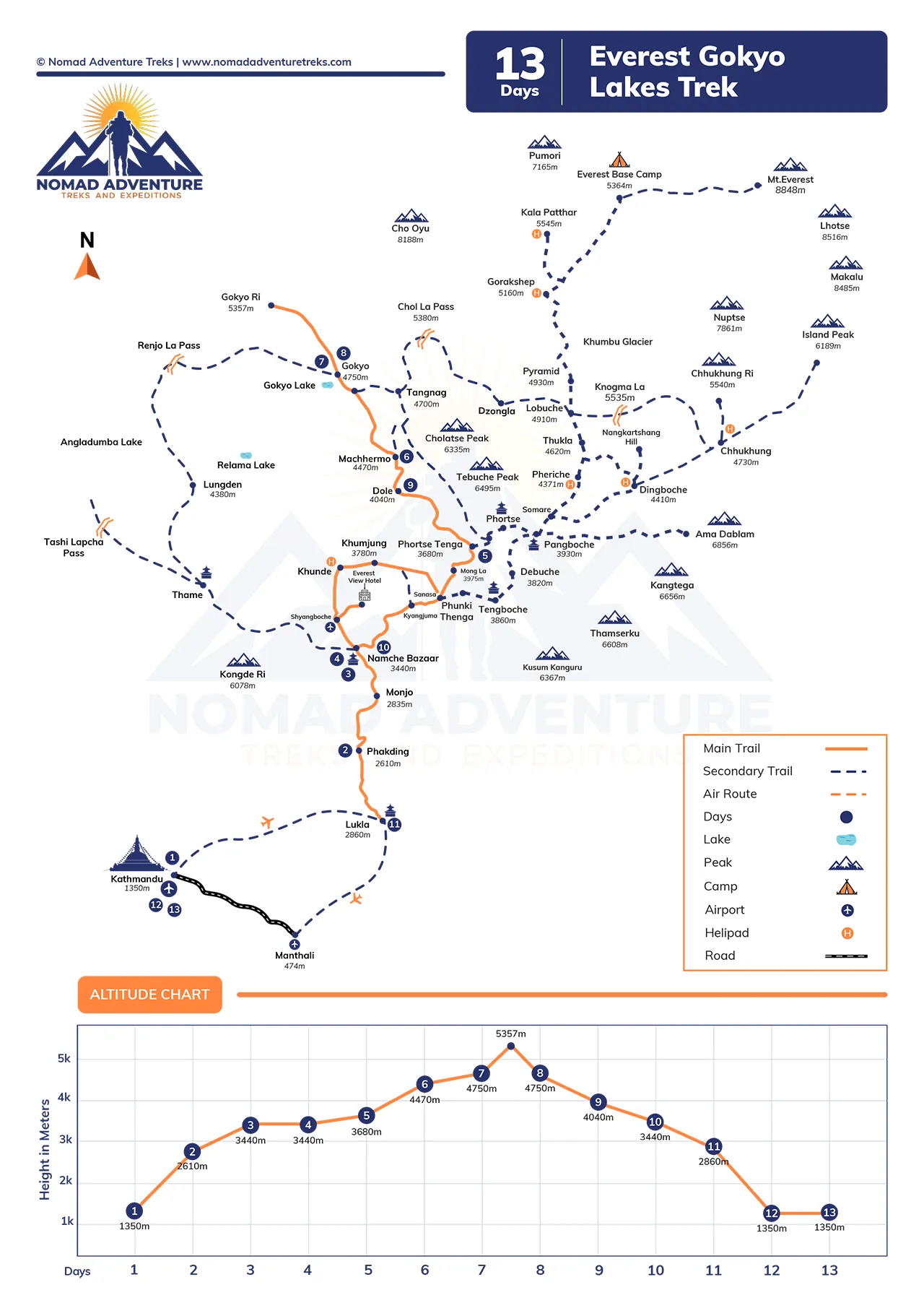
Trip Route Map
Includes & Excludes
What are included with package?
Accommodation
- Twin-sharing/double accommodation in a 3-star hotel for 2 nights in Kathmandu including breakfast (Private room accommodation can be organized at an extra cost)
- Twin-sharing guesthouse accommodation during the trek for 10 nights in the Everest Region with attached toilets in Lukla, Phakding & Namche
Meals & Drinking Water
- All your standard meals during the trek 3 meals a day (Breakfast, Lunch & Dinner) in a guest houses
- A farewell dinner on the last night in Nepal
- Purified drinking water during the trek using Water Filter or water purification tablets..
Transportation
- All (international and domestic) airport transfers on a tourist vehicle
- Round-trip airfare between Kathmandu/Manthali and Lukla
- Kathmandu – Manthali – Kathmandu transportation by shared tourist vehicle
Guide and Staff
- Experienced, first-aid trained, government licensed, English speaking, and locally recruited Nomad Adventure’s trekking guide (2 guides for group size more than 7 people)
- Porters during the trek for carrying luggage (1 porter for every 2 clients)
- Wages, accommodation, meals, gear, insurance and medications for all staff
Medical Assistance
- Assistance in arranging rescue operations in case of complicated health conditions (funded by travel insurance)
- Medical kits, including an oximeter to monitor blood oxygen saturation levels in high altitudes
Permits
- Sagarmatha (Everest) National Park Permit
- Pasang Lhamu Rural Municipality fee
- TIMS (Trekkers’ Information Management System) card
Benefits and Takeaways
- Sleeping bags and down jackets, duffle bag (one for every two trekkers) if you do not have your own
- company’s T-shirt & Cap
- Trip completion certificate
Administrative & Taxes
- All administrative expenses and government taxes
What are not included with package?
Price Excludes
- Lunch and dinner in Kathmandu
- International flight fare and airport departure tax
- Nepal Entry Visa (Visa can be acquired easily after your arrival at Tribhuvan International Airport in Kathmandu with a fee of USD 30 for 15 days visa, USD 50 for 30 days visa and USD 125 for 90 days visa)
- Guided tour in Kathmandu (Private car + tour Guide), Monument entrance fees while sightseeing in Kathmandu
- Extra night accommodations in Kathmandu due to early arrival or late departure, early return from the trek or other itinerary changes
- Travel insurance along with high-altitude emergency evacuation coverage
- Medical check-ups, vaccinations, or medications required for the trek are not included.
- Any beverages including bottled and boiled water
- Tips to trekking staff and driver
- Personal trekking gear and equipment
- Any expenses other than the Price Include section
- Personal expenses (shopping, snacks, boiled bottle water, hot (Tea/ Coffee) and cold drinks, hot shower, alcohol, Wi-Fi, telephone call, battery re-charge fee, extra porters, etc
- Personal clothing and gear

Note:
If you have a private group and prefer a personalized experience, we can organize a custom trip tailored to your requirements and group size, running it any day you choose.
Detail Information about Everest Gokyo Lakes Trek 13 Days
Everest Gokyo Lakes Trek Difficulty
The Everest Gokyo Lakes Trek difficulty is marked as moderate but trekkers need to have basic physical fitness requirements. The trek includes rough terrain steep elevation changes and rocky path features that require lots of stamina. The hike requires daily walks lasting between 5 to 6 hours and altitude reaching the peak at 5,360 meters on Gokyo Ri peak.
Altitude sickness risks become more severe when one reaches this location because the thin atmosphere promotes symptoms including headaches and nausea. Trips to Gokyo during off-season months become harder because of unpredictable weather that brings cold temperatures combined with occasional snowfall.
Long ascents combined with descents make remote glacier and valley regions difficult to traverse throughout the route, even though tourists must put in extra work. The Gokyo Lakes Trekking takes 13 to 14 days, and on average, each day requires trekking 10 kilometers. The available accommodations are only teahouses that lack luxurious comfort due to limited facilities and shared rooms. Trekking safely and happily depends on routine sleep proper adaptation and fluid consumption for your body.
Best Season for Everest Gokyo Lakes Trekking
Autumn (September to November) and Spring (March to May) represent the prime times for Everest Gokyo Lakes Trekking.
The climate of spring in this destination offers moderate temperatures alongside enchanting scenery because flowering plants decorate the trails. Because of its popularity, autumn creates beautiful landscapes yet makes the trails slightly more crowded. It brings refreshing air combined with stunning mountain vistas, which hikers can enjoy.
During this time frame, the atmospheric conditions tend to be unclouded, providing dreamlike views of the neighboring mountain summits. Trekkers will find the temperature easy to handle during this season while walking on the trails. Autumn offers trekking visitors a more blissful experience because it draws fewer tourists than spring. Pleasant trekking conditions exist simultaneously in spring and autumn in the Everest Gokyo Lakes Trekking, making these times ideally suitable for this adventure.
Permits Required for Gokyo Lake Trekking
The Sagarmatha National Park Permit and the Khumbu Pasang Lhamu Rural Municipality Permit are the essential permits required to complete the Everest Gokyo Lakes Trekking. The Sagarmatha National Park Permit functions as a mandatory entry authorization for the Sagarmatha National Park which features Mount Everest among its attractions.
The cost for this permit is set at $30 for visitors from outside Nepal. To walk in the Khumbu region the visitor needs to obtain approval from Khumbu Pasang Lhamu Rural Municipality. The permit which costs $20 for international visitors is accessible from Lukla which serves as the starting point for most Everest treks. The authorized permit contributes indirectly to the development of local communities within this geographical region.
Trekking permits at Mount Everest offer affordable accessibility for anyone to get them through various offices and points of entry. You must show your passport alongside the required payment at these specified offices. You can obtain the Sagarmatha National Park Permit from the Nepal Tourism Board office at Kathmandu, and the Khumbu Pasang Lhamu Rural Municipality Entry Permit from checkpoints at Lukla or Monjo. To avoid such hassle and have peace of mind instead, you can choose our package which includes the permits within.
Weather and Temperature in the Gokyo Lakes Trek Route
The Gokyo Lake Trek route faces unexpected weather conditions because its path passes through regions with different altitudes and geographical characteristics. Trekking finds its perfect period during the spring months of March to May along with the autumn months of September to November when weather conditions provide clear skies. Temperatures in Namche Bazaar and other lower elevations reach levels between 10°C and 15°C throughout daytime hours but nighttime brings temperatures from 0°C to -5°C. When climbing towards Gokyo Ri (5,357 meters), nighttime temperatures drop below -10°C even though daytime, and at Namche Bazaar range between 10°C and 15°C.
During winter, from December through February, temperatures frequently drop to freezing levels, with severe nighttime chills. Snow is frequent, and the pathway becomes more difficult to traverse. After December 15, temperatures can drop below -15 °C, and chances of snow storms and avalanches increase. In monsoon (June to August), visitors face the warmest of temperatures, from 20°C to 30°C, making it difficult and exhausting. Also, the lower regions can be muddy and slippery, with possible swap of leeches that make the trek quite uncomfortable too.
Physical Fitness Required for the Gokyo Lake Trek Route
As the Gokyo Lakes Trek difficulty is marked as moderate, physical fitness isn’t that extreme to achieve. Traversing through rough grounds requires you to walk for extended periods of approximately 5 to 6 hours a day.
Travelers will face tough physical requirements during their hikes between steep elevation changes on these trails. People need excellent stamina to work through the demanding challenges that exist primarily at elevated locations. A successful Gokyo Lakes Trekking requires people to start by building endurance through cardio activities that include running hiking or cycling. Your physical strength in legs, core, and upper body through exercises will make steep terrain easier to tackle.
You have to engage in the exercises 2 to 3 months before the actual trek and stimulate the trekking condition by wearing a weighted backpack while going uphill. The trek demands endurance because its high altitude conditions combine with uncertain weather factors although the terrain lacks complex climbing areas.
Your success in reaching the destination requires proper acclimatization to avoid altitude sickness together with hydration and rest. The combination of fitness together with proper preparation along with strong determination enables you to benefit from this mind-blowing undertaking.
Altitude Sickness on the Everest Gokyo Lakes Trekking
People who participate in the Everest Gokyo Lakes Trekking need to be mindful of altitude sickness because they will hike at elevations between 3,500 meters and 5,360 meters when climbing Gokyo Ri.
Rising to higher elevations causes both reduced air pressure and oxygen amount which creates difficulties for breathing. High altitude sickness produces several symptoms such as headache along with nausea which leads to dizziness and intense fatigue. Preventing altitude sickness requires slow altitude ascents, which allow the body to adapt properly. The trek schedule incorporates rest periods that help lower the susceptibility to sickness.
While hiking at a normal pace, water consumption should be high, and alcohol avoidance is essential. People should rest when their ailments onset, and descending to a lower elevation might be necessary for recovery.
Most trekking participants experience mild symptoms, although few individuals can persist with this condition. Severe forms of altitude sickness, including HACE and HAPE, pose a threat to life. You need to monitor your body’s signals, inform the guide if you feel uncomfortable, and seek medical assistance if your symptoms worsen.
Accommodation and Meals on the Everest Gokyo Lakes Trekking
During the Everest Gokyo Lakes Trekking, basic yet comfortable accommodations are available. Teahouses provide rooms with twin beds and blankets for each bed. All teahouses offer communal toilets, but access to hot showers and Wi-Fi can cost extra.
Visitors at the teahouses can join one another for social meals at communal dining rooms that enhance group connections. The food offered on the trail consists of large portions designed to power your trekking activities. The typical Nepali dish, dal bhat, is a nourishing combination of lentils, rice, and vegetables.
Tibetan food includes momo (dumplings) and noodle soup. The menu also includes Western meals such as pizza, pasta dishes, and simple sandwiches.
The teahouses include basic breakfast options which include porridge, pancakes as well as eggs. Most trekkers choose either fried rice or noodles as their preferred choice. The meals served during the trek consist of basic yet nutritious foods that provide excellent fuel for ascending into higher elevations.
Cultural Highlights on the Gokyo Lakes Trek Route
On the Gokyo Lake Treks Route, trekkers can explore Sherpa culture through its lively traditions. The trek leads adventurers to Namche Bazaar and Gokyo traditional Sherpa communities, where tourists can view the local population performing their daily activities and attending social events.
These villages showcase architectural designs that depict mountain survival approaches through the utilizations of stone and wood to construct houses that prevent damage from severe weather conditions.
Everest Gokyo Lakes Trekking allows visitors to witness Buddhist monks conducting rituals while they spin prayer wheels and meditate. The spiritual heart of this region exists in these monasteries, which become stronger due to the fluttering prayer flags that express deep religious connections.
Traditional Sherpa food encompasses typical dishes that consist of yak meat as well as butter tea and momos. Gokyo Lake appears sacred to the Sherpa people because they consider it one of their spiritual places.
People regard Gokyo Lake as purifying and utilize it for prayer and contemplation. Local religious worship in the peaceful surroundings allows Gokyo Lake Trekking to become a deeply spiritual experience.
When your trek falls on the dates of, you can observe both local festivals. Each festival offers both Buddha Jayanti and Lhosar (Tibetan New Year) local festivals when your trek happens to fall on their dates. The festival grants unique celebrations and Sherpa cultural insights, which you can gain through communal participation.
Why Everest Gokyo Lakes Trek?
The Everest Gokyo Lakes Trek involves multiple exciting aspects, including thrilling adventures and cultural interactions against outstanding scenery.
The trek enables visitors to tour the Gokyo Lakes, which consist of turquoise high-altitude waters and adjacent peaks such as Everest, Lhotse, Kantega, Thamserku, Makalu, Ama Dablam, and Cho Oyu. Gokyo Lake Trekking presents an alternative to Everest Base Camp, which offers visitors calmer conditions due to fewer people and more peaceful environments. On the route, you can visit Namche Bazaar which presents an opportunity to understand the diverse local Sherpa heritage.
Climbing to Gokyo Ri reveals breathtaking vistas of the mountains and the famous Ngozumpa Glacier so the effort you make is completely worthwhile. During the trek, you gain not only the mesmerizing beauty but also the high-altitude experience which builds your physical strength and creates lasting life memories.
Everest Gokyo Lake Trekking emerges as a prime destination because it offers breathtaking scenery, cultural discovery, and satisfying triumph to adventure seekers who are focused on natural charm.
Frequently Asked Questions
What is the typical duration of the Everest Gokyo Lakes Trek Itinerary?
The complete walkthrough Gokyo Lake reaches Gokyo Ri. It involves visiting high-altitude bodies of water and takes an average of 13 to 15 Days to complete the Trip around the the Everest region.
What is the Gokyo Lakes Trek Difficulty?
The Gokyo Lakes Trekking is considered moderate difficulty to experienced hikers because it demands extensive walking hours across challenging mountainous terrain, including steep terrain.
Prior exercise training and proper physical conditioning enable individuals to handle the challenging nature of the trek.
Do I need prior trekking experience for the Gokyo Lakes Trekking?
Although unnecessary for Gokyo Lakes Trekking, having a trekking experience enhances endurance and adaptability to high-altitude conditions. A crucial step in success involves regular hiking, strengthening, and cardiovascular exercises before undertaking the trek.
How can I prevent altitude sickness during the Gokyo Lake Trekking?
The prevention of altitude sickness involves a slow ascent pattern, sufficient rest days, adequate water consumption, and avoidance of alcohol. The key to success during the trek depends on consuming healthy meals at a comfortable speed combined with adequate rest. Trekkers who consult their doctor can take Diamox as an additional method for altitude adjustment.
Are there any acclimatization days in the Gokyo Lakes Trek itinerary?
The trek features complete restful days in Namche Bazaar at 3,440 meters and Gokyo at 4,750 meters where your body gains altitude adjustability. Trekkers perform brief hikes to elevation heights yet sleep at lower altitudes throughout these days as a preventive measure against altitude sickness.
Reviews on Everest Gokyo Lakes Trek 13 Days
 Write a Review
- 1 - 1 personUS$ 1430
- 2 - 4 personUS$ 1370
- 5 - 10 personUS$ 1330
- 11 over 9999 US$ 1250
Total Cost:
US$ 1430
- Your safety, our no 1 priority
- Best price guarantee
- Experienced & dedicated team
- Easy booking, no hidden charge
- You can customize this trip
Talk to Travel Expert Samundra Rimal (+977-9843127084)
Related trips you may like