



Luxury Mera Peak Climbing with Heli Return

Duration
13 Days

Max Altitude
6,461 m. / 21,198 ft.

Difficulty
Moderate

Group Size
2-20 Pax

Meals
- 12 Breakfast
- 10 Lunch
- 11 Dinner

Accommodation
- Hotel
- Lodge
- Tent

Transportation
Private Vehicle, Flight

Activities
- Trekking
- Sightseeing
- Climbing

- Your safety, our no 1 priority
- Best price guarantee
- Experienced & dedicated team
- Easy booking, no hidden charge
- You can customize this trip



Talk to Travel Expert
Samundra Rimal (+977-9843127084)
Introduction of Luxury Mera Peak Climbing with Heli Return
The journey begins in Kathmandu with a private airport transfer, trip briefing and preparation for the climb. Once you verify your gear, you fly together to Lukla, bypassing the road & flight route that is usually required for the approach. The trail from Lukla passes through the villages of Paiya, Panggom, Ningsow, Chhatra Khola and Kothe before reaching the higher Hinku Valley.
The path gradually ascends through forest, open fields and snow-covered areas. Overnight stay at Thangnag with a continuation on to Khare (5045 m / 16552 ft). This is the option that gradually ascends to Mera Peak and the surrounding mountains while enjoying a scenic ride.
The next day on Khare is acclimatisation and climbing training. Your climbing guide will teach you how to use equipment like crampons, ice axe, harness and climbing rope. A brief walk up to a higher spot close to Mera Base Camp also helps acclimatize you to the higher elevations that lie ahead.
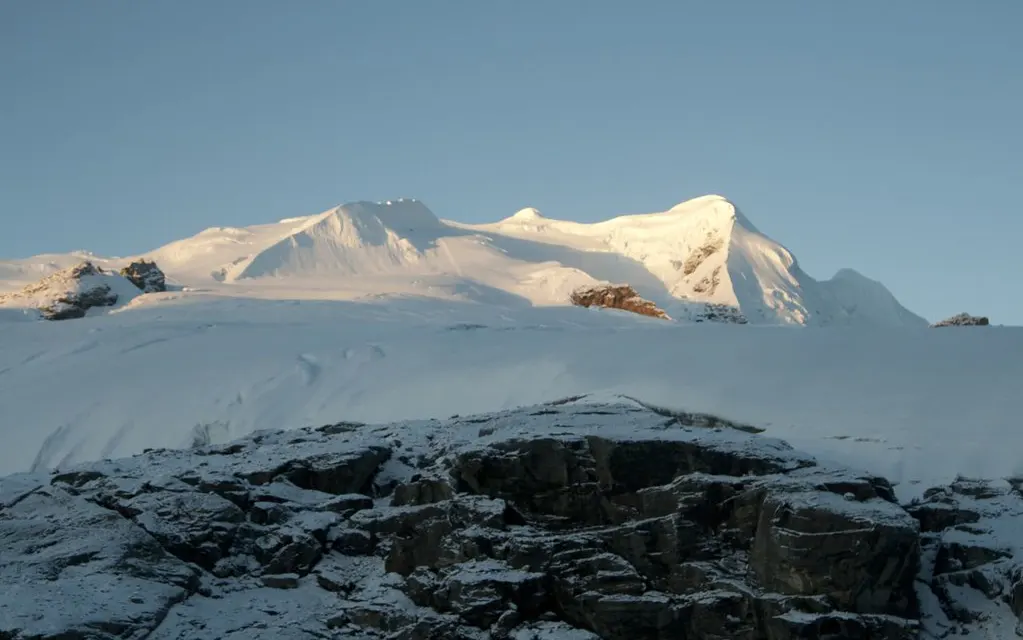
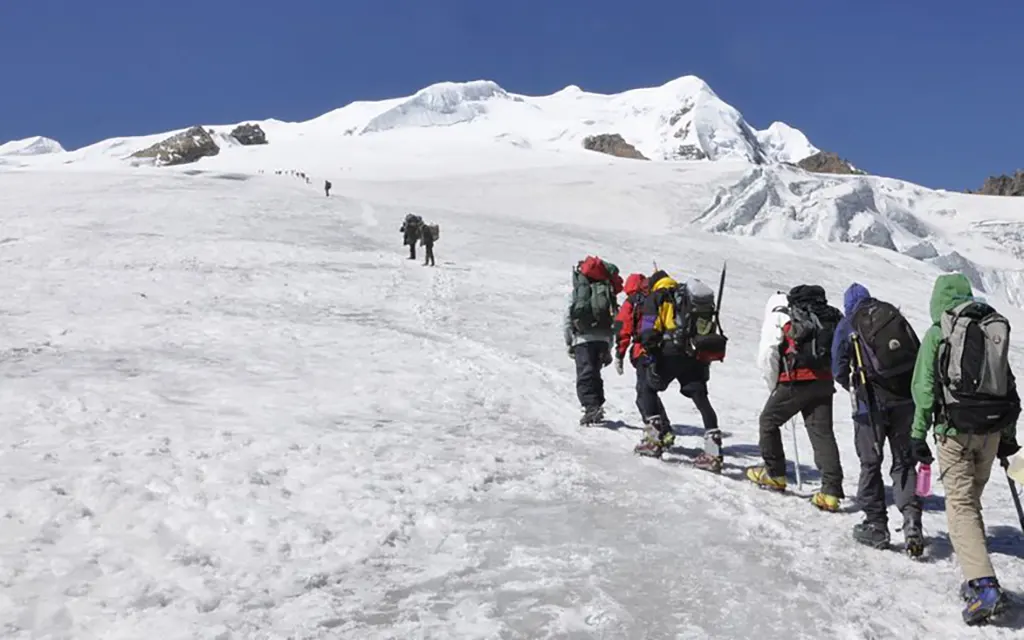
The next big part of the journey is up to High Camp. The trail then goes through rocky and glacial landscape to Mera La and then to High Camp (5,780 m / 18,963 ft) from Khare. The climbing crew will inspect your gear and get you ready for the early morning summit hike.
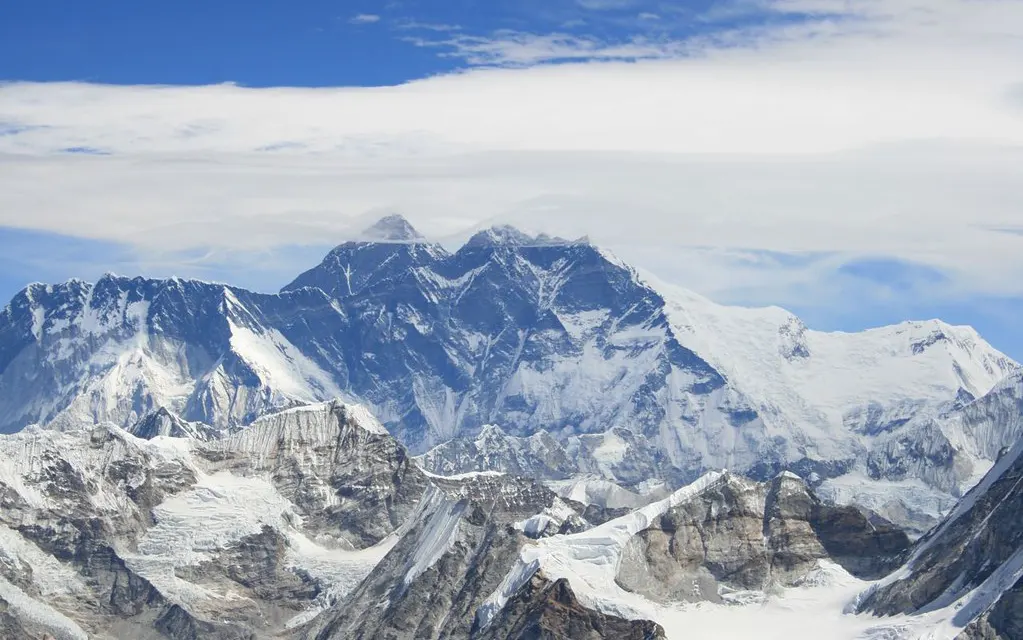
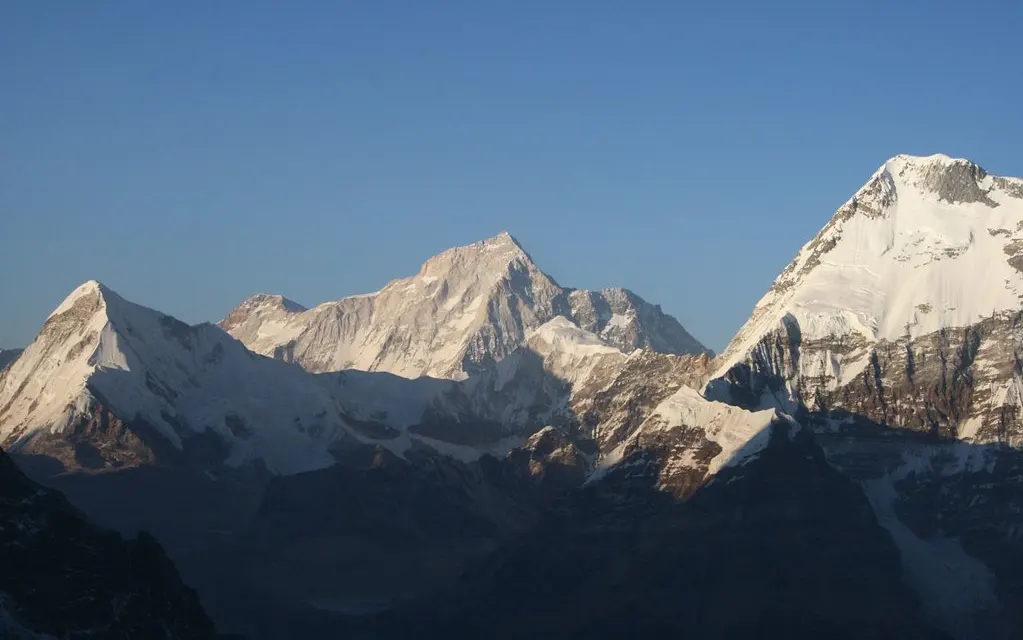
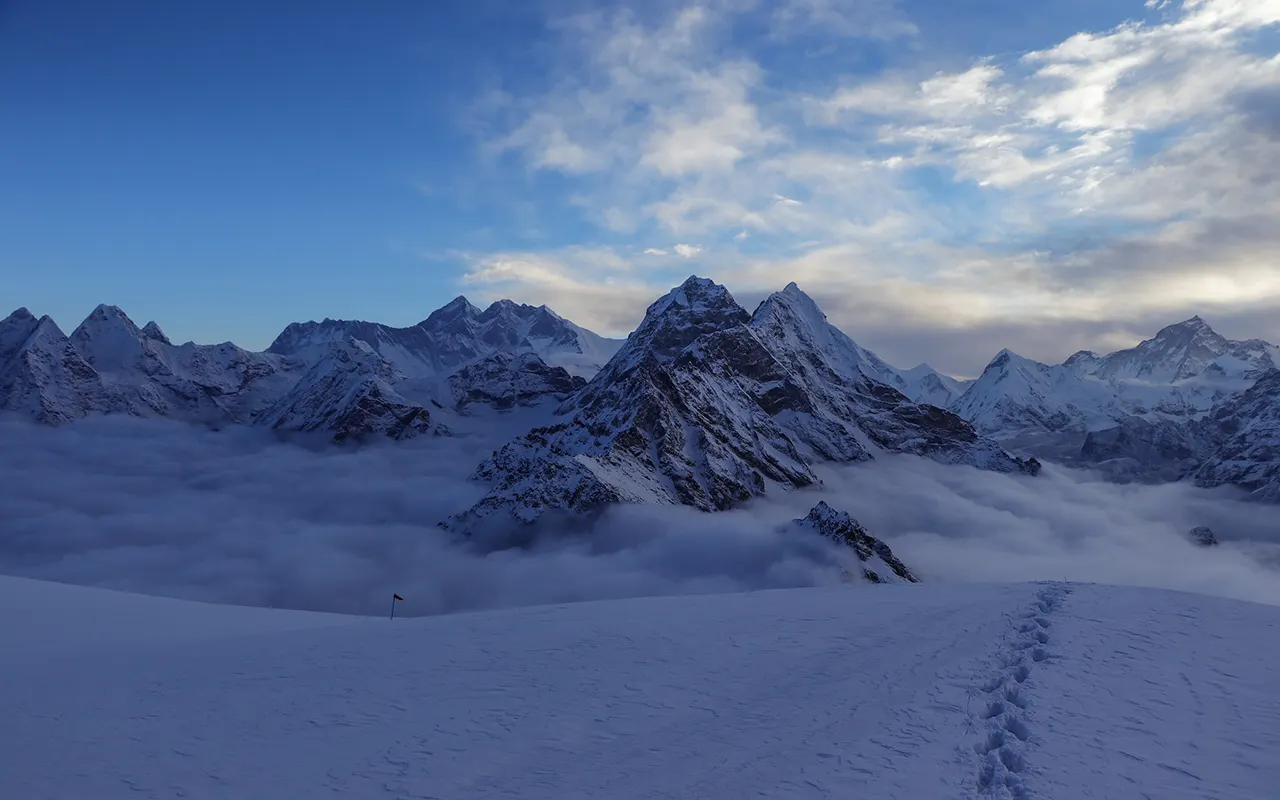
The summit day normally starts around 2:00 am. As night envelops you, you begin to climb up the glacier and slowly ascend towards Mera Central. The final climb is tough, due to the cold temperature, steep terrain and thin air. From the summit (6,461 m / 21,198 ft), you are able to view a vast selection of peaks across the Himalayas, including Everest, Lhotse, Makalu, Baruntse, Cho Oyu and Kanchenjunga.
Once at the summit, you then return to High Camp and then to Khare. Rather than trekking the entire route back to Lukla, the return journey is by helicopter. The duration of the flight to Kathmandu from Khare is approximately one hour and varies with the weather and the operating conditions.
This Mera Peak Climbing Package covers the gradual trek, acclimatization, preparation to climb, peak experience and helicopter return. The package includes services arranged by Nomad Adventure Treks for the trekking, climbing support, permits, transportation, equipment and other services.
Trip Highlights
- Tour to Lukla by helicopter with views of the mountain ranges of the Himalayas
- Exploring the peaceful paths of Paiya, Panggom, Ningsow, Chhatra Khola and Kothe
- Climbing high passes such as Khari La and Panggom La
- Hiking in the woods, alpine meadows and the changing landscape of the Hinku Valley.
- Slowly gaining ground to Thangnag and Khare to gain in altitude
- Practical climbing training at Khare followed by acclimatization.
- Rocky and glacial landscape on the approach to Mera High Camp
- Overnight at Mera High Camp (5,780 m / 18,963 ft), before the summit attempt.
- Walking up to Mera Central (6,461 m / 21,198 ft): Everest, Lhotse, Makalu and other peaks in the Himalayas.
- Flight from Khare to Kathmandu, via Lukla, after summiting the peak.
Detail Itinerary of Luxury Mera Peak Climbing with Heli Return

Day 01: Arrival in Kathmandu and Transfer to Hotel
Once you have arrived at Tribhuvan International Airport, you will be collected at the arrival gate by a Life Himalaya Trekking representative. This will then take you in a private car to your hotel.
On settling down, your guide will give you an orientation about Mera Peak climbing with helicopter return. The briefing will include the path, ascent plans, safety measures and other practical information. Your climbing equipment will be checked as well and if necessary, it can be purchased or hired.
It is an evening for rest and preparation. You will get to taste the Nepali dishes as well.

Activity: Airport arrival, hotel transfer, trip briefing and gear preparation, Approximately 45 min drive

Max. Altitude: 1,320m/4,331ft. Kathmandu

Accommodation: Hotel
Day 02: Helicopter Flight from Kathmandu to Lukla and Trek to Paiya
After the shared helicopter flight from Kathmandu, the day starts. The duration of the flight is approximately 45 minutes, offering aerial perspectives of the Himalayan scenery, such as Langtang, Kanchenjunga, Jugal, Everest and Makalu.
Once you have landed at Lukla, the climbing crew will meet you and will arrange your bag. The walk then heads down towards the Handi Khola and its suspension bridge. The path then heads towards Surke and then to Pake on the southern route.
It rises steadily through the woods and passes through the Chutok La area (2945m /9662ft). Then you head towards Paiya, where you will stay for the night. From this area, you can enjoy views of Kongde Ri, Khatang and Tengi Ragu Tau.
Activity: Shared helicopter flight and trekking, Breakfast, Lunch, Dinner, 45 min helicopter flight and 5 to 6 hrs trek
Max. Altitude: 2,945m/9,662ft. Lukla

Meal: Breakfast, Lunch, Dinner
Accommodation: Tea House
Day 03: Trek from Paiya to Panggom
From the lodge, you head down the mountain to a small bridge over the Paiya Khola, leaving Paiya after breakfast. This path then heads into the woods leading up to Khari La Pass (3,081 m /10,108 ft).
The trail offers a view from the pass towards Gyachung Kang, Khumbila and the hills around it. The trail then heads for Lenji Kharka, where the terrain slowly becomes more open and the Dudh Koshi River can be seen below.
The path eventually leads to the small mountain village of Panggom, which is linked to the historic path to Everest. You will stay overnight at a local lodge where you can get some rest for the next part of the trek.
Activity: Trekking through forest and mountain trails, 5 to 6 hrs
Max. Altitude: 3,081m/10,108ft. Panggom
Meal: Breakfast, Lunch, Dinner
Accommodation: Lodge
Day 04: Trek from Panggom to Ningsow
The trail starts at Panggom and ascends to Panggom La (around 10,417 ft/3,175 m). On the other side of the pass, the track heads north through wooded areas and open hillside.
As you continue, Mera Peak and Numbur Peak start to come into view. The trail crosses Peseng Kharka Khola and then passes through an area of green meadows around Sibuje Village till it reaches Peeng Kharka Danda.
The route then goes past the Ningsow Khola and then towards Ningsow village. There are several climbs and descents included on the day, but the walking is relatively short and you can walk at a steady pace
Activity: Trekking over Panggom La and through forested trails ,4 to 5 hrs
Max. Altitude: 3,175m/10,417ft. Panggom
Meal: Breakfast, Lunch, Dinner
Accommodation: Tea House
Day 05: Trek from Ningsow to Chhatra Khola
The fifth trekking day is made up of several ascents and descents, as the trail leaves Ningsow and moves to Ramailo Danda. The path traverses through forests and offers a view of Mojang, Salpa, Mera, Sanu and Kusum Kanguru peaks.
The trail goes on to Tama Khola and then passes over the area on a suspension bridge. With another climb, you will arrive at 4G Danda, the site of a mountain lodge that will afford you a brief rest.
The track then heads into the Pasang Lhamu trail leading to Makalu Barun National Park. From there, it leads you towards Chhatra Khola, where you can stay for the night in a lodge.
Activity: Trekking through forest and Makalu Barun National Park, 7 to 8 hrs
Max. Altitude: 3,122m/10,243ft. Chhatra Khola
Meal: Breakfast, Lunch, Dinner
Accommodation: Lodge
Day 06: Trek from Chhatra Khola to Kothe
The path then heads north through the forest, which is lush with greenery and moss. The climb is slow and then the trip becomes more or less level as it proceeds through the Hinku Valley.
You cross the Taktor and head on towards Tashing Dingma along the Hinku Khola. It then crosses the Sanu Khola over a long suspension bridge and then moves through the valley.
The route as you near Kothe is more level and the forest slowly merges into a higher mountain environment. You will go through the permits at Makalu Barun National Park before entering the Kothe.
Activity: Trekking through the Hinku Valley and permit verification, 6 to 7 hrs
Max. Altitude: 3,600m/11,811ft. Kothe
Meal: Breakfast, Lunch, Dinner
Accommodation: Lodge
Day 07: Trek from Kothe to Thangnag
As the path follows away from the forest, a gradual change in landscape occurs as the trail begins to come into a high alpine meadow. Today, the route will be kept at a comfortable pace to allow your body to acclimatize to the rapidly rising altitude and to cross 4,000 m (13,123 ft).
The trail goes along the ridge of Drangka under Mera and crosses the local herders’ terrain. Next up is Gondishung, a small village that allows you to take a break for lunch and explore Lungsumgba Gompa.
The path turns uphill after Gondishung and heads towards Thangnag through the mountain scenery. The town is a small temporary grazing field and is equipped with simple lodging and shops.
Activity: Trekking through alpine meadows and mountain terrain, 4 to 5 hrs
Max. Altitude: 4,358m/14,298ft. Thangnag
Meal: Breakfast, Lunch, Dinner
Accommodation: Lodge
Day 08: Trek from Thangnag to Khare
This path winds up from Thangnag to the higher glacial terrain. Some 30 minutes’ walk later, you arrive at an area around Sabai Tsho, a glacial lake at around 4463m (14642 ft).
The trail then crosses more and more rocky and glacial terrain from the lake to the Hinku Nup Glacier. Safety is a concern on these sections, as the trail may be uneven and slippery.
As you head on towards Khare, the surrounding mountains start to stand out more. On the way, you can see Kangtega and Charpate and as you approach, Mera Peak is getting nearer. Stay in Khare overnight in a lodge and get ready for the climbing part of the trip.
Activity: High altitude trekking through glacial terrain, 3 to 5 hrs
Max. Altitude: 5,045m/16,552ft. Khare
Meal: Breakfast, Lunch, Dinner
Accommodation: Lodge
Day 09: Acclimatization at Khare and Pre-Climbing Training at Mera Base Camp
Today is Khare Acclimatization and Climb Prep day. Your climbing guide will give you hands-on training and discuss equipment on the mountain before you start on the higher sections of Mera Peak.
You will learn and practice correct use of an ice axe, climbing boots, crampons, harness and climbing rope. Your guide will also demonstrate and explain appropriate methods for safe travel on steep and icy terrain.
Following the training session, a hike can be made towards the higher ridge nearest Mera Base Camp. The training hike is a combination of hiking and cycling, ending around 5,350 m (17,552 ft). Then you’ll be back in Khare to rest and get ready for the ascent to High Camp.
Activity: Acclimatization hike and pre-climbing training, 3 to 4 hrs training and hike
Max. Altitude: 5,350m/17,552ft. Mera Base Camp
Meal: Breakfast, Lunch, Dinner
Accommodation: Lodge
Day 10: Climb from Khare to Mera High Camp
The climb starts from Khare and follows towards Mera La. The path then passes through rocky, boulder-strewn areas to cross the pass at about 5,415 m (17,766 ft).
Once across Mera La, the trail goes across the higher glacial terrain towards Mera High Camp. The weather conditions may fluctuate due to snow and ice and the climbing team will be able to take you through the more exposed and difficult sections carefully.
The Mera High Camp is at the height of about 5780 m (18963 ft). The camp is also home to a wide variety of Himalayan peaks visible from the camp, including Everest, Lhotse, Makalu, Chamlang, Baruntse, Nuptse, Pumori, Cho Oyu and Ama Dablam.
Activity: Glacier trekking, climbing and preparation for summit attempt, 6 to 7 hrs
Max. Altitude: 5,780m/18,963ft. Mera High Camp
Meal: Breakfast, Lunch, Dinner
Accommodation: Tent
Day 11: Climb from Mera High Camp to Mera Central Summit and Descend to Khare
Summit day starts early, typically at 2:00 am. You don your climbing gear, gear up with the guide and begin to climb up the glacier under the headlamp light.
The ascent gets steeper and the air thinner the higher you rise. This is a fairly difficult day due to the steepness, cold temperatures, snow and ice. The last 30 m (98 ft) may be steeper near the summit and the guide may employ a fixed rope if necessary.
The objective is Mera Central (6,461 m /21,198 ft). Once you arrive at the summit, you head back down to High Camp for a brief rest and dinner and then to Khare.
Activity: Mera Central summit climb and descent to Khare, 8 to 9 hrs
Max. Altitude: 6,461m/21,198ft. Mera Central Summit
Meal: Breakfast, Lunch, Dinner
Accommodation: Lodge
Day 12: Helicopter Flight from Khare to Kathmandu via Lukla
Following the climb and descent, you take a more leisurely morning in the village of Khare. After breakfast, you will depart by helicopter to go back towards Kathmandu.
The helicopter will land in Lukla for about 15 minutes before it heads towards Tribhuvan International Airport in Kathmandu. The flight is another chance to see the mountain landscape from another angle.
From Kathmandu, a private car will collect you for your hotel. The team will have a Celebratory Dinner at Life Himalaya in the evening. A certificate of completion will also be awarded for the expedition.
Activity: Helicopter flight from Khare via Lukla to Kathmandu, Approximately 1 hr helicopter flight
Max. Altitude: 5,045m/16,552ft. Khare
Meal: Breakfast, Dinner
Accommodation: Hotel
Day 13: Departure from Kathmandu
Today is the end of your trip to Mera Peak by helicopter from Kathmandu. Once you have made all the arrangements, you will be picked up from your hotel by a representative of Life Himalaya Trekking and driven to the Tribhuvan International Airport.
The airport transfer will be booked based on your flight time. Before you depart the hotel, ensure that you have picked up all your personal items and travel papers, as well as any climbing gear that requires return.
No trekking is planned on the last day. After arriving at the airport, the pre-arranged expedition services are concluded.
Activity: Hotel check-out and airport transfer, According to flight schedule
Max. Altitude: 1,320m/4,331ft. Kathmandu
Meal: Breakfast
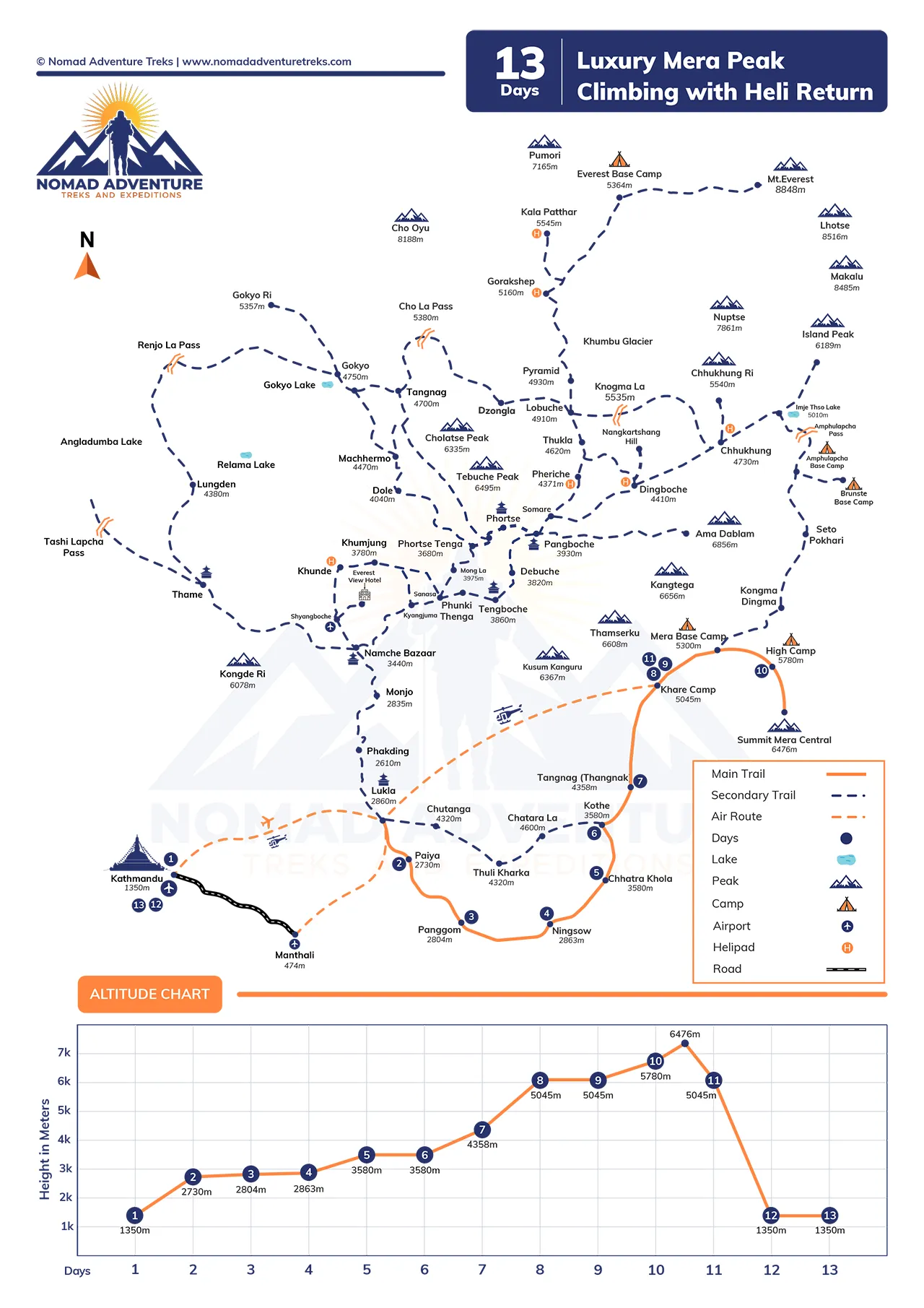
Trip Route Map
Includes & Excludes
What are included with package?
Accommodation
- 2 nights accommodation in Kathmandu (twin sharing or double occupancy) with breakfast.
- Best available teahouses and lodges during the trek in twin sharing or double rooms.
- Hot water bag available as needed for warmth at night above base camp.
- Modern tents, such as a sleeping tent, a dining tent and toilet tents in the climbing part, of excellent quality.
- Guides/porters accommodation, equipment and travel-related arrangements as detailed in the package.
Meals & Drinking Water
- Meals at the lodge during the trek and expedition – breakfast, lunch and dinner.
- Morning breakfasts at Kathmandu Hotel.
- Bottled water 3 to 4 litres per person.
- Hot drinks of boiled water, hot tea, coffee and ginger lemon drinks all along the trek and expedition.
- Seasonal fruits such as apples, oranges, pomegranates (as available).
Transportation
- Required private transportation to/from the airport.
- Accompanied Helicopter flight from Kathmandu to Lukla.
- From Khare to Kathmandu by helicopter, via Lukla.
- Arrangements for transportation of guides and staff.
- Helicopter flight allow 20kg, which is 15kg for main luggage 5kg personal carry.
Guide and Staff
- Two climbing guide staff for four guests and one climbing guide staff for two guests from base camp to summit.
- For every 4 guests, there was 1 experienced, English-speaking, government-licensed trekking guide and for each additional 5 guests, there would be an additional guide.
- Kit porter per guest to Mera Peak High Camp, up to 15kg per porter in duffle bags.
- Personal bag carry from High Camp to the summit and back to High Camp (sherpa support).
- Guide and porter wages, lodging, gear and insurance.
Medical Assistance
- Emergency and safety oxygen supply.
- Satellite phone for communication and emergencies.
- Climbing staff and group have a first aid kit including an oximeter.
- Walkie-talkies to communicate amongst the climbing group, Base Camp and High Camp staff.
- Support for emergency and rescue activities if necessary.
Permits
- Makalu Barun National Park Permit.
- Climbing permit for Mera Peak.
- Waste-disposal site for summiting Mera Peak.
Benefits and Takeaways
- Warm down jacket appropriate for the climbing time.
- Climbing sleeping bag rated for minus 30 degrees (to be provided during the climbing season).
- Climbing boots, ice axe, harness, ascenders and descenders, carabiners, rope and necessary climbing gear.
- The map for the Mera Peak trail.
- Trekking duffle bag.
- Garbage bag.
- We will provide you with an achievement certificate from NMA and Nomad Adventure Treks.
Administrative & Taxes
- Government taxes.
- Office service charges.
- Farewell dinner at a reputed restaurant.
- Services coordination for emergency and rescue.
What are not included with package?
- Lunch and dinner in Kathmandu.
- International airfare.
- Nepal visa fees.
- Climbing insurance and travel insurance.
- Climbing equipment (not otherwise described in the inclusions).
- Personal oxygen cylinders and other personal climbing needs.
- Warm showers on the way.
- Items that aren’t in the drinks menu.
- Personal expenses.
- Guidance for guides, porters, drivers and other staff.
- Services, equipment, meals or expenses not listed under inclusions.

Note:
If you have a private group and prefer a personalized experience, we can organize a custom trip tailored to your requirements and group size, running it any day you choose.
Detail Information about Luxury Mera Peak Climbing with Heli Return
Weather Month to Month and Best Season
The season is key to a high altitude climb as the weather is very unpredictable. The most popular times tend to be either in the spring or the fall, when the weather is more consistent and mountain visibility is generally better. The lower part is colder in winter and wetter and cloudier in summer.
| Month | Weather Conditions | Trekking and Climbing Conditions |
| January | Very cold and dry | Snow and cold make climbing demanding |
| February | Cold with possible snowfall | Suitable mainly for experienced climbers |
| March | Warmer with improving visibility | Good conditions begin |
| April | Stable, dry and clear | Excellent period for climbing |
| May | Generally warm and clear | Good climbing conditions |
| June | Increasing cloud and rain | Less suitable due to monsoon |
| July | Wet and cloudy | Poor visibility and difficult trails |
| August | Frequent rain and cloud | Generally unsuitable |
| September | Rain gradually decreases | Conditions start improving |
| October | Dry, clear and stable | Excellent climbing conditions |
| November | Dry but increasingly cold | Good conditions, especially early in the month |
| December | Very cold and dry | Possible but demanding |
The best time to book Luxury Mera Peak Climbing with Heli Return can be the month of March to May and September to November.
Difficulty and Altitude Sickness
The route to Mera Peak is challenging as a result of high altitude, a long summit day, cold conditions and the varying mountain terrain. Trekking experience is useful, but it’s also essential to be in good physical condition. Altitude is also a factor since the summit is at 6461 m (21198 ft).
Mera Peak Climbing with Helicopter Return involves a slow ascent and acclimatization day at Khare before climbing up. Your climbing guide will keep an eye on you all the time.
You may experience symptoms of altitude sickness such as headache, nausea, dizziness, fatigue, or loss of appetite. A slow walking pace, adequate fluid intake, dietary changes and allowing your body to acclimatize will reduce risk. If there are serious symptoms, it is necessary to immediately descend and receive medical care.
Insurance, Visa and Permit
This is where travel and climbing insurance is a must-have. Your policy should include high-altitude trekking, evacuation, treatment and a helicopter rescue as necessary. The package does not include insurance, so please make sure this is arranged in advance of travel.
Most tourists require a valid passport and a tourist visa to enter Nepal, except those who are visa-exempt according to the Nepal immigration policy.
Climbing and conservation permits are organised by Nomad Adventure Treks and these permits are part of the package. These are the Makalu Barun National Park permit, Mera Peak climbing permit and garbage deposit.
Health and Safety
Preparing for a high-altitude climbing trip is important to ensure good physical preparation. Walking, hiking, cardiovascular exercise and strength training can be useful to get your body ready for long days on the trail and high altitudes.
Luxury Mera Peak Climbing with Heli Return is accompanied by various safety measures. The climbing team has oxygen, a satellite phone, first aid and an oximeter. Walkie-talkies are also employed for group-to-group communication and communication with higher camps.
- Walk at a pace and a rhythm that are right for you.
- Drink water regularly.
- On snow and glacier sections, follow your guide’s directions.
- If you are getting symptoms of altitude sickness, notify your guide right away.
- Stay warm and avoid excessive exposure to strong sunlight.
- If your guide does not feel you are safe to continue, you should not.
Transportation
Transportation is taken care of in the Mera Peak Climbing Packages, so you don’t need to plan for your travel.
The first day is a joint flight by helicopter from Kathmandu to Lukla. A helicopter will fly you from Lukla to Kathmandu after you have finished the climb, via Lukla. Other necessary transport arrangements are also included, such as private airport transfer.
The trekking agency will make all the necessary transportation arrangements for your guides and staff. The flight by helicopter also eliminates the need for a return hike from Mera, making the whole trip more comfortable.
Your Extra Expenses
The basic trekking and climbing packages are covered, but extra cash will be needed for individual needs. Prices may vary for the trip, depending on the services selected and preferences.
There are some personal expenses that are not covered in Mera Peak Climbing with Helicopter Return.
- Lunch and dinner in Kathmandu
- International airfare
- Nepal visa fees
- Climbing insurance and travel insurance
- Any climbing equipment not listed in the included section.
- Personal oxygen cylinders
- During the walk, hot showers too!
- Snacks and additional beverages
- Personal purchases
- Advice to guides, porters and drivers
- Discover services not included in the package inclusions.
Language and Communication
The local community is mostly fluent in the Nepali language. Other local languages are also spoken, such as Sherpa, which can be heard in the mountain villages. Trekking and climbing staff who work with international visitors use English as their language of communication.
Your guide will give you information about the route, the programme, safety and climbing techniques in English. This is helpful for following instructions in the more difficult parts.
Some basic Nepali greetings can help when conversing with locals. A friendly Namaste is universal and is a good greeting in the villages, lodges and on the trail.
Mobile Network, Internet and Charging Facilities
Cell phones have irregular service throughout the hike. The availability of network service is reasonably good in larger villages but decreases in high and distant areas.
In some lodges, Wi Fi or local services may provide access to the Internet; however, the connection may be slow or not available at high elevations. It is not advisable to rely on the Internet during the climbing section.
Charging stations are available at many lodges and may be scarce at higher elevations. Always use a power bank/power charger and don’t let your electronic devices freeze. In addition, your climbing team has a satellite telephone available to communicate in case of emergency.
Don’ts on this Trip
Luxury Mera Peak Climbing with Heli Return expedition respects the mountain environment and local communities throughout. Decisions at high altitude also need to be made carefully, especially when the weather or physical conditions change.
- Avoid disregarding the signs of altitude sickness.
- Avoid climbing at a pace higher than your guide’s.
- Avoid littering the trail and camps.
- Don’t harm plants, monuments or religious structures.
- Never trespass in monasteries or private areas.
- Don’t depend on mobile phones solely for communication.
- Never overlook the effects of cold, wind, snow or high altitudes.
- Don’t drink before or during challenging climbs.
- Never go over the top against your instructor’s instructions.
Cultural Festivals on the Trail
The route to Mera Peak goes through places where Buddhist and Hindu traditions are being practiced in all aspects of life. Local festivals may also be of interest, depending on the year, but they are determined by the lunar calendar.
Dussehra, Tihar, Losar and Mani Rimdu are some of the major celebrations in the region. There are religious ceremonies, prayers and traditional performances, which are closely associated with the Sherpa Buddhist communities in the Everest region that come under the name of Mani Rimdu.
Festival activities may not be available during your Mera Peak Climbing Package, depending on the dates traveled and local festivals. If there is a festival during your hike, your guide will be able to explain the traditions of the area and how to treat it with respect.
Tips for First-Time Visitors
If you are a beginner climber, you should be prepared before starting to climb Mera Peak Climbing with Helicopter Return. A few weeks prior to the trip, walking regularly and completing physical training sessions can make the long walking days more manageable.
Layer clothing as there may be significant differences in temperature between the lower valleys and the climbing camps. It is important to have warm gloves, good trekking boots, sunglasses, sunscreen and personal medication. You must inspect your equipment with the agency before departure to determine what additional equipment is needed.
Don’t rush at higher altitudes and listen to your guide’s recommendations on acclimatization. Be flexible with the schedule, as mountain weather can impact plans for climbing. Lastly, be sure to have your travel paperwork, insurance information and contact numbers on hand during the trip.
Mera Peak Climbing Equipment Checklist
The right gear makes all the difference while hiking Luxury Mera Peak Climbing with Heli Return. The temperature drops from mild in Kathmandu to freezing near the summit (6,461 m / 21,198 ft). Clothing layers make for comfort on the trip.
The climbing equipment they offer includes all the essential items like a down jacket, sleeping bag, climbing boots, ice axe, harness, climbing rope and expedition tents. Your personal clothes and items are all that are required.
Equipment provided:
- Down jacket
- Sleeping bag
- Climbing boots
- Ice axe
- Harness
- Rope and climbing equipment
- Expedition tents
You should bring:
- Base and thermal layers
- Fleece jacket
- Waterproof coat and pants
- Warm gloves and hat
- Sunglasses
- Sunscreen
- Headlamp
- Personal medication
- Power bank
- Water bottle
What Is the Summit Day Like?
The most challenging and longest day of the trip will be Summit Day. The ascent typically starts about 2 am in the dark. Though it is still very cold, below freezing, the team follows the glacier with headlamps to the top.
Mostly a snow and glacier climb, but every step up the high altitude makes climbing more difficult. Close to the peak (6,461 m / 21,198 ft), it is advisable to take slow breaths and to take your time when doing it. Depending on snow conditions, a fixed rope may be necessary in some steep areas.
Once at the summit, there is some time to take in the vistas of Everest, Makalu, Lhotse, Cho Oyu and Kanchenjunga. The team then heads down to High Camp and back up to Khare for the night.
Helicopter Return: What to Expect
One of the greatest benefits of Mera Peak Climbing with Helicopter Return is the helicopter return. From Khare, one doesn’t have to make the entire trek again, but one can simply fly back to Kathmandu and the return trip is not extensive.
It will normally make a brief stop at Lukla before heading for Kathmandu. As you travel, you have the chance to see more aerial views of the valleys, glaciers and snow-covered mountains that you have crossed during the expedition.
What to expect:
- Departure of the helicopter from Khare.
- Stop at Lukla for a short time.
- Splendour of the mountains on the way.
- Total flying time of about 1 hour.
- 20 kg of luggage: 15 kg for the main bag and 5 kg for a personal bag.
- After arriving in Kathmandu, private hotel transfer service.
- Weather can impact a helicopter schedule; be flexible.
Mera Peak Climbing vs Island Peak Climbing
While they both offer a popular climbing objective in Nepal, they have different experiences. Luxury Mera Peak Climbing with Heli Return is designed to gradually ascend to the highest trekking peak in Nepal and then return with a helicopter on comfort level. There is more technical climbing on Island Peak, but it is shorter.
For a high Himalayan peak that does not require as much technical climbing, Mera Peak may be a better option if you want to experience the peak. For those who already have some basic climbing experience and are looking for a more challenging climb, Island Peak might be a better choice.
| Feature | Mera Peak | Island Peak |
| Height | (6,461 m / 21,198 ft) | (6,189 m / 20,305 ft) |
| Region | Hinku Valley | Everest Region |
| Technical difficulty | Moderate | More technical |
| Glacier travel | Yes | Yes |
| Fixed rope sections | Usually near summit | Common on steep sections |
| Summit day | Longer | Shorter but steeper |
| Best for | First Himalayan peak climbers with good fitness | Climbers with previous mountaineering experience |
| Return option | Helicopter return available | Usually returns by trekking |
| Main challenge | High altitude | Technical climbing |
Both ascents demand physical fitness, proper acclimatization and leadership of a climbing professional.
Frequently Asked Questions
Is Mera Peak a beginner's peak?
By preparing appropriately, with trekker experience, acclimatization and climbing guidance, Mera Peak can be suitable for fit first-time peak climbers.
Is Mera Peak a technical trek or not?
The route is largely non-technical, but there are some glacier sections, steep terrain, cold weather and high altitude, which necessitate proper climbing skills.
Is any climbing equipment provided?
Items included in the package: climbing boots, ice axe, harness, climbing hardware, down jacket, sleeping bag and expedition tents.
What if the helicopter is incapable of flying from Khare?
Mountain weather and visibility are critical to helicopter operations. The itinerary may be adjusted if flying is not possible due to conditions until flying is permitted.
Are there restrictions on the amount of luggage the helicopter can carry?
Yes. The allowance given is 20 kg per person: 15 kg for main luggage and 5 kg for personal luggage.
Do we need to take climbing insurance for Mera Peak?
Yes. High-altitude climbing, medical treatment, emergency evacuation and helicopter rescue (if applicable) insurance should be included.
What emergency communication facilities available?
The climbing team has a satellite phone and walkie-talkies to support emergencies, oxygen and a first aid kit for emergency support.
Can the summit attempt be cancelled for safety reasons?
Yes. When weather, snow conditions and/or a climber’s health create unsafe conditions, the climbing guide may change or cancel the summit attempt.
What is the next step once at Mera Central?
After summiting Mera Central (6,461 m / 21,198 ft), you head back down to High Camp and then down to Khare.
What training are they doing at Khare during the itinerary?
On the acclimatization day, you will have the opportunity to get used to the altitude and to practice the use of crampons, ice axe, harness and climbing rope in practice.
Reviews on Luxury Mera Peak Climbing with Heli Return
 Write a Review


- Your safety, our no 1 priority
- Best price guarantee
- Experienced & dedicated team
- Easy booking, no hidden charge
- You can customize this trip
Talk to Travel Expert
Samundra Rimal (+977-9843127084)