





Short Manaslu Trek 12 Days

Duration
12 Days

Max Altitude
5,160 m. / 16,929 ft.

Difficulty
Moderate

Group Size
2-6 Pax

Meals
- 11 Breakfast
- 10 Lunch
- 9 Dinner

Accommodation
- Guest House
- 3 Star Hotel

Transportation
Car/Jeep

Activities
- Trekking
- Driving

- 1 personUS$ 1100
- 2 - 5 personUS$ 980
- 6 - 12 personUS$ 880
- 12 over 9999 US$ 840
Total Cost:
US$ 1100
- Your safety, our no 1 priority
- Best price guarantee
- Experienced & dedicated team
- Easy booking, no hidden charge
- You can customize this trip



Talk to Travel Expert Samundra Rimal (+977-9843127084)
Introduction of Short Manaslu Trek 12 Days
The Short Manaslu Trek feels like a land from different time frames, with each village having its own adventure. The trek offers great views and knowledge of the snowy peaks, not to mention the ancient monasteries.
This Short Manaslu Trek 12 days combines adventurous high-altitude trekking with deep cultural immersion, 12 days Short Manaslu Trek combines adventurous high-altitude all while being quiet and peaceful. It is a peaceful breakthrough away from the crowded routes of Annapurna and Everest.
The Short Manaslu trek is handcrafted to be an unforgettable experience, combining the feel of adventure, festivals, cultural sightings, and scintillating landscapes.
To ensure a smooth and stress-free start, you’ll stay at a comfortable 3-star hotel in Kathmandu the night before the trek. This is where we will gather the group members and explain the Manaslu Trekking itinerary plan.
This well-placed 12 days Short Manaslu trekking Plan gives you a lot of time to sink in the beauty of the region, to the serene Larkya La at 5,160m, exploring historically Rich Tibetan-tuned villages all around.
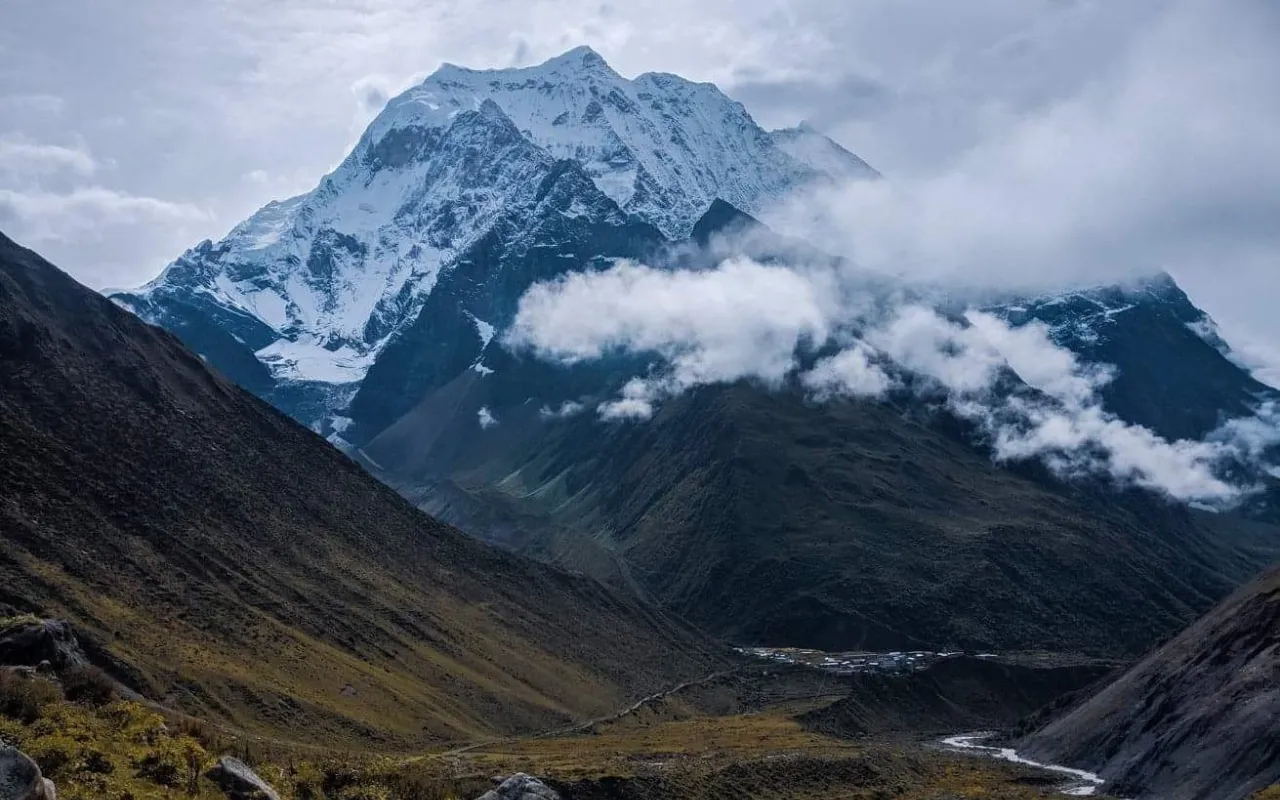
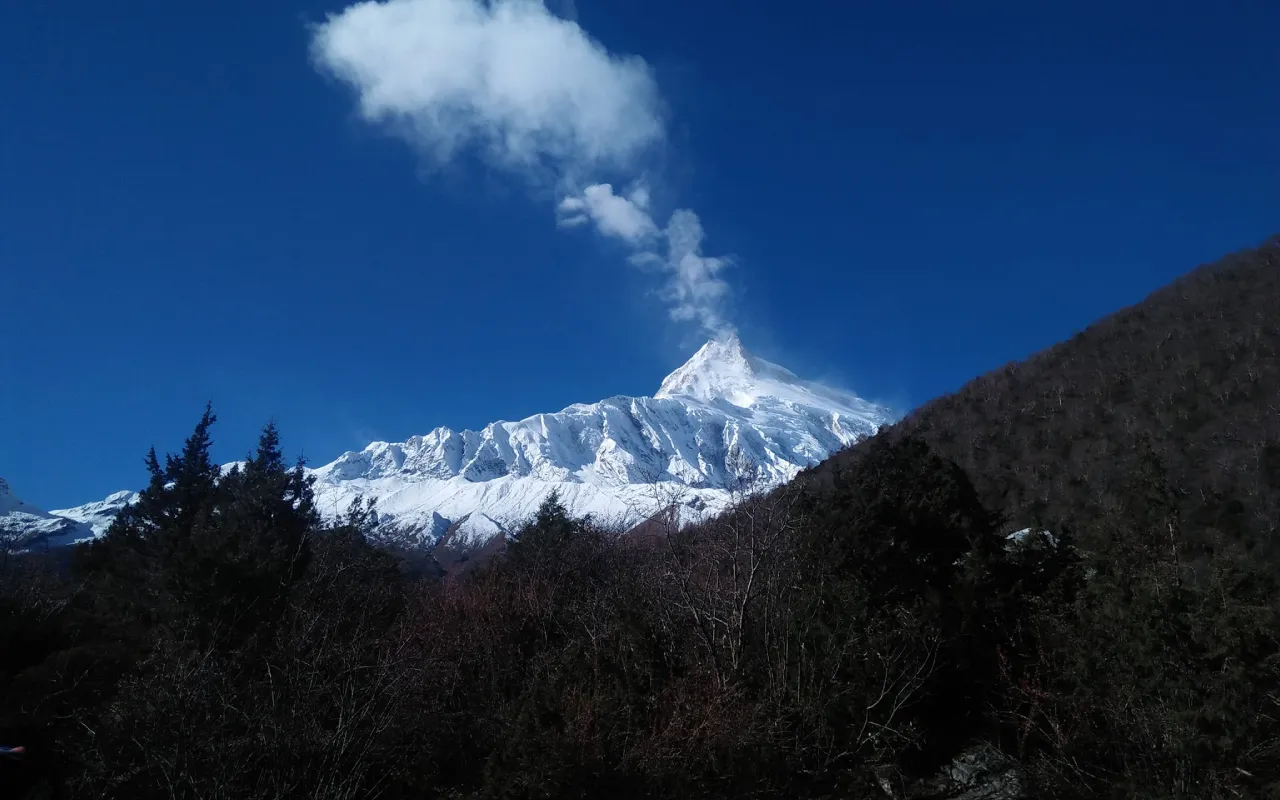
In addition to this, there is the warm hospitality of tea houses, uncrowded trails, and the perfect Himalayan views like Himalchuli, Annapurna, Shringi, Cheo, Ganesh, and Manaslu.
On this 12 Days Manaslu Trek, you will have the most enjoyable moments with packages including facilities like permits, accommodation, meals, insurance, and guides.
Trip Highlights
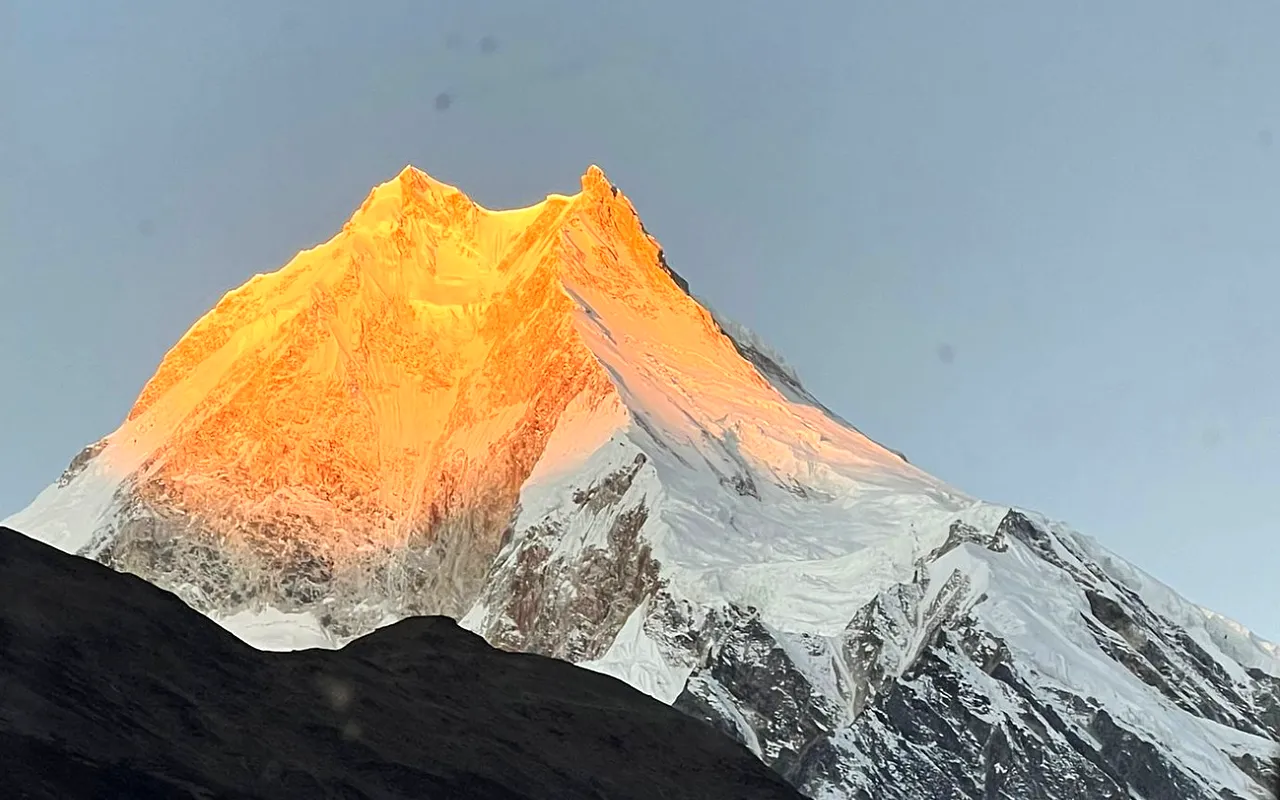
- Trek to the base of Mt. Manaslu ranked as the eighth tallest mountain globally.
- Travel to an exhilarating Himalayas region, one of the most secluded.
- Experiencing tea houses, mountain living as it is, and delicious, locally prepared meals.
- Explore Tibetan refugee settlements and contact the Nupri community.
- Come across historic stupas, chortens, monasteries, and waving prayer flags along the trail.
- Trek along the Budhi Gandaki River enjoying a diverse landscape of terraced rice, millet, forests, and glacial moraines.
- You can also take side trips to Birendra Lake, Rui La Pass, and Pun Gyen Gompa.
- Cross the challenging snow-covered Larkya La Pass.
- Enjoy astonishing mountain views and beautiful nature throughout the trek.
Detail Itinerary of Short Manaslu Trek 12 Days

Day 1: Arrival Day to Kathmandu
After you arrive in Kathmandu, your representative will wait for you at Tribhuvan International Airport (TIA) to provide hotel transportation. Our team members will describe to you the Manaslu Trekking Itinerary. After that, you will rest and then prepare your gear and equipment for the upcoming adventure.
You can decide to visit three famous attractions Boudhanath Stupa, Swayambhunath (Monkey Temple), and Pashupatinath Temple. You can spend the night observing Thamel’s lively shops and dining venues during the evening walk. You can feast on a traditional Nepali dinner experience at a cultural restaurant.

Activity: Drive for 30 minutes

Max. Altitude: 1,324m/4,344ft. Kathmandu

Accommodation: 3 Star Hotel
Day 2: Kathmandu to Macchakhola (930m)
A drive that feels just like a roller coaster will be your start today. You’ll leave Kathmandu’s busy streets behind you and ride to the countryside, through spectacularly lovely hillsides and along rivers such as the Trishuli. You will pass beautiful rice terraces, a quiet little village of Arughat, where everything is relaxed and moving at a slow pace.
At times, the ride is bumpy, rivers cut through green hills, and sometimes you get a glimpse of Ganesh Himal on clear days, and Soti Khola. Through subtropical forests and small villages like Lapu Besi, the drive follows the Budhi Gandaki River.
When you get to Machha Khola, a small town on the river’s banks, you’ll stop for the night with the pleasant sounds of flowing water and birds chirping.
Activity: Driver for 7-8 hours
Max. Altitude: 930m/3,051ft. Macchakhola

Meal: Breakfast, Lunch, Dinner
Accommodation: Guest House
Day 3: Machha Khola to Salleri (1,410m)
Today, the trail goes deeper into the gorge, surrounded by tall, huge cliffs. Tatopani, a village boasting natural hot springs will be the spotlight today, where you can take a quick soak for sore muscles. The trail goes through slim sections along the Budhi Gandaki River and some impressive suspension bridges.
Just as you are near Salleri, terraced fields and views of the near by peaks come to view. Your trip officially begins in Salleri, with its stone-paved streets, which mark the entrance to the Manaslu Conservation Area, where you will officially register before you continue.
Activity: Trekking for 6-7 hours
Max. Altitude: 1,410m/4,626ft. Salleri
Meal: Breakfast, Lunch, Dinner
Accommodation: Guest House
Day 4: Salleri to Bihi Phedi (1,985m)
Today, you truly enter the wilderness of the Manaslu region, entering the conservation area with lush forests and terraced fields. The path passes through a few villages like Jagat, and Deng with unique views over Shyar Khola Valley. You’ll also see farms growing millet, wheat, and potatoes, along the way.
The trail climbs gradually, moving along the river and crossing rivers, following ridges, with sweeping valley views. Bihi Phedi is a peaceful little village located in a valley surrounded by mountains, that is set against terraced slopes for you to stay overnight and enjoy the local hospitality.
Activity: Trekking for 6-7 hours
Max. Altitude: 1,985m/6,512ft. Bihi Phedi
Meal: Breakfast, Lunch, Dinner
Accommodation: Guest House
Day 5: Bihi Phedi to Lho (3,180m)
From Bihi Phedi, the trail continues its sluggish ascent up to small, pretty Tibetan-style villages like Shyaula and through beautiful forests. The climb isn’t too steep and the trek isn’t insurmountable.
As you reach the village of Lho the surroundings start to widen out and you get your first proper view of the great Mount Manaslu (8,163 meters).
Lho is a unique little village with modern houses made of traditional stone, encompassing a beautiful little monastery. It is an excellent place to rest your legs for a bit and take pictures of the surrounding mountains and glaciers.
Activity: Trekking for 5-6 hours
Max. Altitude: 3,180m/10,433ft. Lho
Meal: Breakfast, Lunch, Dinner
Accommodation: Guest House
Day 6: Lho to Samagaon (3,520m)
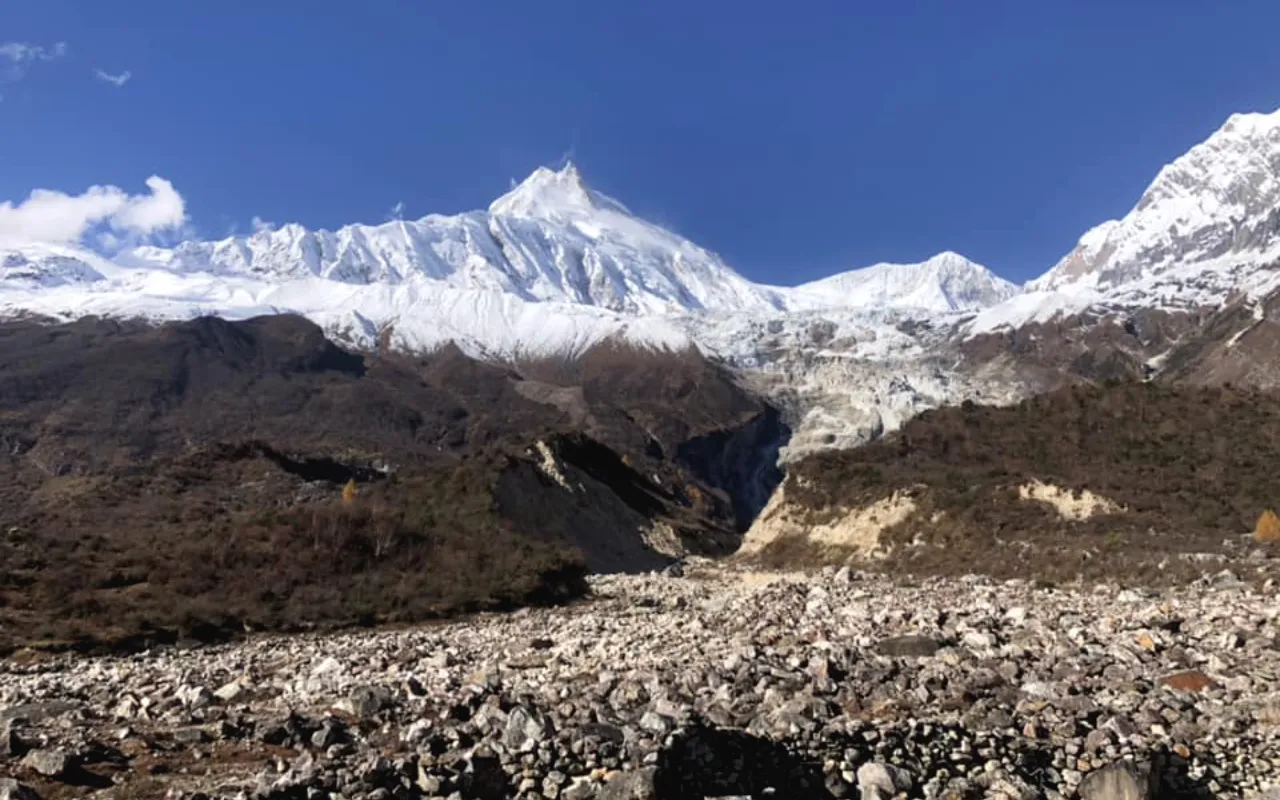
Today’s Trek leads you to a beautiful valley and presents a backdrop of Manaslu Glacier and towering peaks like Ngadi Chuli and Manaslu, Sama Gaun. Sama Gaun is also one of the biggest settlements in the area, and the entry point to the high-altitude trek to Manaslu Base Camp.
While walking through, you will pass through dense forests of Rhododendrons and Junipers, cross rivers, and encounter more Tibetan-style villages. You will acclimatize here and get ready for the next trek point.
Activity: Trekking for 4-5 hours
Max. Altitude: 3,520m/11,549ft. Samagaon
Meal: Breakfast, Lunch, Dinner
Accommodation: Guest House
Day 7: Acclimatization Day in Samagaon
Today is a day to relax, as well as acclimatize. For those with lots of energy, there’s an optional hike up to Pungyen Gompa, a centuries-old monastery with a view over Manaslu and its glaciers. You can also take up the more difficult option of climbing to Manaslu Base Camp, a high-altitude place with a great view of the mountains.
You’ll have a rare chance to connect with local Tibetan culture at Samagaon. Chat with villagers, and view traditional houses as well as nearby yak pastures, also allowing your body to get used to the altitude.
Activity: Rest Day
Meal: Breakfast, Lunch, Dinner
Day 8: Samagaon to Dharam Shala (4,470m)
Today’s trek is higher into the Himalayan realm. The climb is gradual over the trail to Dharamshala, the final stop before we cross Larkya La Pass. On the way, you’ll be treated to up-close views of the gigantic Larkya Glacier surrounded by huge mountains like Cheo Himal and Himlung Himal.
The beauty of the landscape from this height is amazing. Camp at Dharamshala is basic but cozy, with trekkers getting ready for the big day up ahead. Rest and enjoy the camaraderie around here before tomorrow’s big challenge.
Activity: Trekking for 5-6 hours
Max. Altitude: 4,470m/14,665ft. Dharam Shala
Meal: Breakfast, Lunch, Dinner
Accommodation: Guest House
Day 9: Trek to Bimthang (3,720m) through Larkya La Pass (5,160 m)
It’s the most difficult day, but it’s also the most exciting. You will start early for the highlight of the trek to cross Larkya La Pass at 5,160m. It’s tough going, but the 360-degree views are worth it. Every direction is filled with mountains such as Kang Guru, Himlung Himal, and Annapurna II.
Soaking in the scenery you’ll start descending to Bimthang, past glaciers, moraine fields, and finally dense forests. After a long trek, the Bimthang between the pine forest and the snowy peaks, feels like a paradise.
Activity: Trekking for 9-10 hours
Max. Altitude: 3,720m/12,205ft. Bimthang
Meal: Breakfast, Lunch, Dinner
Accommodation: Guest House
Day 10: Bimthang to Dharapani (1,910m)
After descending from the high alpine zone you will find yourself in the dense valley of Marsyangdi. Many travelers walk through verdant rhododendron forests during the spring season along snowy rivers with sporadic waterfalls during their meandering trek.
You will observe the last peaks of Lamjung Himal together with other mountains as you descend to Dharapani.
The Annapurna Circuit can be accessed by joining fellow trekkers while recalling fantastic trek memories. After spending time in remote areas you can feel excited to reach populated villages following days of solitary exploration.
Activity: Trekking for 7-8 hours
Max. Altitude: 1,910m/6,266ft. Dharapani
Meal: Breakfast, Lunch, Dinner
Accommodation: Guest House
Day 11: Dharapani to Kathmandu (Drive)
The upcoming road trip toward Kathmandu is what you need to prepare for. The drive follows part of its previous trail through rolling agricultural slopes using curving mountain pathways which finally provide one last sight of the Himalayas.
When you reach Kathmandu you will look forward to enjoying a tasty dinner while you observe stunning views across the city from your hotel window. This return to Kathmandu marks the end of your Manaslu Trekking Itinerary, and the mountain memories stay with you strongly even after being back among city people.
Activity: Drive for 8-9 hours
Max. Altitude: 1,324m/4,344ft. Kathmandu
Meal: Breakfast, Lunch
Accommodation: 3 Strar Hotel
Day 12: Departure Day
Your Manaslu region adventure concludes by creating beautiful lifelong memories. If you have any leisure time, you can take a stroll through Thamel and purchase products of handmade crafts pashminas, and Thangka paintings before departure.
As your Nepali adventure draws to an end, complete your experience by tasting traditional Himalayan cuisine. Our representative will arrange your airport transfer to Tribhuvan International Airport where you will leave with Nepal’s spirit along with all your special memories.
Meal: Breakfast
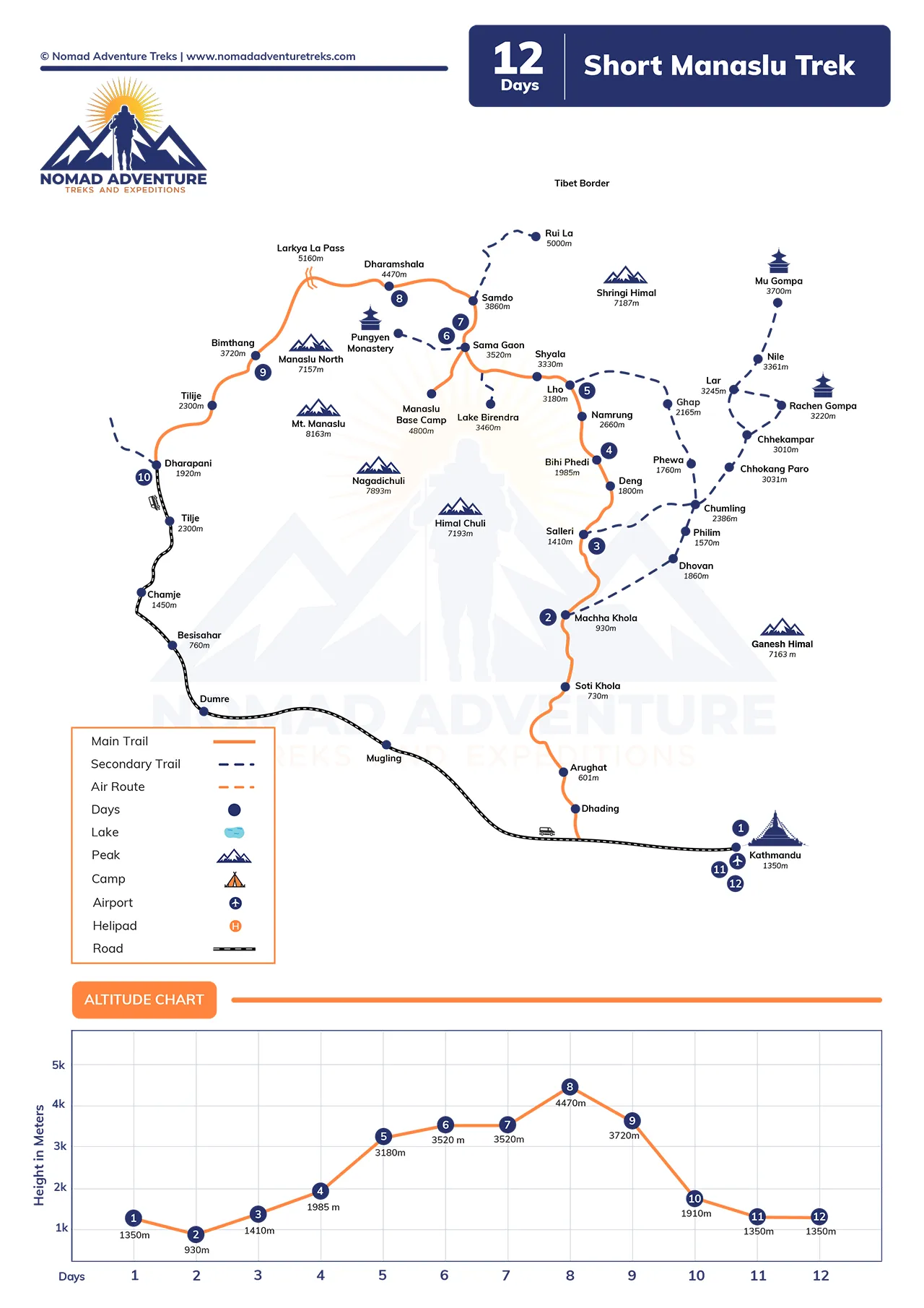
Trip Route Map
Includes & Excludes
What are included with package?
Accommodation
- Twin-sharing/double accommodation in a 3-star hotel for 2 nights in Kathmandu including breakfast (Private room accommodation can be organized at an extra cost)
- Best available accommodation Tea house/lodge accommodation during the trek
Meals & Drinking Water
- All your standard meals during the trek 3 meals a day (Breakfast, Lunch & Dinner) in a guest houses.
- A farewell dinner on the last night in Nepal
- Purified drinking water during the trek using Water Filter or water purification tablets.
Transportation
- All (international and domestic) airport transfers on a tourist vehicle
Transportation by bus from Kathmandu to Machha Khola (trekking starting point) and at the end from Dharapani to Kathmandu
Guide and Staff
- Experienced, first-aid trained, government licensed, English speaking, and locally recruited Nomad Adventure’s trekking guide (2 guides for group size more than 7 people)
- Porters during the trek for carrying luggage (1 porter for every 2 clients)
- Wages, accommodation, meals, gear, insurance and medications for all staff
Medical Assistance
- Assistance in arranging rescue operations in case of complicated health conditions (funded by travel insurance)
- Medical kits, including an oximeter to monitor blood oxygen saturation levels in high altitudes
Permits
- TIMS (Trekkers’ Information Management System) card
- Annapurna Conservation entry permits
- Manaslu Conservation entry permit.
- Restricted Manaslu Trekking Permit.
Benefits and Takeaways
- Sleeping bags and down jackets, duffle bag (one for every two trekkers) if you do not have your own
- company’s T-shirt & Cap
- Trip completion certificate
Administrative & Taxes
- All administrative expenses and government taxes
What are not included with package?
Price Excludes
- Lunch and dinner in Kathmandu
- International flight fare and airport departure tax
- Nepal Entry Visa (Visa can be acquired easily after your arrival at Tribhuvan International Airport in Kathmandu with a fee of USD 30 for 15 days visa, USD 50 for 30 days visa and USD 125 for 90 days visa)
- Extra night accommodations in Kathmandu due to early arrival or late departure, early return from the trek or other itinerary changes
- Travel insurance along with high-altitude emergency evacuation coverage
- Medical check-ups, vaccinations, or medications required for the trek are not included.
- Any beverages including bottled and boiled water
- Tips to trekking staff and driver
- Personal trekking gear and equipment
- Any expenses other than the Price Include section
- Personal expenses (shopping, snacks, boiled bottle water, hot (Tea/ Coffee) and cold drinks, hot shower, alcohol, Wi-Fi, telephone call, battery re-charge fee, extra porters, etc
- Personal clothing and gear

Note:
If you have a private group and prefer a personalized experience, we can organize a custom trip tailored to your requirements and group size, running it any day you choose.
Detail Information about Short Manaslu Trek 12 Days
Briefing the Highlights of 12 Days Short Manaslu Trekking
Trek to the base of Mt. Manaslu (the eighth-highest mountain in the world)
Short Manaslu Trek takes you to the base of Mount Manaslu, at a height of 8,163 meters is ranked eighth in the world. You can enjoy the unobstructed views of snow-covered Manaslu, Himalchuli, and Ngadi Chuli, and engulf in Himalayan scenery throughout the ascent.
Travel to an exhilarating Himalayas region, one of the most secluded.
The trail winds through the secluded Nubri and Tsum Valleys, regions rich with unspoiled landscapes and wildlife such as Himalayan tahr and langur monkeys. These valleys offer pristine, isolated paths that provide a unique off-the-beaten-path trekking experience for free from other crowded trails of Nepal.
Experiencing tea houses, mountain living as it is, and delicious, locally prepared meals.
Accommodations in such villages are simple but cozy, you will usually stay in family-run tea houses in Samagaun, Lho, and Namrung. It serves you local dishes, like dal bhat (lentil soup and rice) and momo (Tibetan dumplings), letting you tuck into genuine Nepali and Tibetan flavors, as well as the mountain community’s warm hospitality.
Explore Tibetan refugee settlements and contact the Nupri community.
The Short Manaslu trek takes you through villages settled with Nupri people, who are responsible for sustaining the traditional Tibetan Buddhist lifestyle.
Samdo and Lho are some places with colorful Tibetan customs, prayer flags, and monasteries which make for a great opportunity for you to observe and participate in monastic rituals and festivals unique to the Tibetan diaspora.
Come across historic stupas, chortens, monasteries, and waving prayer flags along the trail.
Trekkers encounter many Stupas, Chortens, and Prayer Wheels along the trail. The major sites, such as the serene Pungyen Gompa above Birendra Lake, and Sama Gompa, the center of the spiritual site in Sama Gaun where monks conduct rituals honoring the mountain deity Nyenpo Yésha, who is believed to guard the Manaslu region.
Trek along the Budhi Gandaki River enjoying a diverse landscape of terraced rice, millet, forests, and glacial moraines.
The trek follows the Budhi Gandaki River has a shift in landscapes from fertile rice and millet terraces in lower elevations to dense rhododendron and pine forests, and finally the rugged glacial moraines of Larkya La Pass. This range of ecosystems enriches the trek and brings you an amazing aspect of Nepal’s natural beauty.
You can also take side trips to Rui La Pass, Birendra Lake, and Pun Gyen Gompa.
You can go for side trips to the peaceful Pun Gyen Gompa with opportunities for wide mountain views, the glacial waters of Birendra Lake for impressive reflections, and the high altitude pass, Rui La Pass at the Tibetan border famous for stunning views of the Manaslu Range.
Cross the challenging snow-covered Larkya La Pass
Larkya La Pass is the highest point of the Short Manaslu trek at a height of 5,160 meters, which is layered in snow and also with the most difficulty. Crossing its icy and rugged terrain, you are rewarded with expansive views of peaks such as Himlung, Cheo Himal, and the Annapurna Range, making it a real highlight of the journey.
Enjoy astonishing mountain views and beautiful nature throughout the trek.
From the glacial lake Birendra Tal to the towering peaks of the Manaslu and Annapurna Ranges, you are surrounded by dynamic landscapes that vary with altitude. The suspension bridges over the Budhi Gandaki River and the scenery of high-altitude valleys, provide you with numerous beautiful highlights.
Manaslu Trekking Best Season
Spring (March through May) together with Autumn (September through November) are the Manaslu Trekking Best Season.
Spring has blooming rhododendrons and gently warm spring temperatures, whereas Autumn has clear skies, stable weather, amazing sight of mountains, and rich cultural and festival experiences.
This season usually has moderate temperatures ranging from 5°C to 20°C, which brings comfort and ease.
If you seek off-peak seasons like Monsoon (June to August), it will be very warm temperatures (25°C to 30°C), and slippery trails full of leeches. This season is usually avoided as it has several uncomfortable factors like mud and leeches during Short Manaslu Trek 12 Days.
Winter (December to February) is a time of extreme cold where you can face temperatures of -20°C. This season seeks warm clothing and gear as well as expert navigation since the trail can be immersed in snow. The risk of avalanches and snowstorms generally makes it an avoidable system.
Physical Preparation For the Short Manaslu Trek
For a successful Short Manaslu trek, you need to prepare physically for the challenges of high-altitude trekking. The Larkya La Pass, located at 5,160 meters (16,930 feet) is the highest point of the trek.
At this high altitude, the air has so little oxygen that without being prepared physically, it becomes difficult to handle the conditions. Physical preparation for beginners aids in preventing exhaustion, injuries, and altitude sickness. Here’s how to prepare effectively:
Cardiovascular Fitness
Building cardiovascular endurance is the first step toward preparation. Improving stamina will help when trekking at high altitudes as you need more energy. Do cardio exercises around 3 to 4 days a week and dedicate 30 to 60 minutes per day, before 2 to 3 months to trekking.
One useful thing is trying to walk on inclines and hiking trails similar to the terrain on the trek. This builds endurance and trains your body for the steep, long climbs and descents that you face in the steep section to Samdo, at 3,860 meters (12,664 feet).
Leg Strength
Each day you’re going to be hiking for hours with a backpack that weighs 8 to 12 kilograms, so you need to build leg strength. Perform exercises like planks, lunges, and squats focusing on strengthening quadriceps, hamstrings, calves, and glutes.
It enables you to climb steep slopes such as Larkya La Pass, which is a relatively physically demanding part of the trek. The more your legs are prepared, the easier you will feel to do these climbs.
Core Stability and Balance
Making balance on uneven surfaces requires core exercises, such as planks, and Russian twists. Rocky paths, forests, and narrow bridges make the Manaslu Circuit a trek where you need to stay stable. For dangerous regions like the Soti Khola to Samagaon stretch, core strength is useful in preventing falls.
Who Can and Cannot Do The 12 Days Short Manaslu Trekking?
The Short Manaslu Trek is a great adventure, but only for those who come prepared. Suppose you’re a hiking person, with a bit of trekking experience on you, and are generally in the Gym Sector (Cardio and core exercise Included). In that case, exercise Included), this Majestic climb To The Mountain of Spirit calls for you.
You will require a pair of strong legs, decent cardio fitness, the capability to walk for hours with 5 to 6 kg backpacks, and a willingness to push yourself through high-altitude steps for this trek to feel calming and rewarding. So, make sure you.
On the other hand, this mountain may not be the best choice for everyone. Calling it is tough on the knees and lungs, if you’re in poor condition with severe heart, respiratory, or knee problems, or are brand new to trekking, this can be a bit too much to tackle right now. So, you want to sincerely second guess the tour.
Larke La Pass and Tibet border hike
The Short Manaslu Trek covers one of the most important and difficult parts of the trek, Larkya La Pass (5,160 Mt.) which stands at 16,929 feet. A true test of endurance. Trekking through this high-altitude pass lets trekkers taste how harsh these conditions must have been for early mountaineers paving exploration for the region.
The Larkya La Pass made its reputation for steep ascents and wildly changing weather. Accomplishing this physically challenging path also rewards you with 360 beautiful views of Himalchuli, and Ngadi Chuli amongst others.
Another Historical and stunning highlight besides the Pass is the Tibetan Border Hike. This path was once used for transporting goods between Nepal and Tibet. It emphasizes the area’s cross-border trade connection through remote and rugged paths once used by traders and locals to trade products.
Monasteries, Gompas, and Cultural Encounters During Manaslu Trek 12 days
Monasteries and Gompas on Short Manaslu Trek
Short Manaslu Trek 12 days lets you immerse into Himalayan spirituality by visiting various renowned monasteries and gompas that serve as a key landmark of Buddhist heritage. Sama Gompa in Sama Gaun, a monastery where monks perform rituals honoring Nyenpo Yésha, the revered mountain deity of Manaslu is one of the most notable landmarks.
Nyenpo Yésha, the protector of the region, makes sure people living in the region and travelers are safe. Offerings made at Sama Gompa are for acknowledging his role as a guardian and bringing blessings for safe trips.
Next along the trek is Mu Gompa in Tsum Valley, sitting 3,510 meters above, in an isolated part of the region which is famous for its peaceful atmosphere. This is a monastery, and a center for Tibetan Buddhism featuring mani stones and fluttering prayer flags commemorating spiritual guardians and indicating a place of contemplation and reverence.
Rachen Gompa nearby, is a spiritual retreat for Buddhist nuns and a place where locals and visitors can pay their prayers to deities like Machhindranath, who is known for his mercy and protection. Machhindranath’s loving energy balances Nyenpo Yésha’s heavy guardianship above Manaslu, bringing a gentle spiritual significance to the land.
Pungyen Gompa is another key stop, located near Birendra Tal, it is a monastery overlooking dramatic Himalayan landscapes. This smaller monastery holds historical significance for the local communities, and its location allows for a sense of peace and reflection.
Cultural Encounters | Round Year Festivals on Manaslu
If you happen to traverse Short Manaslu Trek in January, then you are lucky to get to Maghe Sankranti, a Hindu festival that marks the winter solstice. At Arughat and Soti Khola, it’s all about family gatherings, feasting, and rituals to promote fortune throughout the year.
One of Nepal’s most famous holidays is the festival of Dashain, generally in late September or the beginning of October. At Arughat and Soti Khola it’s family reunions, animal sacrifices (careful vegans), and worshiping goddess Durga to please blessings and prosperity.
Tihar (Deepawali) lights the lower part of the trek in October, bringing another festival into its domain. From Arughat villages, it is a beautiful festival where people can be seen decorating their homes with colorful lights, Diyo, worshiping animals like cows and dogs, and exchanging sweets with neighbors.
The lovingly celebrated Bhai Tika also falls within, which honors the love and bond between siblings.
If you happen to be on the trail in February or March, you are sure to pass by Shivaratri. All in the feet of Lord Shiva, worshiping His Mighty.
Are you into colors and water? Plan the trek in March. Holi (the festival of colors), be prepared to take part in a colorful celebration during Fagu Purnima (Holi) in March. In Soti Khola, for example, people throw colorful powders at one another, rejoicing over the promises of spring.
Hindu festival Naga Panchami celebrates serpents, around the corner in July or August. Villagers pray to Lord Krishna, asking for his blessings and protection from snakes.
Teej is a festival where women fast in the name of Goddess Parvati and Lord Shiva and pray for a long life and well-being of their husbands. It’s usually in practice during the end of August.
Talking about August, in the middle of the month, we have Janai Purnima, a sacred festival when men change the sacred thread they wear around their bodies after Bartamanna.
Finally, if you’re trekking in April or May, you can witness Vaishakha Purnima, a day marked by both Hindus and Buddhists to honor the life, teachings, and legacy of Gautama Buddha.
History Short Manaslu Trek
Cultural and Trade Legacy
The region was an active part of the ancient trade route, trading salt from Nepal to Tibet. The villages such as Samdo, Lho, and Namrung were major trade centers. These villages still retain the impact of the people of Tibet, which is seen in the practice of Tibetan Buddhism at various monasteries, stupas, and Prayer flags alike.
When traversing the area, trekkers travel over ground that once was walked by ancient traders ferrying commodities such as salt, wool, and barley.
Mountaineering Legacy
The Short Manaslu trek also holds the history of the early ascents on Mount Manaslu. British explorer named, H.W. Tilman was the first man to map the northern route of the Mountain in the 1950s. However, it was not until 1956 that the first Summit was accomplished by Toshio Imanishi and Sherpa Gyalzen Norbu, Japanese expenditures.
Trekking the circuit and walking the route gives a firsthand experience of the rugged terrain these early climbers faced, with challenges like the Larkya La Pass at 5,160 meters.
Opening to Trekkers
The Short Manaslu Trek was introduced to trekkers officially in 1991. Being believed to be the abode of gods, the region had been closed to tourists to safeguard the natural and cultural heritage of the area.
Its preservation till the late 90s saved it from modernization and Western impact, thus the circuit gives the feeling of remoteness and spirituality.
Health and Safety Tips | Altitude Sickness Awareness
During the Short Manaslu Trek, a high-altitude trek, the primary difficulty is altitude illness. At high altitudes, oxygen levels remain low, insisting the human body gets used to it by acclimatizing.
Some of the common symptoms of altitude sickness are headache, nausea, dizziness, and insomnia. The golden rule? Climb up gradually and don’t mask the signs that your body gets during the trek.
We provide rest days for hikers to adapt to the altitude in required regions such as Sama Gaun where the altitude is 3,530m. It is also better if you take day hikes to higher elevations or regions and later sleep at a lower altitude.
Make sure you are hydrated and not taking alcohol or smoking. If your body signifies being weak, listen to it and rest before taking brave indecisive actions. If anything, take your altitude sickness tablet like Diamox.
In case of severe altitude sickness, hikers must descend immediately to lower altitudes. The Manaslu Circuit is a quiet and remote area, so an emergency helicopter evacuation can be a necessity.
HAPE or HACE are certain conditions of altitude sickness that are life-threatening and you should stop the trek right then. This is a rare occurrence but not to be ignored, so properly acclimatizing and preparing mentally is important.
Frequently Asked Questions
Can I do the Manaslu Trek 12 days solo, or do I need a guide?
The Short Manaslu Trek cannot be done independently. Since April 1, 2023, Nepal’s government does not permit solo trekking in the Manaslu Region.
Hiring a licensed guide is compulsory, as they know the safety regulations, proper navigation, and arrange your stays and permits. Porters are also encouraged if the load is heavy on your back.
Do I need travel insurance for the Manaslu Trek 12 days?
Indeed, there are really strong reasons to take travel insurance when undertaking the Short Manaslu Trek. You’ll be covered by your insurance for high altitude trekking, and if a medical emergency or evacuation happens (helicopter rescue), providing safety and a peaceful trek.
What flora and fauna can I expect to see along the way?
The Short Manaslu circuit trek takes you through a range of ecosystems, beginning with subtropical forests of pine, oak, rhododendrons, flowers, and so on.
The trail passes through livestock and wildlife, especially Himalayan blue sheep, musk deer, and langur monkeys. High in the mountains, it’s possible to see snow leopards and Himalayan griffon vultures soaring above.
What Kind of Food and Accommodation is Available along the Trek?
Teahouses will be the available accommodation with basic establishments and facilities.
Dal Bhat (lentil soup and rice) is the best, common, and traditional food along the route that helps you maintain energy throughout the trek.
You can also taste Tibetan-influenced dishes like momo (dumplings), noodle soups, or Thukpa and Chowmein, although it will not be in the package and will be your expense.
Are the Guides helpful and Friendly?
Yes, as Nepal is known to be a Friendly Country overall, the Guides along with porters are extremely helpful and friendly indeed.
What’s the distance of the Short Manaslu Trek with return?
The total distance of the 12 days of Short Manaslu Trekking, including the return, is about 177 to 180 kilometers (110 to 112 miles).
What’s the Difficulty Level of Manaslu Circuit Trek?
The Short Manaslu Trek Has been Labelled Moderately Challenging in Difficulty Level.
Reviews on Short Manaslu Trek 12 Days
 Write a Review
- 1 personUS$ 1100
- 2 - 5 personUS$ 980
- 6 - 12 personUS$ 880
- 12 over 9999 US$ 840
Total Cost:
US$ 1100
- Your safety, our no 1 priority
- Best price guarantee
- Experienced & dedicated team
- Easy booking, no hidden charge
- You can customize this trip
Talk to Travel Expert Samundra Rimal (+977-9843127084)