



Three Passes and Everest Base Camp Trek

Duration
20 Days

Max Altitude
5,643 m. / 18,514 ft.

Difficulty
Moderate

Group Size
2-10 Pax

Meals
- 19 Breakfast
- 17 Lunch
- 18 Dinner

Accommodation
- 3 Star Hotel
- Teahouse

Transportation
Car/Jeep/Aeroplan

Activities
- Trekking
- Hiking
- Flight

- 1 personUS$ 1790
- 1 - 2 personUS$ 1750
- 1 - 3 personUS$ 1690
- 4 - 6 personUS$ 1650
- 7 - 12 personUS$ 1600
- 13 - 18 personUS$ 1590
- 19 over 9999 US$ 1490
Total Cost:
US$ 1790
- Your safety, our no 1 priority
- Best price guarantee
- Experienced & dedicated team
- Easy booking, no hidden charge
- You can customize this trip



Talk to Travel Expert Samundra Rimal (+977-9843127084)
Introduction of Three Passes and Everest Base Camp Trek
Under the majestic shadow of Mount Everest lies one of the most thrilling, finest, and adventurous treks in the Himalayas: the three passes and Everest Base Camp trek.
This Everest three passes trek 20 days journey will take you across the three enormous and fearsome Everest Passes counterclockwise: the Kongma La (5535 m), the Cho La (5420 m), and Renjo La (5360 m).
Along the Everest three passes trek route, you will also discover the three other iconic landmarks: the Kala Patthar (5643 m), Everest Base Camp (5364 m), and Gokyo Ri (5357 m).
However, we like to emphasize that if you choose this trek, then you should be ready for long and demanding hikes and climbs. But wait, the three passes with Everest Base Camp trek do not require advanced climbing or technical skills so it is equally ideal for both the newcomers and the experienced ones.
In fact, it is a circular route where you don’t have to repeat the trail on your way home so you will have different views from different sides.
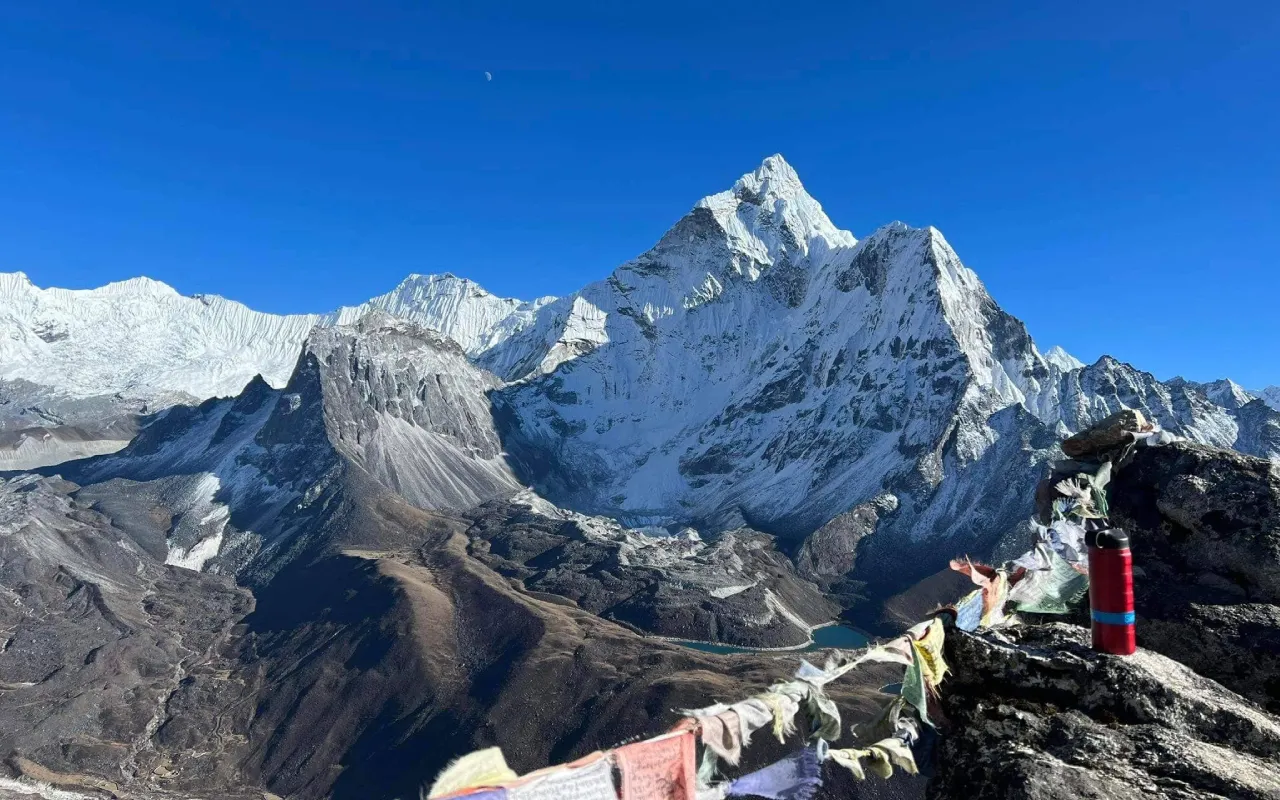
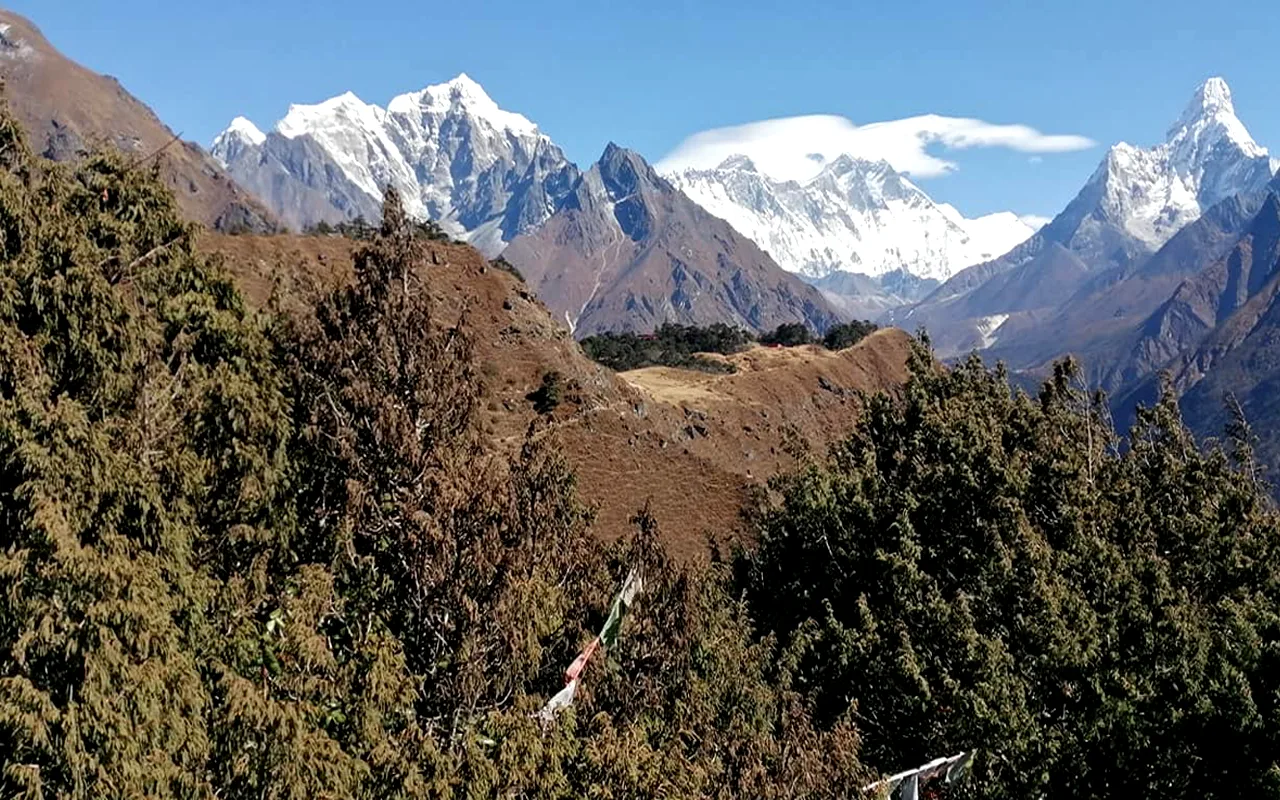
Another most appealing feature of the Everest three passes trek route is you will have spectacularly fantastic mountain views all the time including Thamserku (6608 m), Kusum Kanguru (6367 m), Everest (8848 m), Nuptse (7861 m), Lhotse (8516 m), Khumbila (5761 m), Taboche (6495 m), Kongde Ri (6187 m), Ama Dablam (6812 m), and Cho Oyu (8188 m).
Additionally, you will also have the opportunity to enjoy some quiet moments by the serene blue waters of the Gokyo Lakes. You will also discover charming Himalayan villages of warm-hearted Sherpa locals, their unique Buddhist religion, the vibrant green land to the icy expanse, and the paths less traveled in one of the famed destinations of the world.
Our three passes and Everest Base Camp trek will start with your departure to the famous mountain airport of Lukla. You will then journey to Namche Bazaar, dine in the tallest luxury hotel, and progress to Dingboche where you will have the option to climb the 5083 m high Nagarjung Ridge.
Then, you will climb to the most spectacular observation platform, the high Kongma La Pass and proceed towards Everest Base Camp and ascend Kala Patthar.
Then, you will climb the Cho La Pass, go down to the Gokyo Lakes, and meet sunrise on Gokyo Ri. The Everest three passes trek will then culminate once you triumph over the Renjo La Pass.
So, if you don’t have the ambition to summit any Himalayan peaks but would like to experience a demanding trek under Everest once, then our three passes and Everest Base Camp trek is the right adventure for you.
Join us today to achieve what you dream of and create lasting memories in the world’s highest mountain range!
Trip Highlights
- Experience life at the base camp of Everest
- Triumph the three high mountain passes of Kongma La, Cho La, and Renjo La and see Everest from all sides
- Access the stunning viewpoints of Gokyo Ri and Kala Patthar
- Watch the majestic Himalayas of Island, Cho Oyu, Makalu, Ama Dablam, Everest, Lhotse, Pumori, Nuptse and several others
- Walk the most astounding and less traveled trail of Everest
- Take the thrilling mountain flight back and forth between Lukla and Kathmandu
- Dine in the world’s tallest luxury hotel
- See the exceptional beauty of Kathmandu
Detail Itinerary of Three Passes and Everest Base Camp Trek

Day 1: Arrive in TIA and Hotel Transfer in Kathmandu (1350 m)
Greetings and Tashi Delek! We are very thrilled and happy to welcome you all to the land of His Majesty- the Everest! After completion of the customs and you get out of the TIA gate, you will find our agency representative right at the exit.
After assisting you with loading your luggage, you will be driven to your chosen lodging in the city. Once you are all rested and recovered from the flight, you can go out and discover the charm of this old city.
In the evening, our tour guide will gather all the group members of our three passes and Everest Base Camp trek and give all of you the vital details regarding our Everest three high passes trek itinerary.
Afterward, you can join our guide for a trip to the Thamel market to pick up any necessary gear. We advise you to retire early, as we may need to depart for Ramechhap around midnight for the early morning flight to Lukla.
Note
Please kindly note that the Kathmandu-Lukla flights will not operate during the high tourist season of autumn, spring and during the fog, inclement weather, and heavy congestion at TIA.
In such an incident, we will need to make a 4 to 5-hour driving journey to Manthali airstrip in Ramechhap for which we will have to depart around midnight.
After completing the trek, we may have to fly to Manthali to head back to Kathmandu via Lukla. If at that time, direct Lukla flights are operated, we will choose those. We therefore kindly request all our clients to reach Kathmandu early in the morning if possible.

Max. Altitude: 1,350m/4,429ft. Kathmandu

Accommodation: 3 Star Hotel
Day 2: Kathmandu/Ramechhap to Lukla Flight (30/20 minutes) and hike to Phakding (2,610 m), 3 to 4 hours
An early morning departure will fly us over Everest, Jugal, Kanchenjunga, and Makalu towards Lukla. We will witness the skill of our pilot while landing on the unusually short runway of this iconic airstrip.
Once we land, we will see our smiling crew of Sherpas along with the giant silhouettes of Kongde Ri. Once we have our breakfast here, together we will walk leisurely beside Dudh Koshi and pass through the scattered hamlets of Chheplung, Chaurikharka, Thadokosi, and Ghat to reach Phakding with the beautiful mountain environment.

Activity: Fly & Trek for 4-5 hours
Max. Altitude: 2,610m/8,563ft. Phakding

Meal: Breakfast, Lunch, Dinner
Accommodation: Teahouse
Day 3: Hike up to Namche Bazaar (3,440 m), 5 to 6 hours
Soon after breakfast, we will leave Phakding and walk through Benkar village towards Monjo where we will pass the entrance to the Sagarmatha National Park.
Now walking high above Dudh Koshi, we will pass by Jorsale Village and shortly reach the place where we see Dudh Koshi flowing into Bhote Koshi River.
The 60 m-long Hilary Suspension Bridge will allow us to cross the river and reach Top Danda (3140 m). Now, a steep climb to Namche begins which is tough but the white peaks of Lhotse, Thamserku, Everest, Kongde Ri, Khumbila, and Nuptse will ease our journey.
Activity: Trekking for 5-6 hours
Max. Altitude: 3,440m/11,286ft. Namche Bazaar
Meal: Breakfast, Lunch, Dinner
Accommodation: Teahouse
Day 4: Day Off at Namche, Short Acclimating Walk
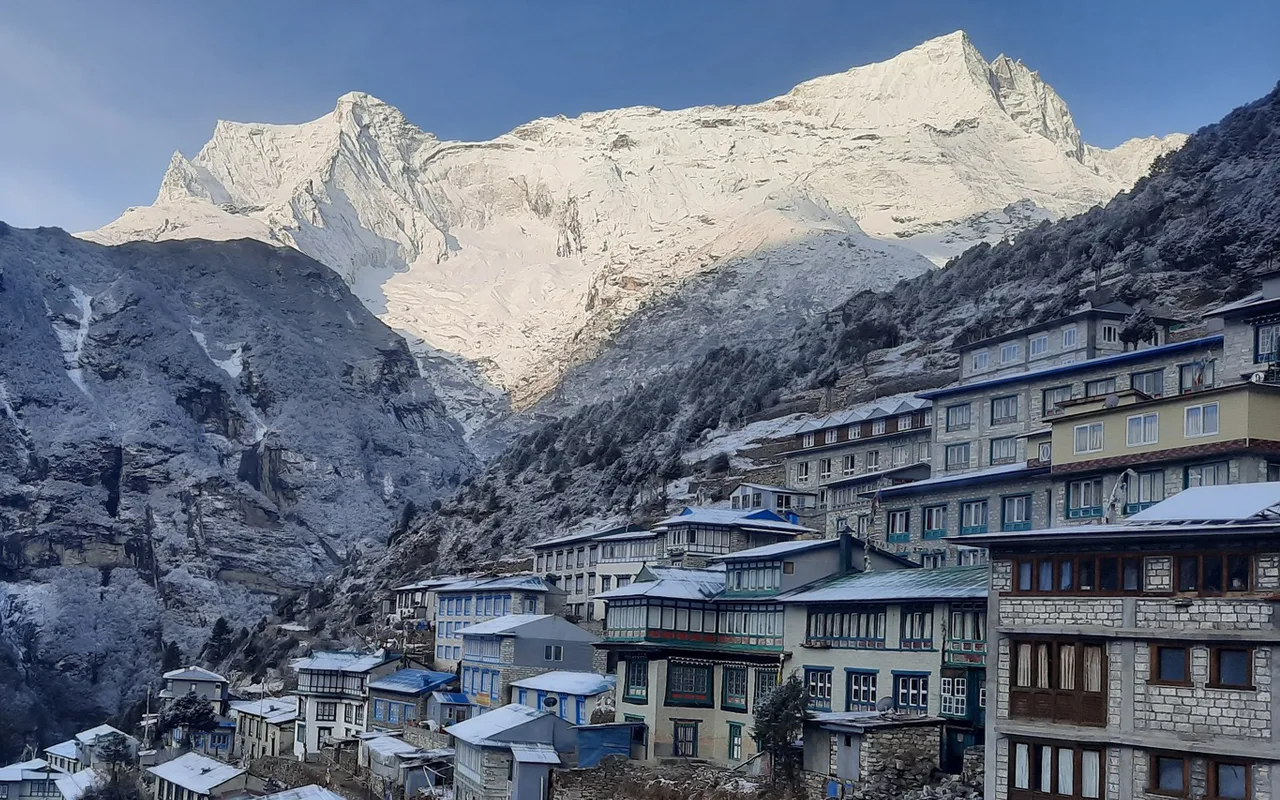
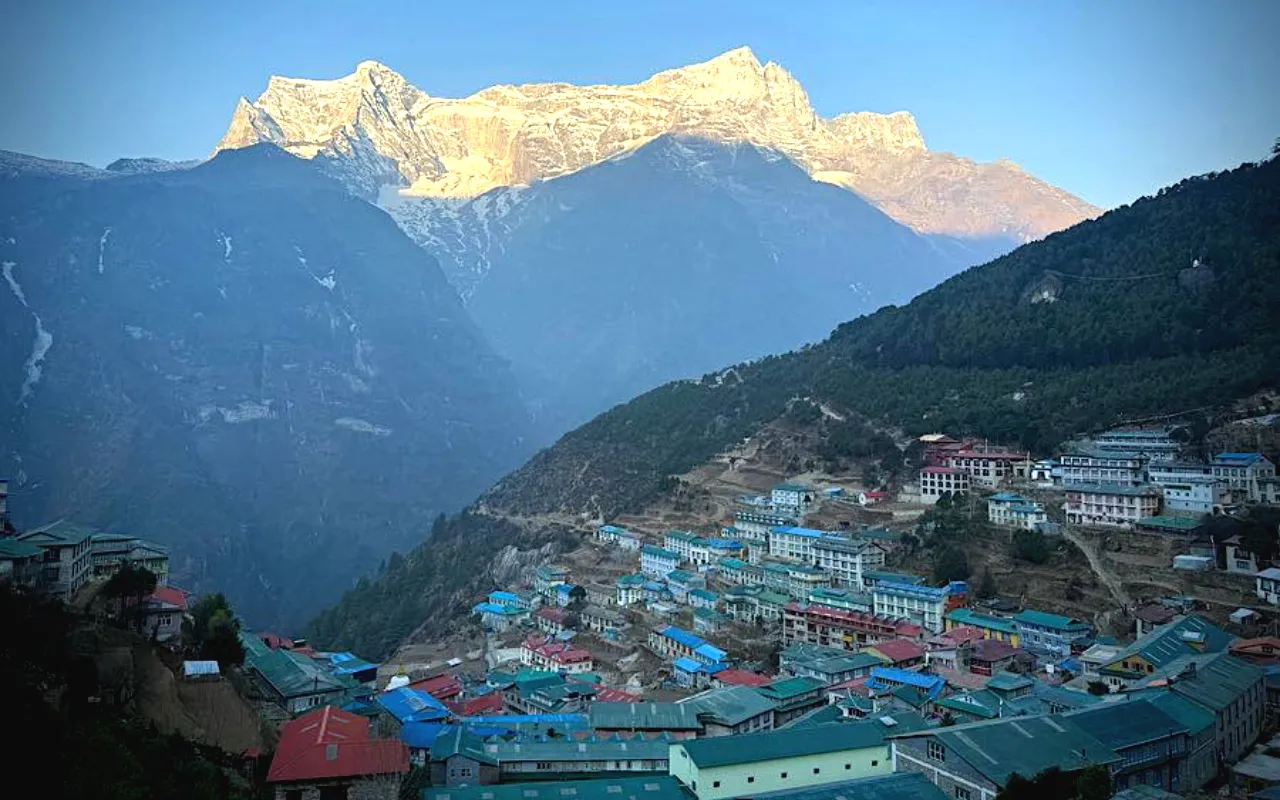
Namche is like a bowl surrounded by high mountains. There are many things to do and see here or we can also take a short 2 hour acclimating hike up towards the Khumjung Village and see its monastery or eat lunch in the Everest View Hotel regarded as the tallest one in the world.
On the way, we will have a romantic spectacle of Lhotse, Thamserku, Everest, Kongde Ri, Khumbila, Cholatse, Taboche, and Nuptse.
Activity: Hiking for 2-3 hour
Max. Altitude: 3,790m/12,434ft. Khumjung Village
Meal: Breakfast, Lunch, Dinner
Accommodation: Teahouse
Day 5: Hike up to Tengboche Village (3860 m), 5 to 6 hours
After Namche, we will walk steadily for around an hour along the relatively easy terrain. The path will now go down sharply for around 1.5 hour till we are at the solid hanging bridge made of metal.
After walking over this bridge, the dense forest path will lead us over 3250 m high Phungi Thanga where we may take a brief break to eat our lunch.
Get ready for the sharp two hour upward climb which will march us to the religious ground of monastery of Tengboche. We can see numerous monks going around with their everyday rituals and meditation.
This location also gives us the superb views of Thamserku, Ama Dablam, Kangtega, Tawache, Lhotse, Kongde Ri, Nuptse, and Everest. After boggling our mind for a while with these peaks, we will now head to our mountain shelter for the evening rest.
Activity: Trekking for 5-6 hours
Max. Altitude: 3,860m/12,664ft. Tengboche Village
Meal: Breakfast, Lunch, Dinner
Accommodation: Teahouse
Day 6: Hike up to Dingboche Village (4410 m), 5 to 6 hours
Walking above the treeline from Tengboche, we will push further along the steeply climbing trail towards Debuche. Once at this Village, we will walk a little farther and reach a section where we can see two branching trail.
The left one goes right up towards the Upper Pangboche so we will take the right one that will take us to the lower Pangboche and then to Dingboche.
The route will continue to take us upward sharply till we are at Shomare where the high white peak of Ama Dablam starts to show its features. The Imja Khola will now direct us along the rising track which ultimately takes us to our shelter at Dingboche.
Activity: Trekking for 5-6 hours
Max. Altitude: 4,410m/14,469ft. Dingboche Village
Meal: Breakfast, Lunch, Dinner
Accommodation: Teahouse
Day 7: Day Off at Dingboche
We will acclimatize another day in Dingboche where we can just sit out in the lodge enjoying the view and the village environment. Or, we can also set forth for a 3 hour climb towards the Nagarjung Hill (5080 m).
The ridge is locally called Nangkartshang Peak which rewards all its climbers with the view of the towering snowy titans of Island Peak, Baruntse, Thamserku, Cholatse, Lobuche, Ama Dablam, Makalu, Khakaru, and the pass of Amphu Laptse.
Activity: Rest Day
Max. Altitude: 4,410m/14,469ft. Dingboche
Meal: Breakfast, Lunch, Dinner
Accommodation: Teahouse
Day 8: Hike up to Chhukung Village (4730 m), 2 to 3 hours
We have a beautiful short acclimating walk today that will lead us towards Chhukung Village. The route to the village is however not that easy as we hike alongside the impressive cliffs of Lhotse, Ama Dablam and Nuptse.
Further, the landscape will become even more challenging with high sharp edge rocks and ice streams. Once we are through, we will be at the Village where we can look straight at Makalu, Kongde Ri, Karyolung, Cholatse, Taboche, and Numbur Himal.
There is a 5546 m high ridge of Chhukung Ri we can try but it is advisable to rest, as we will be preparing for the first Everest pass the next morning.
Activity: Trekking for 2-3 hours
Max. Altitude: 4,730m/15,518ft. Chhukung Village
Meal: Breakfast, Lunch, Dinner
Accommodation: Teahouse
Day 9: Climb the Kongma La Pass (5535 m) and hike down to Lobuche Village (4925 m), 8 to 9 hours
One of the first passes of Everest awaits our footprints today so we will start very early probably before the sun wakes up. We will then take the north direction and walk upward toward the glacier walls of Nuptse.
We will walk past Bibre and arrive inside the Nyiang Valley protected by the Chhukung Ri and Pokalde. Now, heading west, we will keep climbing for about 4 hours and arrive the summit of the Pass that lies between Pokalde and Kongma Tse.
We will be on time to see the sun painting the white faces of Gaurishankar, Lhotse, Makalu, Pumori, Everest, Lobuche, Ama Dablam, and Nuptse with its orange hue.
Get ready for the tough sharp hiking down the pass, and once we are at the base, we will cross the side walls of Khumbu Glacier and make our way to our shelter at Lobuche.
Activity: Trekking for 8-9 hours
Max. Altitude: 4,925m/16,158ft. Lobuche Village
Meal: Breakfast, Lunch, Dinner
Accommodation: Teahouse
Day 10: Hike up to Gorakshep- EBC (5364 m)- and back to Gorakshep (5160 m), 6 to 7 hours
Once again, the lateral walls of the Khumbu Glacier will lead us our way for a while till we are at the icy slope of the Lobuche Pass. From here, we will climb down towards the rocky and sand terrain of Gorakshep where we will take our time eating lunch and resting our feet.
Now, we will set forth for a steep 3-hour climb towards Everest Base Camp where the notorious icefall of Khumbu awaits our stares. Side by side, we can also look at the massive structure of Nuptse, Khumbutse, and Lhotse but Everest will be nowhere to be admired.
After an impressive historical moment at the camp, we will direct our feet back to our Gorakshep shelter.
Activity: Trekking for 6-7 hours
Max. Altitude: 5,160m/16,929ft. Gorakshep
Meal: Breakfast, Lunch, Dinner
Accommodation: Teahouse
Day 11: Ascend the Kala Patthar (5643 m), and hike down to Dzongla (4830 m), 6-7 hrs
Since we want to witness the sun rising above the sparkly head of Everest, so we will begin our journey right in the dark before dawn. A 2 to 3 hour vertical but manageable climb will take us to the top of the sparsely grassy dark hill.
At the top there is a view of the black pyramid of the Everest and slightly behind, we can also see the illuminating walls of Khumbutse, Lobuche, Changtse, Lhotse, Lingtren, Ama Dablam, Nuptse, and Pumori.
Back at Gorakshep, we will savor a hot meal and prepare to descend towards Lobuche. Now the path becomes constricted as we cross the lake of Chola and arrive at the sunny Dzongla Village.
Activity: Trekking for 6-7 hours
Max. Altitude: 4,830m/15,846ft. Dzongla
Meal: Breakfast, Lunch, Dinner
Accommodation: Teahouse
Day 12: Climb the Cho La Pass (5420 m) and hike down to Thaknak (4358 m), 8 to 9 hours
From Dzongla, we will take on a downhill walk for a short distance and reach the foot of the wide valley. From here, the base of the pass is just 1 hour 30 minutes away.
The last section of the Pass from its base is quite tricky and steep that goes over rocky edge and some ice. A fixed rope can be of help if the stretch seem to be quite difficult.
Once atop, Rolwaling Peak can be seen enormously. We will now prepare for the descent from the Cho La on the Gokyo side which is steep and can be done with the fixed ropes.
Once we descend, we will have to tackle one more short climb of around 100 m before we finally descend over the bumpy grasslands to Thaknak.
Activity: Trekking for 8-9 hours
Max. Altitude: 4,358m/14,298ft. Thaknak
Meal: Breakfast, Lunch, Dinner
Accommodation: Teahouse
Day 13: Hike up to Gokyo (4790 m), 3 to 4 hours
From Thaknak, we will set forth to cross the longest glacier of Ngozumpa. First, we will begin from the eastern side and then turn north. We will then ascend the side wall and traverse the section with huge boulders and rock blocks.
Once we reach the end, we will head back up the moraine, and the stunning blue-green Longponga Lake will come into view. Then, moving on further, we will see the next blue Taujung Lake.
Not too far away is the Dudh Pokhari or the Gokyo Lake itself where we can find resorts and lodges in front of Kangtega, and Cho Oyu.
Activity: Trekking for 3-4 hours
Max. Altitude: 4,790m/15,715ft. Gokyo
Meal: Breakfast, Lunch, Dinner
Accommodation: Teahouse
Day 14: Climb the Gokyo Ri (5357 m) and hike down to Gokyo, 5 to 6 hours
Gokyo Ri is a mountain peak in the Gokyo Valley which we can leisurely from our lodge. Traversing the glacial trail, we will climb past several other chains of Gokyo Lakes and reach the top of the peak.
We will have a good and clear view of Everest, Cho Oyu, Makalu and Lhotse from here. Let’s just go back and sit at the lodge as we will have a third Everest pass to cross tomorrow.
Activity: Trekking for 5-6 hours
Max. Altitude: 4,790m/15,715ft. Gokyo
Meal: Breakfast, Lunch, Dinner
Accommodation: Teahouse
Day 15: Climb Renjo La Pass (5360 m) and hike down to Lungden Village (4370 m), 7 to 8 hours
We will be triumphing the last pass of our three passes and Everest base camp trek- the Renjo La which is the most simple among the three. The initial journey to the top pass summit will be quite simple and non-technical but the descending journey can be quite tough.
To help us out, there will be stairs down the pass. We will first encircle the Gokyo Ri and follow the upward trail towards the Pass. It will take around 3 to 4 hours to reach the foot of the pass from where the track now bends here and there till we are at the top.
Makalu, Cho Oyu and Everest will be at their best from here. Now get ready to climb down towards the valley of Bhote Koshi where the village of Lungden will wait for our arrival.
Activity: Trekking for 7-8 hours
Max. Altitude: 4,370m/14,337ft. Lungden Village
Meal: Breakfast, Lunch, Dinner
Accommodation: Teahouse
Day 16: Hike down to Thame Village (3800 m), 4 to 5 hours
We will journey inside the Bhote Koshi Valley and reach the Marlung settlement. From here, we will walk relatively easy mostly downhill for around 3 to 4 hours to reach Thame.
The small village is bordered by the rock and ice cliffs of Kongde Ri and Thyangboche. A little later, we can take a small walk towards the Thame Gompa (Monastery) a little above the village.
Activity: Trekking for 4-5 hours
Max. Altitude: 3,800m/12,467ft. Thame
Meal: Breakfast, Lunch, Dinner
Accommodation: Teahouse
Day 17: Hike down to Namche, 4 to 5 hours
Outside Thame, we will walk over the bridge over the Bhote Koshi and walk towards the Dudh Koshi Valley once more. In the middle of the route, we will ascend towards the Thamo Monastery and then climb some more to reach Namche.
Activity: Trekking for 4-5 hours
Max. Altitude: 3,440m/11,286ft. Namche
Meal: Breakfast, Lunch, Dinner
Accommodation: Teahouse
Day 18: Hike down to Lukla via Phakding, 5 to 6 hours
Walking the way back down, we will delve deeper into the Dudh Koshi Valley and pass through Phakding and Ghat to reach Lukla. Here, our loyal and friendly Sherpa companion will leave us while we remain with the pleasant memory of Everest and its three passes.
Activity: Trekking for 5-6 hours
Max. Altitude: 2,860m/9,383ft. Lukla
Meal: Breakfast, Lunch, Dinner
Accommodation: Teahouse
Day 19: Travel back to Kathmandu from Lukla
Either a straight flight or a diverted flight will take us back to Kathmandu. In the case of Ramechhap landing, our private transfer will be in order at the airport to journey us back to the capital.
You enjoy the rest of the day with massage, movies, or a small visit to the Garden of Dreams. We will sit together in the evening over a tasty Nepali meal and celebrate the completion of our Everest Three passes with the Everest Base Camp trek.
Activity: fly for 30 minutes
Max. Altitude: 1,350m/4,429ft. Kathmandu
Meal: Breakfast, Dinner
Accommodation: 3 Star Hotel
Day 20: Departure
Final farewell from Nepal! One of our team will be with you till TIA and graciously leave you at TIA for your onward journey.
Meal: Breakfast
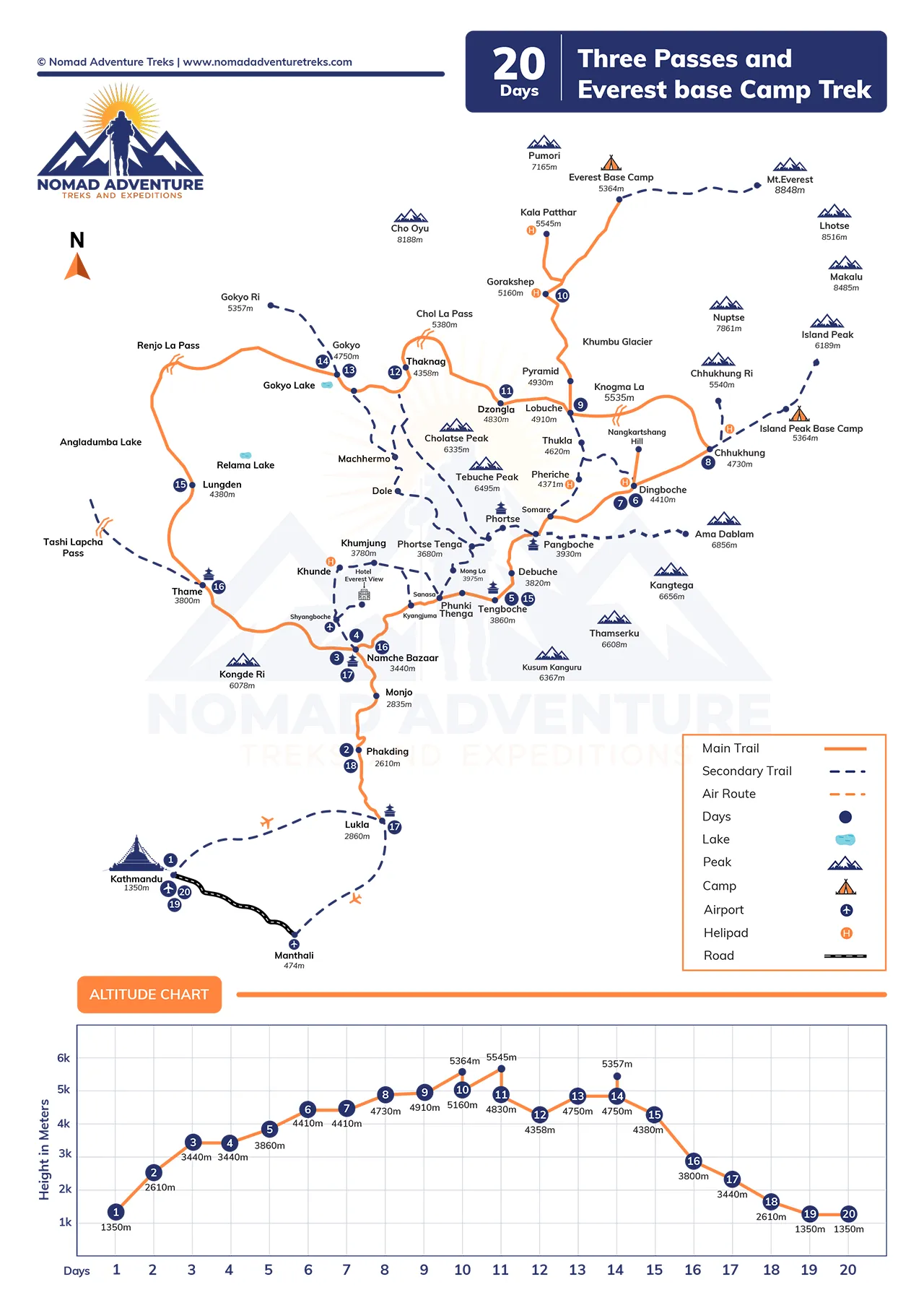
Trip Route Map
Includes & Excludes
What are included with package?
Accommodation
- Twin-sharing/double accommodation in a 3-star hotel for 2 nights in Kathmandu including breakfast (Private room accommodation can be organized at an extra cost)
- Twin-sharing guesthouse accommodation during the trek for 17 nights in the Everest Region with attached toilets in Lukla, Phakding & Namche
Meals & Drinking Water
- All your standard meals during the trek 3 meals a day (Breakfast, Lunch & Dinner) guest houses
- A farewell dinner on the last night in Nepal
- Purified drinking water during the trek using Water Filter or water purification tablets.
Transportation
- All (international and domestic) airport transfers on a tourist vehicle
- Round-trip airfare between Kathmandu/Manthali and Lukla
- Kathmandu – Manthali – Kathmandu transportation by shared tourist vehicle
.
Guide and Staff
- Experienced, first-aid trained, government licensed, English speaking, and locally recruited Nomad Adventure’s trekking guide (2 guides for group size more than 7 people)
- Porters during the trek for carrying luggage (1 porter for every 2 clients)
- Wages, accommodation, meals, gear, insurance and medications for all staff
Medical Assistance
- Assistance in arranging rescue operations in case of complicated health conditions (funded by travel insurance)
- Medical kits, including an oximeter to monitor blood oxygen saturation levels in high altitudes
Permits
- Sagarmatha (Everest) National Park Permit
- Pasang Lhamu Rural Municipality fee
- TIMS (Trekkers’ Information Management System) card
Benefits and Takeaways
- Sleeping bags and down jackets, duffle bag (one for every two trekkers) if you do not have your own
- company’s T-shirt & Cap
- Trip completion certificate
Administrative & Taxes
- All administrative expenses and government taxes
What are not included with package?
Price Excludes
- Lunch and dinner in Kathmandu
- International flight fare and airport departure tax
- Nepal Entry Visa (Visa can be acquired easily after your arrival at Tribhuvan International Airport in Kathmandu with a fee of USD 30 for 15 days visa, USD 50 for 30 days visa and USD 125 for 90 days visa)
- Guided tour in Kathmandu (Private car + tour Guide), Monument entrance fees while sightseeing in Kathmandu
- Extra night accommodations in Kathmandu due to early arrival or late departure, early return from the trek or other itinerary changes
- Travel insurance along with high-altitude emergency evacuation coverage
- Medical check-ups, vaccinations, or medications required for the trek are not included.
- Any beverages including bottled and boiled water
- Tips to trekking staff and driver
- Personal trekking gear and equipment
- Any expenses other than the Price Include section
- Personal expenses (shopping, snacks, boiled bottle water, hot (Tea/ Coffee) and cold drinks, hot shower, alcohol, Wi-Fi, telephone call, battery re-charge fee, extra porters, etc
- Personal clothing and gear

Note:
If you have a private group and prefer a personalized experience, we can organize a custom trip tailored to your requirements and group size, running it any day you choose.
Detail Information about Three Passes and Everest Base Camp Trek
Best Season for Three Passes and Everest Base Camp Trek
The autumn or the fall period commencing from the mid days of September month and lasting till October is the best season for the three passes and Everest Base Camp trek.
The days are still warm, humid, and green while the forests slowly start to shed their leaves clearing the sky for a better view of the Himalayan titans. The chances of rain become smaller and you start to see many alike trekkers on the trail to Everest.
The transitioning time between winter and summer is the spring of March through May which is the second best season for the Everest three passes trek.
During this time, the rhododendrons and magnolias bloom: forests full of red, pink, and white flowers. The paths also become spectacular, with sometimes still a lot of snow and many flowers, and usually good views of the snow-capped peaks.
From the beginning of June, the Everest region sees a lot of rainfall till the early days of September. You will generally have very few views of the mountains, and the path will turn into a muddy and slippery trail. Nature is at its most exuberant, but all in all, it is not a very attractive period to make a trek.
Between December through February, winter begins and the three passes of Everest become snowed I,n and temperatures drop to -30 degrees or lower. The three passes often become impassable at this time, so the Everest three passes trek 20 days journey, should be avoided this time.
Everest Three Passes Trek 20 Days: Level of Difficulty
Our Everest three passes trek 20 days journey, falls under the non-technical category 5 adventure in Nepal. This trek will throw some of the tougher challenges on the way, from the winding, icy, and glacial trail that is often hard to follow to the high elevation exceeding 5000 m.
Along with the massive three high mountain passes of Everest, this trek also includes traversing the rugged setting of the Gokyo valley, along with the ascension of Gokyo Ri and Kala Patthar.
Likewise, most of the sleeping stays will be above 5000 m, with Gorakshep being the highest sleeping settlement. Such conditions often trigger the onset of acute mountain sickness.
On the other hand, the total length of the Everest three passes trek route goes over 166 km with daily walking stages stretching to 6 or 7 hours. The pass crossing days will be particularly challenging and long, taking almost 9 hours a day.
So, being in top physical shape is essential for anyone joining the Everest Three Passes Trek itinerary.
Can a beginner trekker walk our Everest Three Passes trek route?
We usually suggest that only experienced trekkers participate in our three passes and Everest base camp trek. Since the trek involves climbing of not one, not two, but three enormous elevated passes along with the summits of Kala Patthar and Gokyo Ri, the trek is nothing but demanding.
The heights of these summits are comparable to some of the tallest mountains in the world. Plus, most of your hiking days will occur at heights above 4000 m, and you will be traversing high, steep slopes, crossing wide rivers and high valleys, trekking through forest and glacial paths.
Additionally, the track to Everest’s three passes has numerous confusing branches that can be tricky to find your way. So if this is your first adventure in Nepal, then the Everest Base Camp trek, Gokyo Lake trek, or Annapurna trek will be more fit for you.
However, if you are a newcomer in great health and still eager to take on this challenge, then you can skip the climbing part of Kala Patthar and Gokyo Ri, so the journey becomes a bit easier for you.
Just keep in mind that you can’t avoid the tough terrain, and it will certainly push you to your limits. So, please ensure you are in excellent shape and have a strong determination if you want to join, even as a beginner.
However, if you are already going through respiratory, musculoskeletal, or circulatory problems, then please avoid this journey.
Acute Mountain Sickness and Acclimatization
It is often common to experience a nagging dry cough, especially at night when trekking on Everest. The condition is called the Khumbu cough, which should not be mistaken with altitude or acute mountain sickness (AMS).
However, we have seen most of the hikers experiencing headaches, trouble sleeping, loss of appetite, fatigue, and dizziness as they approach Kala Patthar or Kongma La Pass.
These are the signs that you have to be aware of, which are the manifestations of AMS. Thus, to make our journey easier, we suggest that you to remain hydrated and consume as much fluid as you can.
You should also not climb more than 300-500 meters in elevation from one night to the next. It is ideal to do some daytime hikes that go higher and then come back down, which we will follow when we have days off at Namche, Dingboche, Chhukung, and Gokyo.
This measure will help you to get adapted to the high-altitude air quickly. Taking Diamox can also help, but make sure to let your guide know first so they can monitor your condition.
Preparation And Training For Everest Three Passes Trek Itinerary
The Everest Three High Passes Trek itinerary is one of the most challenging travel programs that requires exceptional mental and physical strength and stamina.
Therefore, only maintaining an active lifestyle won’t suffice for this expedition. We strongly advise all trekkers to engage in some kind of sporting activities like football or join some specialized training programs to boost up their endurance and fitness.
You can begin a routine of walking, running, and cycling two months before your journey. Alternatively, you can also undertake some long or medium hiking adventure in your vicinity. Aim for 3000 m or above trekking journeys so you will be better adapted to the higher grounds.
Please also think about adding weight training, stair climbing, treadmill workouts to increase your endurance. Also, do watch the YouTube videos about the Everest Three Passes, which will also help you get acquainted with the climate, trails, and the demanding conditions you may encounter.
Alternate Approach to Everest Three Passes
If you are looking for a different way to get to Three Passes and Everest Base Camp, then you can also take the clockwise route. With this route, you will first climb up the Renjo La Pass, which is considered the easiest, and then move on to cross the moderate and most frequented Cho La Pass.
Then, you will proceed towards Everest Base Camp and Kala Patthar, after which you will cross the hardest Kongma La Pass and return through Namche and Lukla.
This approach is reserved for more experienced trekkers since it offers fewer opportunities for acclimatization compared to the counterclockwise route we have planned for you.
Accommodation, Dining Options, and Transportation
During your three passes and Everest Base Camp trek, you will have time spent in Kathmandu and the mountain villages of the Khumbu region. In Kathmandu, you will stay in twin occupancy room of a standard three-star hotel where all rooms will have a hot shower and a toilet, along with free availability of WiFi.
As the trekking starts, you will sleep in the lodges, which are of a different order than the hotels in Kathmandu. They can be made of wood or stone, or bricks, with often primitive double rooms with toilets to be communal.
However, now that the Everest trail has seen much development in recent years, you will also get a western-style private toilet and single room on the route.
As for food options, when you are in Kathmandu, your breakfast will be covered, but you will have to budget for your lunches and dinners. On the trek, you will receive three meals each day (dinners, breakfasts, and lunches), which will be served at the lodges. You may expect a wide array of dishes such as traditional dal vat to eggs, pie, pizza, noodles, pasta, cake, etc.
And regarding transportation, you can rely on us as we will be offering a private bus, jeep, van, or car for all your TIA arrivals and departures. We also offer you a round flight trip between Lukla and Kathmandu. And if there is a change in route through Ramechhap, again,n private transport will be used for your road travel.
Mandatory Permits for the Everest Three Passes Trek
When going on the three passes and the Everest Base Camp Trek, we must have two permits in our hands. One is the USD 20 worth local municipality permit for Khumbu, and the second is the USD 30 worth park permit for the Everest National Park.
The Khumbu permit has omitted the necessity of acquiring the TIMS card now. The permit for the National park is available in Kathmandu tourist service center and also in Monjo, while the local area permit is available in Lukla or Monjo.
You can rely on us for the permits and the fees.
Travel Insurance
We require adequate and proper travel insurance for our three passes and the Everest Base Camp trek. It is essential that your policy includes sufficient coverage for any SOS costs, such as for evacuation by helicopter.
We also suggest you to take the cancellation insurance as well, which, in addition to providing coverage before the start of the trip, also assists you financially in the event of a delayed departure or if the trip has to be terminated prematurely.
Please send us the insurance company name, policy number, and emergency number. If a problem occurs during the trip, our tour guide or any one of our team members can act quickly.
Please check your policy coverage carefully to see whether and to what extent they have included the rescue cost. Sometimes, rescue costs and medical transport are incorporated in the medical costs and ensure that these medical costs cover you worldwide.
Frequently Asked Questions
Will I be able to use mobile services when on the Everest Three Passes trek?
Yes, NTC or Ncell network has signal in most of the places of Everest and you can also benefit from their 4G internet service.
Can I only undertake a hike to the three passes of Everest?
Yes, if you have already undertaken the Everest Base camp trek and don’t want to repeat it again, then you can trek straight to three passes of Everest.
Do we have to set up the camps in any part of your Everest three passes trek route?
No, there is no need for camping as it is a complete lodge trek.
Considering my health concerns, can I still take part in your three passes with Everest Base Camp trek?
We usually advise against participating in our Everest three passes trek 20 days journey if you suffer from asthma, heart issues, or any respiratory issues. You should talk to your physician if you like to be a participant in this adventure and also notify us ahead of time.
Can I make some changes to your Everest three passes trek itinerary according to my interest?
Absolutely! Our trek and tour company is devoted to meeting the needs of each of our client and we respect their every desire. If you think our Everest three passes trek itinerary does not go according to your plan, then communicate with us. We will gladly modify the program to fit your specific preferences.
Reviews on Three Passes and Everest Base Camp Trek
 Write a Review
- 1 personUS$ 1790
- 1 - 2 personUS$ 1750
- 1 - 3 personUS$ 1690
- 4 - 6 personUS$ 1650
- 7 - 12 personUS$ 1600
- 13 - 18 personUS$ 1590
- 19 over 9999 US$ 1490
Total Cost:
US$ 1790
- Your safety, our no 1 priority
- Best price guarantee
- Experienced & dedicated team
- Easy booking, no hidden charge
- You can customize this trip
Talk to Travel Expert Samundra Rimal (+977-9843127084)